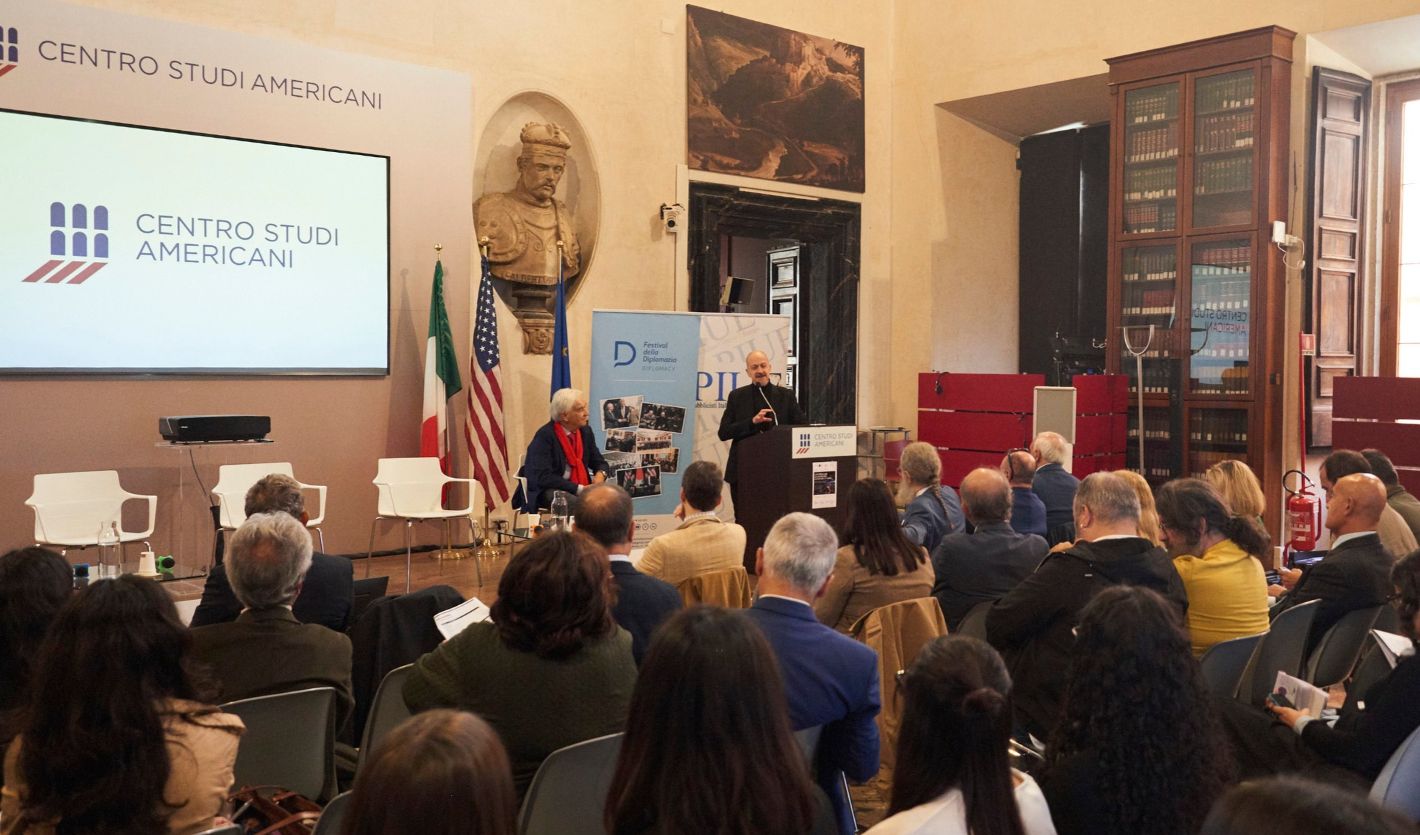
On the occasion of Halloween, the John Cabot University Philosophy Club hosted a thought-provoking guest lecture by Philosophy Professor Stefan Lorenz Sorgner titled “Do You Want to Be a Vampire?” The event blended cultural history, mythology, and cutting-edge technoscience, and examined the intersection between ancient rejuvenation fantasies and modern transhumanist quests for radical longevity.
Tracing the Roots of Eternal Youth
Opening with a macro-historical view of human evolution – from the development of language 300,000 years ago to the digital and AI revolutions of the modern era – Professor Sorgner raised a fundamental question: Should we actively intervene in evolution and human design?
The lecture traced how humanity’s obsession with escaping aging and death has evolved across millennia, bridging ancient magic and modern science through science fiction author Arthur C. Clarke’s famous third law: “Any sufficiently advanced technology is indistinguishable from magic.” The talk explored key historical milestones, including classical mythology, the Renaissance, and the emergence of the Vampire myth.
In Book 7 of Ovid’s Metamorphoses, Medea performs a gruesome ritual of physical renewal for Jason’s aging father Aeson by draining his blood and replacing it with a magical potion of herbs and roots. Similarly, early Christian traditions viewed the Eucharist as a “medicine of immortality” preparing the faithful for eternal resurrection.
15th-century philosopher Marsilio Ficino bridged pagan magic and Christian theology in his treatise Three Books on Life (1489), theorizing that elderly individuals could absorb the vital life force of the young by consuming fresh blood.
Over time, such beliefs and practices evolved into dark folklore, epitomized by the gruesome practices attributed to Hungarian Countess Elizabeth Báthory (1560-1614), one of history’s most infamous figures associated with the origins of the vampire myth.
From Parables to Silicon Valley: Parabiosis and Modern Longevity
Moving into contemporary science, Professor Sorgner highlighted how ancient myths resonate with modern biohacking and longevity research. Scientific studies on parabiosis, in which the bloodstreams of young and old mice, have demonstrated remarkable physical renewal in older subjects, prompting tech figures to express interest in the field.
The lecture also explored how modern entrepreneurs like Bryan Johnson have taken radical longevity to an extreme through high-tech projects, experiments involving intergenerational plasma exchanges, and strictly controlled clinical environments. The discussion also touched upon global political shifts in longevity research, from high-profile figures in US health administration to recent high-level political dialogues in major nations regarding life extension.
The Ultimate Philosophical Question
Concluding the lecture, Professor Sorgner brought the audience back to the core ethical dilemmas shaping the future of humanity: Should we enhance evolution? Should we cure aging, and is aging a disease? And should politics actively support scientific endeavors to radically increase our lifespans?
The session sparked a debate among JCU students and faculty, offering a unique philosophical framework for re-examining the boundaries between science, myth, and human identity.