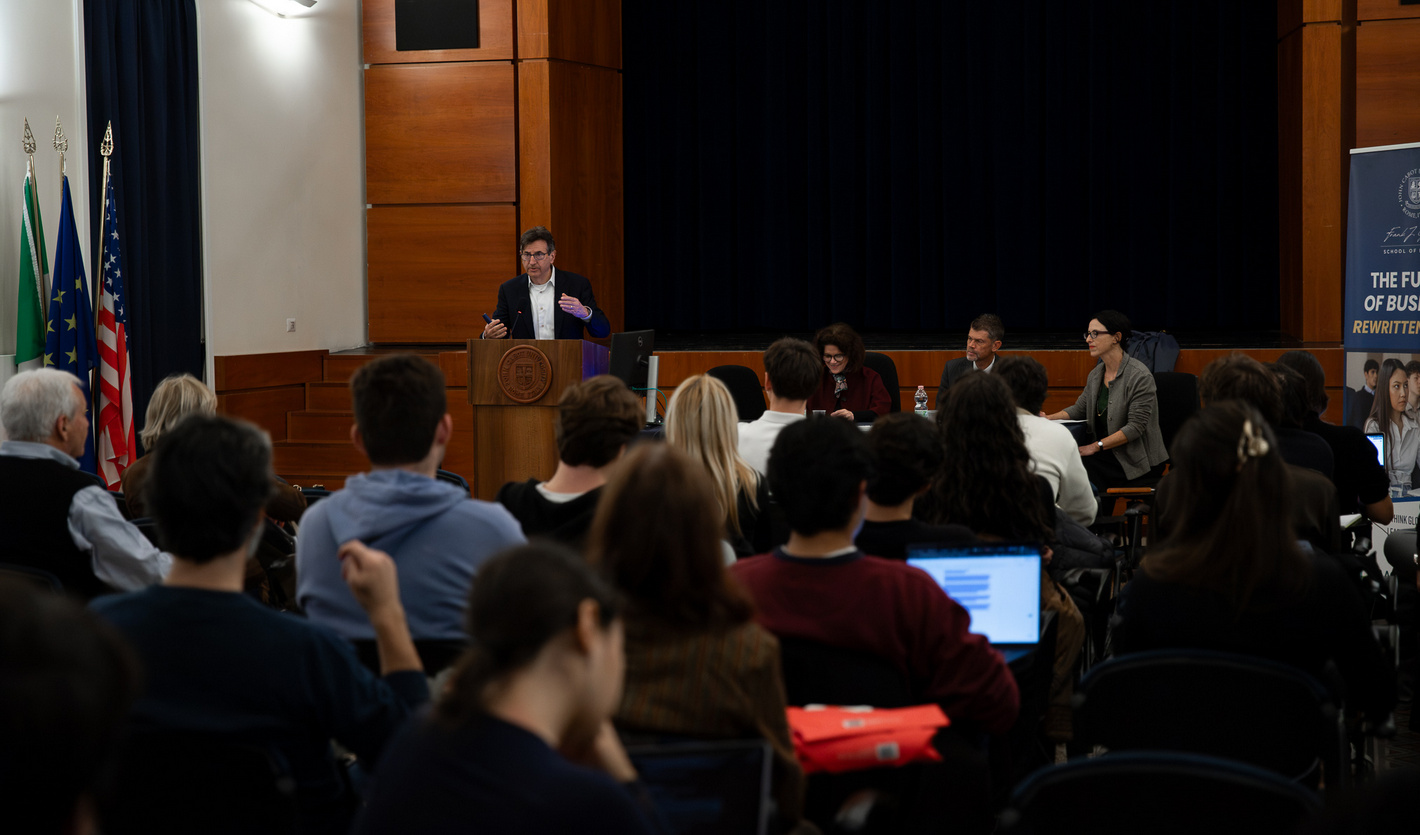
On November 17, 2026, the Frank J. Guarini School of Business, the Guarini Institute for International Affairs, and the Institute of Future and Innovation Studies at John Cabot University (JCU) co-hosted “After the Midterms: The Future of the United States,” a panel discussion bringing together political and international affairs experts to examine the implications of the 2026 US midterm elections and consider the challenges and opportunities shaping the country's political future.
The event featured JCU President Antonia Maioni, Jonathan Aberman, Strategic Advisor to the FJG School of Business, JCU Professor Pamela Harris, and Roberto Menotti, Senior Advisor for International Activities at Aspen Institute Italia. The discussion was moderated by Aberman, who led the conversation on the electoral results, their political significance, and their potential implications for the United States and its international relationships.
The panel opened by examining the electoral results, highlighting shifts in the composition of Congress, the Senate, and state governments. The speakers discussed voter turnout, evolving demographic trends, and the unexpected electoral outcomes across several states. Particular attention was given to the role of younger voters, Hispanic communities, and the economic concerns that influenced voting behavior.
Professor Harris offered an analysis of the constitutional and institutional implications of the election, discussing the effects of gerrymandering, the role of the courts, and the importance of electoral representation. She also highlighted how changes at the state level could influence national politics, particularly in areas such as healthcare and minimum wage legislation.
President Maioni reflected on the broader political significance of the results, emphasizing the magnitude of the electoral shift and the challenges facing both major political parties. She also explored the relationship between federal and state governments and the importance of institutional checks and balances in American democracy.
Menotti brought an international perspective to the discussion, focusing on the implications of US domestic politics for transatlantic relations. His remarks addressed the evolving relationship between the US, Europe, and Canada, particularly in relation to international trade, tariffs, diplomacy, and global security. He also examined the growing importance of China, artificial intelligence, and technological developments in shaping the international political landscape.
Looking beyond the immediate electoral cycle, the panel considered the challenges and opportunities that could define American politics over the next two decades. Topics included the future of the Democratic and Republican parties, the 2028 presidential election, immigration, political polarization, public trust in institutions, and the changing international order. The speakers also discussed potential reforms to the US electoral system and the influence of individual states on national policymaking.
The event concluded with a Q&A session, during which students and audience members engaged with the panelists on issues including US foreign policy, transatlantic security, political leadership, and the country’s future direction.
By bringing together perspectives from political science, constitutional law, business, and international relations, the event provided the JCU community with an opportunity to engage in a thoughtful and wide-ranging discussion of one of the most significant topics in contemporary American politics. It also reinforced John Cabot University’s commitment to fostering critical debate and promoting international perspectives on current global affairs.