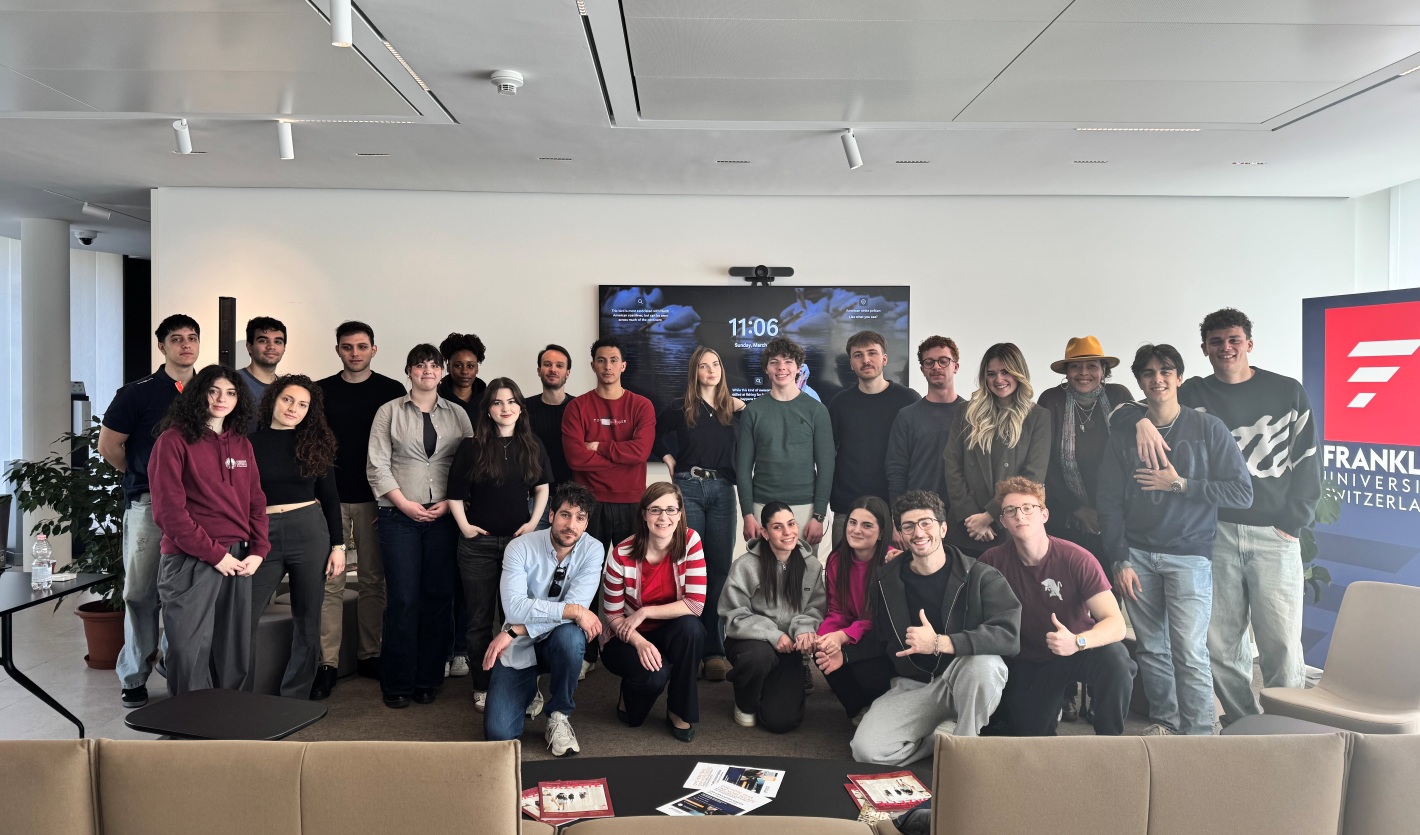
Three JCU Club Leaders were recently selected to participate in a leadership conference called “Intercultural Connection: Becoming Globally Fluent” in Lugano, Switzerland. The first conference of its kind, it was hosted by the European University College Association (EucA) and Franklin Switzerland, a private university accredited in both the US and Switzerland. EucA is a European-based organization dedicated to helping students grow, develop, and become stronger leaders in a diverse international setting, offering programs ranging from master classes to career coaching.
From April 26 to April 29, 2026, students Claire Anderson (USA), Clara Beatriz De Medeiros Saullu (Brazil), and Giorgi Botchorishvili (Georgia) participated in an intensive learning experience alongside 20 other students from various universities in Italy and abroad. The students, whose work was facilitated by EucA Secretary General Mirela Mazalu, Dr Ebonie Rayford, and psychologist Theodosios Tasios, earned a certification of 20 training hours.
The trip to the conference was organized and sponsored by the Student Engagement Office, as part of JCU’s Student Leadership Program. Assistant Director Federica Bocco accompanied the group to Lugano.
“For JCU students and club leaders, intercultural communication is always at play,” noted Claire Anderson, events coordinator of the Film Appreciation Club and the Philosophy Club. “From the classroom to weekly club meetings, we engage with different perspectives daily. As a diverse group representing various countries across the world, we were ready to share our experiences with students who grew up all over Italy, with different backgrounds from ours.”
The five stages of intercultural development
The conference took place over the span of four days. The first day focused on introductions and assessment of students' intercultural communication and conflict resolution styles. All participants had the chance to take two assessment tests: the Intercultural Development Inventory (IDI) and the Intercultural Conflict Style (ICS) inventory.
The second day was spent analyzing the participants’ test results. Participants were introduced to five stages of intercultural development, beginning with denial, where one has a predominantly monocultural mindset and is unwilling to acknowledge differences between cultures. The next stage is polarization, where a person harbors judgmental feelings towards another culture (or their own culture). The third stage is minimization, in which people may feel the need to focus on similarities rather than differences, thereby ignoring important aspects of others' culture and lived experiences. As one moves into the fourth stage, they have entered acceptance, meaning that they have embraced and understood differences between cultures. The final stage is adaptation, which represents a fully developed intercultural mindset, where you can build bridges across cultures and bring people together despite their differences.
“One of the most important lessons I have learned is that where we come from, how we are raised, and our early experiences shape who we are, how we communicate, and how we relate to others,” commented Giorgi Botchorishvili, vice president and co-founder of the Philosophy Club, resident assistant, and incoming Humanities department representative. “When misunderstandings arise, it is not appropriate to blame someone else’s lived experiences, especially when you do not understand their background. A more constructive response is to seek to understand their perspective. This trip has helped me better appreciate, value, and nurture my current personal and professional relationships.”
Conflict resolution styles
During the third day, students learned about how unfamiliar cultures may create different approaches to conflict, and these styles may appear within societies and families as well. “Listening to stories and participating in engaging role-play activities that illustrate different conflict styles – which are usually unspoken – was extremely educational,” said Claire Anderson. “Practicing empathy and being able to shift between conflict styles is a valuable tool in school, the workplace, but also your personal life.”
On the fourth day, students shared new perspectives shaped by increased awareness and understanding.
“Discovering my conflict resolution style and understanding my level of cultural awareness made me learn that the way we naturally approach conflict is not universal,” said Clara Beatriz De Medeiros Saullu. “Since different cultures prioritize different values in moments of tension, it is important to remain flexible and willing to shift approach. Rigid approaches to conflict, no matter how well-intentioned, can damage relationships and create distance. The ability to read a situation, honor someone else’s cultural framework, and adapt accordingly is what truly makes someone globally fluent.”
Clara is the current Social Media Assistant for the Psychology Club, which won the Club of the Year Award during the Spring 2026 Student Life Celebration & Awards. She echoed the importance of intercultural conflict resolution and how the conference gave her tools and enabled her to become an initiative-taking, adaptable, and flexible leader.
“Attending this conference was one of the most valuable experiences of my life,” she concluded.