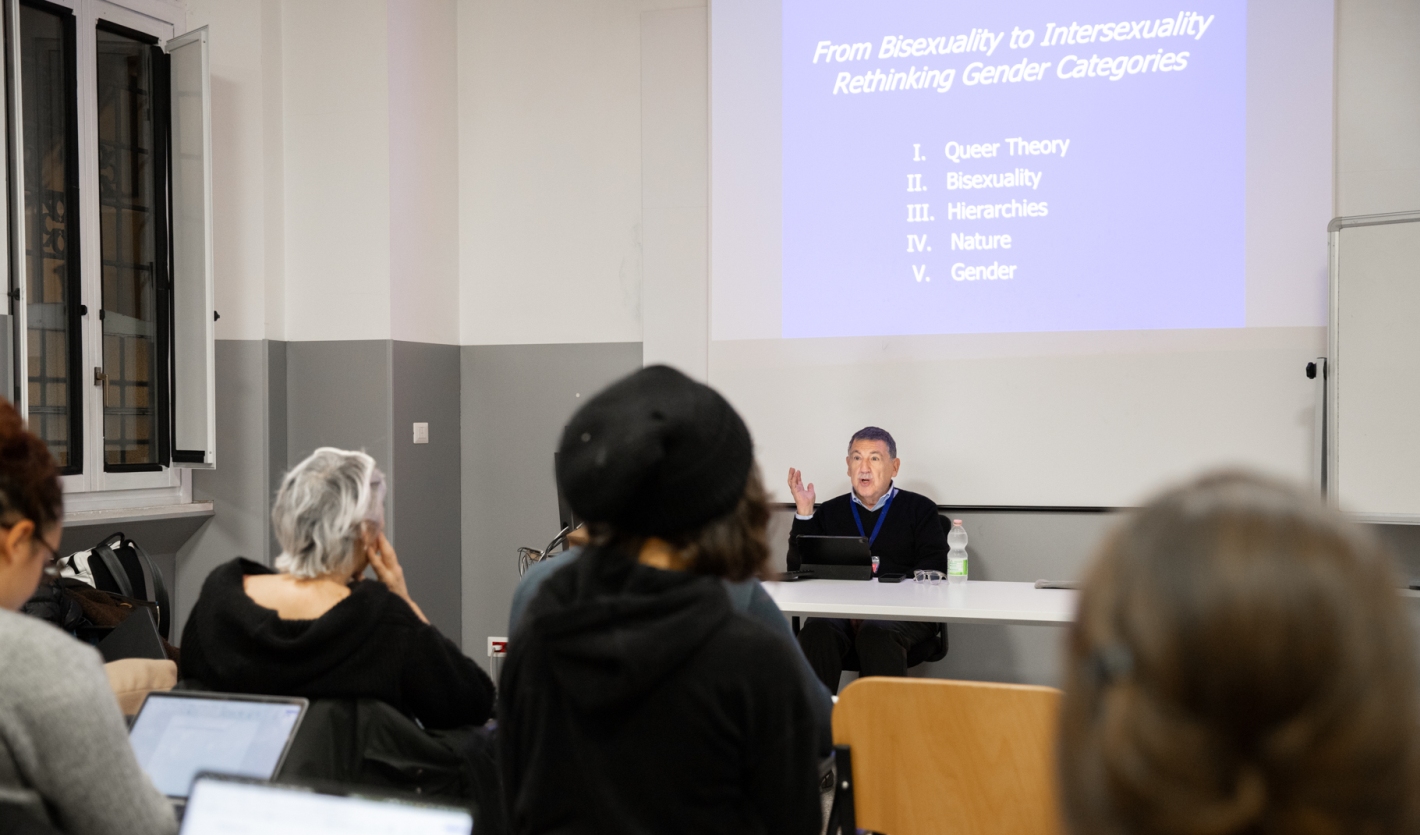
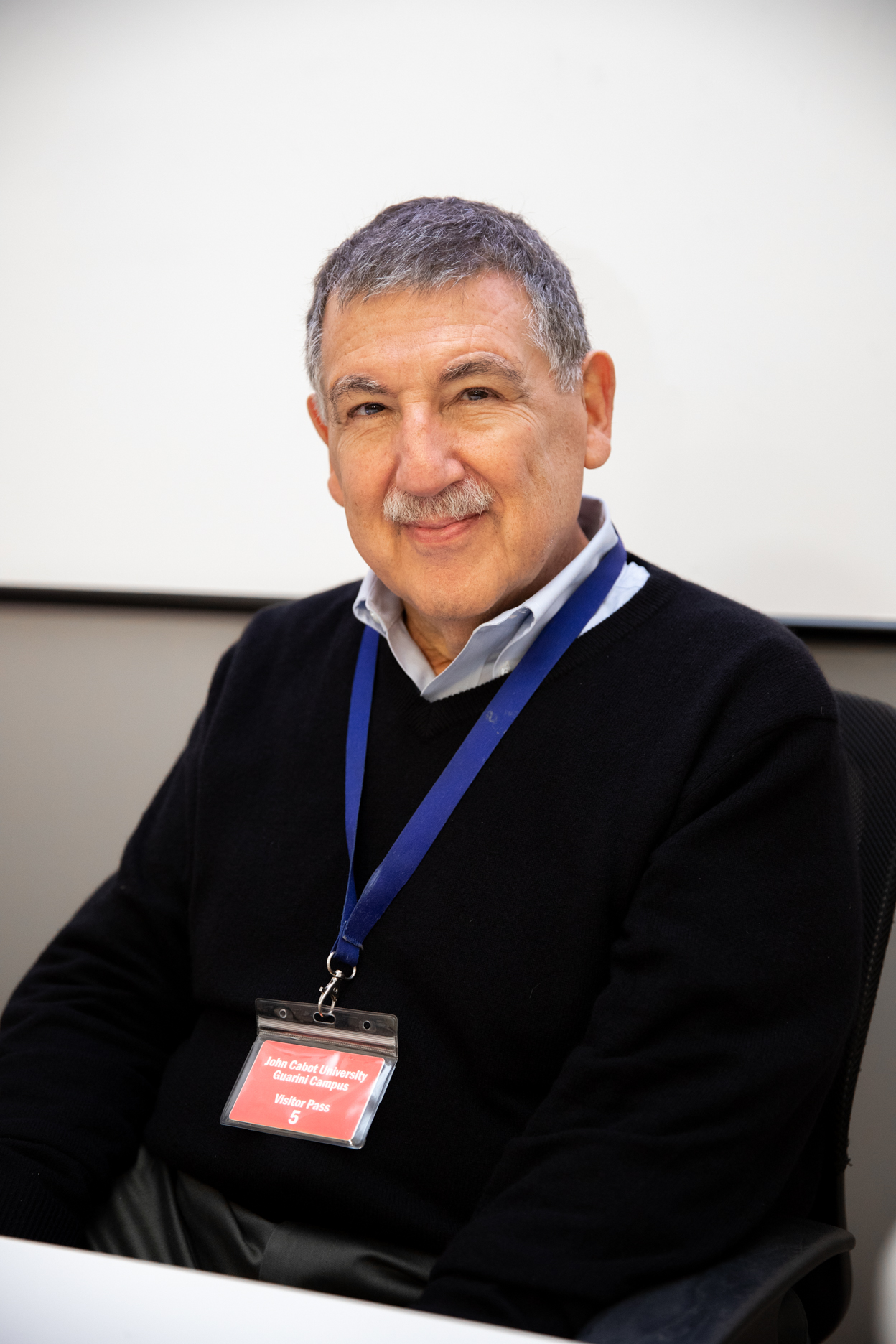
On Monday, December 1, 2025, John Cabot University welcomed Professor Jack Drescher (Columbia University) for a lecture titled "From Bisexuality to Intersexuality: Rethinking Gender Categories." The talk was organized and sponsored by the Department of Psychological and Social Sciences, in collaboration with the Minor in Gender Studies, the Psychology Society, the Queer Alliance club, and the Student Engagement Office.
In his talk, Drescher explored how the study of human sexual and gender identities is rapidly changing, forcing physicians to rethink their approach and look beyond the theoretical constraints of the past.
Drescher addressed the increasing diversity of identities, such as gay, lesbian, bisexual, transsexual, transgender, and intersex, and introduced Queer Theory, which challenges the assumptions underlying conventional, binary categories like "masculinity-femininity" or "homosexuality-heterosexuality." He argues that historical concepts like bisexuality — whether biological or psychological — presume the existence of only two sexes, male and female, thereby reinforcing what queer theorists call the gender binary.
Jack Drescher
Using the medical treatment of intersex individuals as a case study, Drescher illustrated how gender is often socially and surgically constructed to fit cultural expectations of "male" and "female." The talk highlighted that the cultural drive to maintain gender binaries explains why intersex infants were routinely subjected to surgery — which is usually not medically necessary — for the purpose of assigning them to either male or female genders, often accompanied by secrecy and misleading information.
The lecture also touched upon how society creates "sexual and gender hierarchies," labeling certain behaviors as either "natural" or "good" (e.g., heterosexual, monogamous, reproductive) while relegating others to the "outer limits" (e.g., homosexual, promiscuous, non-procreative).
Drescher concluded that while it is inherent to human nature to create categories, we must recognize them as cultural artifacts. He emphasizes the need for physicians to move away from questions of etiology and instead focus on what it means for that person to hold that identity.