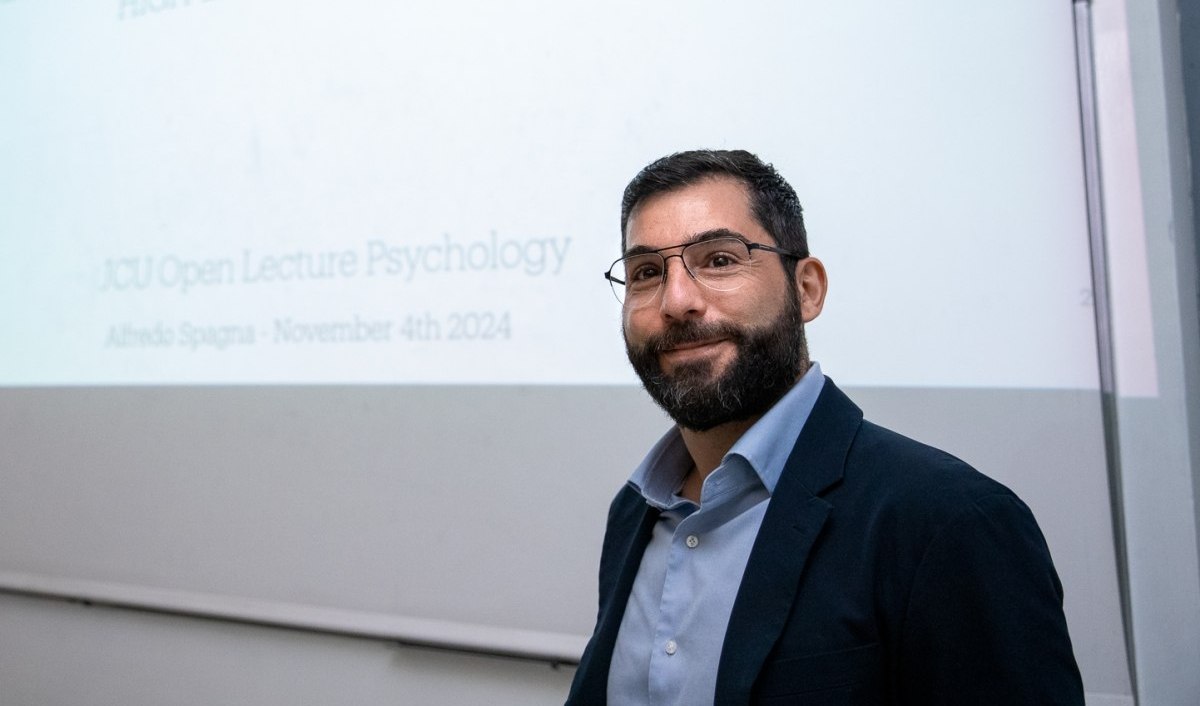
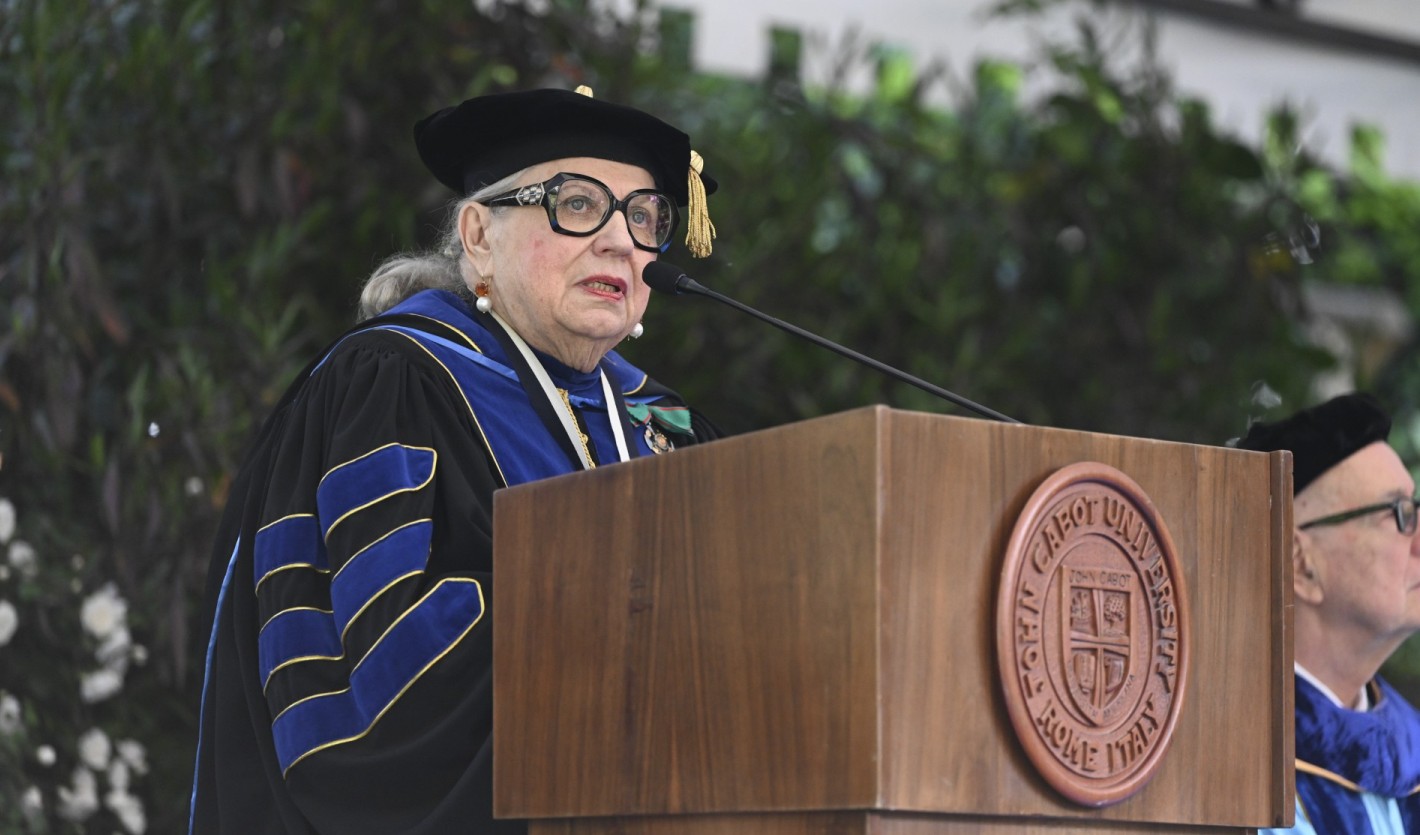
Professor Alfredo Spagna has recently joined the Psychological and Social Sciences department at John Cabot University. Born in Reggio Calabria, in Southern Italy, Professor Spagna studied at Sapienza University of Rome for his undergraduate, graduate, and doctoral degrees, specializing in experimental psychology and cognitive neuroscience. Professor Spagna previously held a lecture at JCU on his research in Visual Mental Imagery, in November 2024.
How did you first become interested in psychology and the workings of the brain?
Initially, I wanted to study astrophysics. I was really interested in looking outward at networks of stars. When I was in my last year of high school, I happened upon the right teacher, in this case, of philosophy and psychology. When we started studying Freud... that was it. So, rather than going outward, we learned to go inward to another important part of human life. When I told my parents I wanted to keep studying psychology, they were like, “What?!” And I told them, “I promise it’s similar!” I was still able to use physics, math, and statistics, in a way.
You were Director of Undergraduate Studies in Neuroscience and Behavior at Columbia University. What prompted you to leave Columbia to teach at JCU?
I directed and later co-directed the Neuroscience major for eight years. Columbia is a great place, but I felt like I had already accomplished my mission there. It was time for me to use my knowledge and skills to help develop something else. I believe that if we only focus on institutions that are already well-established, we do a disservice. We want more people to continue studying, growing, and learning.
Tell us about your research on visual mental imagery.
I’m a cognitive neuroscientist by training, so I did most of my studies in what we used to call experimental psychology. It then transformed into cognitive neuroscience, which studies the relationship between brain and behavior. In the last 20 years we’ve made a lot of progress. Now we understand which regions and mechanisms in the brain are activated when we pay attention to something that is in front of us.
In 2018, I asked myself, “So what happens when we pay attention to something that is not in front of us? And which brain regions and mechanisms allow us to do that?” We talk about imagination a lot, especially with kids; we train them to imagine and to nurture their creativity. But we still don’t have a very good scientific definition of imagination, or why humans developed this ability.
Right now, we are in a very exciting phase of the study of human imagination. Back in 2015, we realized that about 5% of the global population has a condition called aphantasia, which means that if asked to close their eyes and picture something in their mind, they can’t. It’s not a clinical condition; it’s just a neurodiversity on the scale, like people who are good at playing tennis versus people who are bad at playing tennis. Some people have hyperphantasia, meaning a very complex vision, and some people simply have aphantasia. It opens many questions about studies of consciousness.
My research is about investigating the differences in brain patterns and brain activation. We study three different populations of individuals – what we call typical imagers, people with aphantasia, and people with hyperphantasia – and then we compare the mechanisms we observe.
What is your teaching philosophy, and what is it that you wish your students to take away from your classes?
I love teaching. Usually, people tend to think that if you dedicate too much time to teaching, you take time away from research. I never saw it that way. I am training potential members of my laboratory and other people’s laboratories. I see this part of my work as one of the most important parts of research.
Depending on the level of the course, I try to use a slightly different teaching style. During the early years, especially when I teach statistics, my focus is on not scaring the students. I make them understand that they can learn statistics using logic. I put on my psychologist hat and calm them down by saying, “Hey, you can do this – I did it!”
I also try not to cram in too much work, running away from what I call the “tyranny of the content” – the fact that you must finish the program no matter what. That’s not what we want as psychologists. We need students to know the research methods and how to use statistics.
In courses that are more advanced, I turn my classes into a discussion-heavy and collaborative environment. Out of the 75-minute class period, I tend to talk for about 30-40 minutes. The rest of the class is dedicated to students asking questions and me answering them. I find it extremely important that students have the opportunity to listen to questions asked by their peers. It makes the environment very enriching.
What is your impression of JCU so far?
I love it! Great vibe, very international environment, which is fantastic to have in a city like Rome. And I must say that everything works here at JCU, which enables us teachers to really perform at our best and not worry about the small details, like whether the projector is working or not.