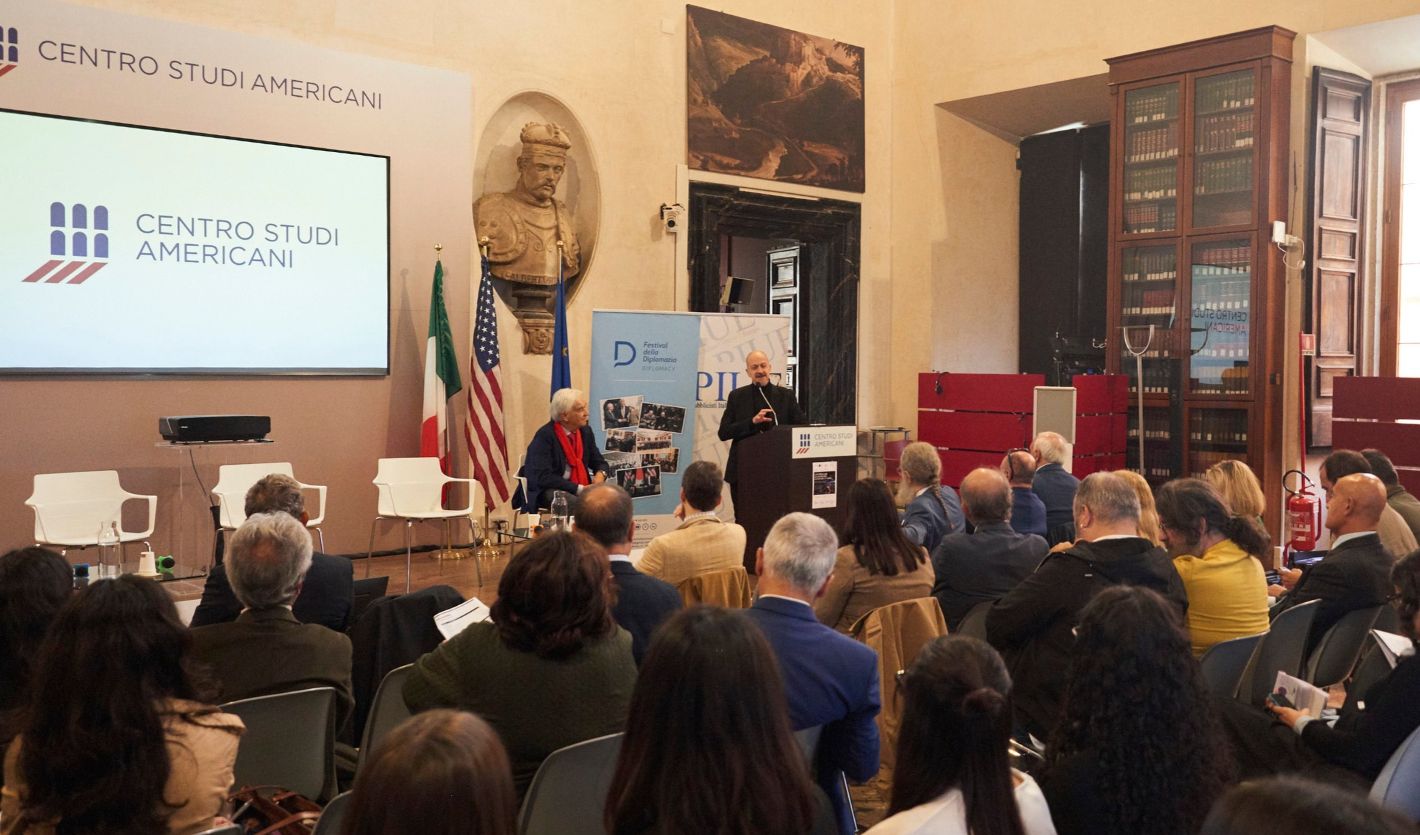
On October 15, 2026, John Cabot University’s Institute of Future and Innovation Studies (IFIS) organized “Control Space to Govern Earth: Space, Power and Information in the New Global Order,” a forum designed to examine a transformation that is rapidly moving space from the margins of public policy to the center of economic, political and strategic life. The event brought together leaders from the space industry, defense, European institutions, academia, cybersecurity, and journalism to examine how orbital systems are becoming part of the infrastructure through which contemporary societies function.
The initiative was co-organized with Associazione PIUE, led by Brigadier General (Res.) Carlo Felice Corsetti, hosted by the Center for American Studies, included in the program of the Festival della Diplomazia, and organized with the active involvement of the Ordine dei Giornalisti del Lazio. Institutional contributions included Roberto Sgalla, Director of the Center for American Studies; Giorgio Bartolomucci, Founder and Secretary General of the Festival della Diplomazia. The forum concluded with remarks by Carlo Corazza, Head of the European Parliament Liaison Office in Italy.
From Individual Technologies to a Complex Space-Earth System
Francesco Lapenta, director of IFIS, moderated the event. The scientific and conceptual framework of the event was developed by IFIS and structured around a central proposition: space can no longer be understood simply as a destination for exploration or as a specialized technological sector. Satellites, Earth-observation systems, navigation, telecommunications, artificial intelligence, autonomous systems, and terrestrial critical infrastructures are becoming increasingly interconnected, creating a network of dependencies on which economies, institutions, and states increasingly rely.
For example, a satellite may simultaneously support telecommunications, navigation, financial synchronization, environmental observation, logistics, intelligence, and security; a drone can operate as an aircraft, a sensor, a communications node, and an autonomous data platform. Artificial intelligence can increasingly connect these layers by interpreting information and translating it into operational decisions.
As Lapenta said: “Control over space increasingly means control over life on Earth. Space is becoming the networked infrastructure through which societies function.”
This framework shaped the four sessions of the forum, organized around a deliberate progression: infrastructure, vulnerability, power, and perception.
Space as Infrastructure, Dependence as Vulnerability
The first discussion examined the extent to which space-based systems have already become operational infrastructure for contemporary society. Ezio Bussoletti, president of e-GEOS and former vice president of the Italian Space Agency, and Lucia Luzietti, chief operating officer of e-GEOS, addressed the increasingly central role of Earth observation and satellite-derived information in civil protection, environmental monitoring and the management of critical infrastructure.
Gerardo Lancia of Lazio Innova considered the industrial ecosystems developing around the space economy, while Giulio Avanzini of Sapienza University of Rome contributed the technological and aerospace perspective. Sirio Zolea of Roma Tre University introduced the legal dimension, examining the questions that emerge as commercial operators assume a growing role in an environment historically shaped by states and public institutions.
The discussion underscored a fundamental shift in how the importance of space should be measured. Its significance can no longer be captured only by the size of the space economy itself. It must increasingly be understood through the number of terrestrial activities that cannot function normally without orbital infrastructure.
The second session focused on security, resilience, and strategic autonomy. Sandra Mezzadri, founder and managing director of MSB Consulting and scientific adviser and senior defense industry expert at ARES Group; Colonel Fabio Biondi of the Italian Air Force, cybersecurity expert Corrado Giustozzi, and Mariangela Dejana, director of the Government & Defense Business Unit at D-Orbit Group examined the growing overlap between civilian, commercial and military infrastructures.
Their discussion highlighted how disruption in space does not remain in space. Cyberattacks, interference with satellite communications, failures in positioning, or loss of critical services can propagate rapidly through terrestrial networks, affecting logistics, transport, communications, finance, emergency services, and defense.
The distinction between civilian and military systems is also becoming progressively harder to sustain. Commercial infrastructures can acquire strategic importance during crises or conflicts, while private operators increasingly provide capabilities that were once almost exclusively associated with governments.
Astropolitics, sovereignty and the geography of power
The third session moved from vulnerability to power. Marcello Spagnulo of Limes, Alfonso Giordano of LUISS, Gianluca Casagrande of European University of Rome, and Valentina Chabert of the Istituto Affari Internazionali and the NATO Centre of Excellence Defense Against Terrorism explored how the expansion of human activity into space is altering the geography through which geopolitical power is exercised.
Launch capabilities, orbital positions, spectrum, satellite constellations, ground infrastructure, communications networks, and access to data are becoming strategic resources. Yet these capabilities are distributed unevenly, raising questions of access, sovereignty, and dependence.
The discussion also examined whether space should be understood simply as another arena into which terrestrial geopolitical competition is being extended, or whether the increasing importance of orbital infrastructure is beginning to transform geopolitics itself.
Space is progressively transformed from an external physical environment into a domain organized through human categories, such as infrastructure, mapping, law, access, ownership, strategic interest, and political meaning. The question is therefore no longer simply who occupies space, but how power is being organized through it.
This leads to a broader understanding of sovereignty. A state may retain legal authority over its territory while depending on infrastructures beyond its direct control to observe that territory, communicate across it, locate assets, synchronize systems, and coordinate action. Strategic autonomy increasingly becomes a question not only of territorial sovereignty, but of sovereignty over critical dependencies.
Shaping what the Earth knows
The final session addressed the informational dimension of orbital power. Frediano Finucci, head of Economics and Foreign Affairs at TG La7, Vittorio Calaprice of the European AI Office, and political analyst Matteo Pedditzi examined how satellite imagery, geospatial data, and artificial intelligence are transforming the ways governments, institutions, journalists, and citizens understand events on Earth.
Greater access to data does not automatically produce greater knowledge; a satellite produces measurements and images, not meaning. Between an event and public understanding lies an increasingly complex chain of communication. Artificial intelligence is becoming a central component of that chain, identifying patterns, classifying objects, detecting anomalies, and increasingly shaping the transformation of raw observation into actionable information. For journalism, this creates a profound new challenge. Space infrastructure is becoming both an object that journalists must understand and a tool through which they understand the world.
One of the central propositions emerging from the forum was therefore simple: we cannot govern what we cannot see. But the ability to see is itself increasingly mediated by infrastructures, technologies, and actors that determine what becomes visible, how it is interpreted, and how it enters public knowledge.
The forum brought these dimensions together in a single conversation because they can no longer be treated separately. For IFIS at John Cabot University, this convergence is precisely why space demands a genuinely interdisciplinary approach. Engineering, economics, cybersecurity, law, defense, geopolitics, artificial intelligence, journalism, and the humanities are no longer examining independent dimensions of space activity. They are increasingly examining different layers of the same emerging system.