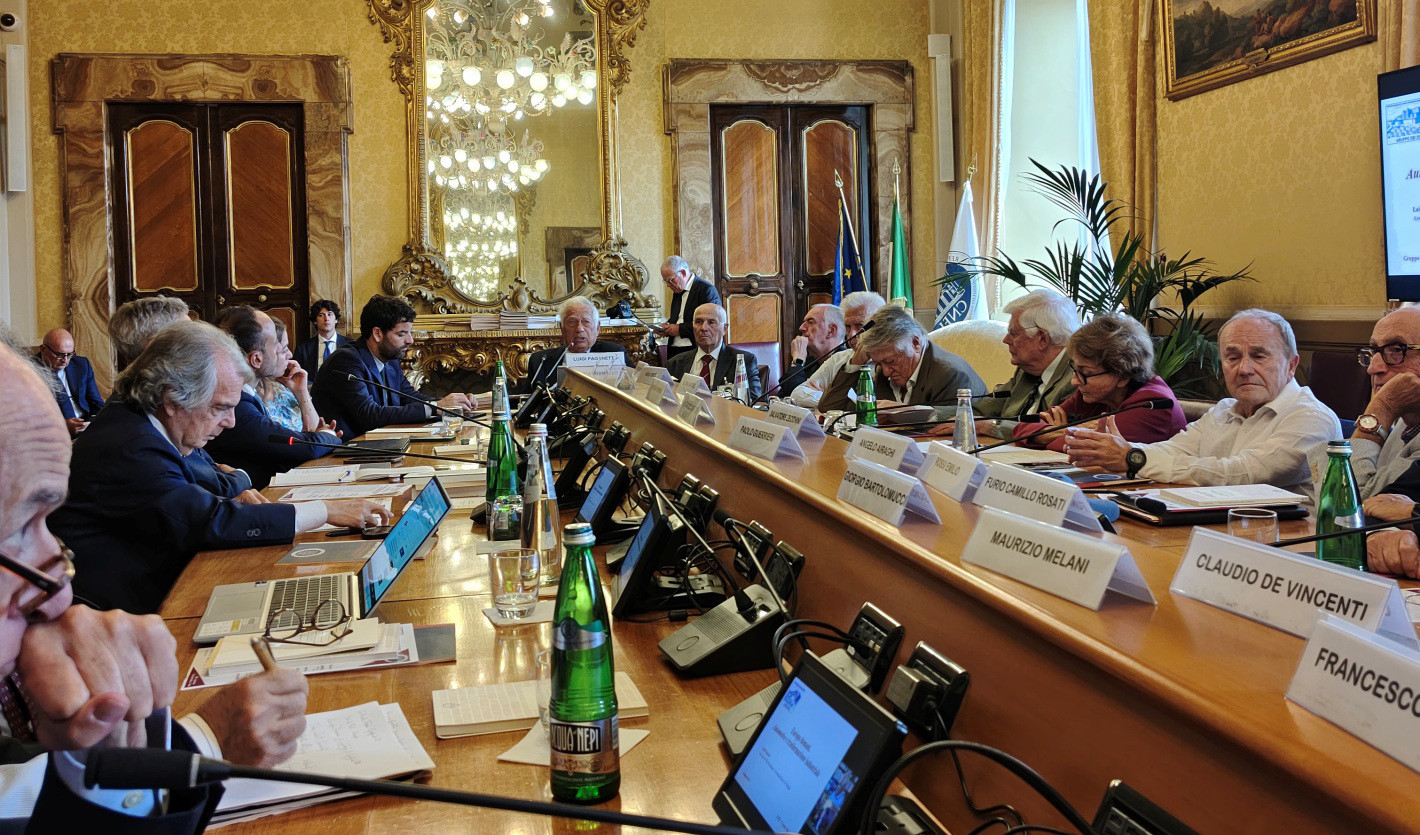
On October 5, 2026, Francesco Lapenta, director of the Institute of Future and Innovation Studies, was invited to participate in a discussion at the Consiglio Nazionale dell’Economia e del Lavoro (CNEL) in Rome, to talk about the future of the automotive industry and the wider transformation of Europe’s industrial system.
The meeting, Europa Domani. Vincere la sfida dell’automotive e della trasformazione industriale was held at Villa Lubin, the historic headquarters of CNEL.
The discussion was organized by Gruppo dei 20, a project founded by Professor Luigi Paganetto, which brings together leading academics and experts to develop policy proposals, research, publications, seminars, and events aimed at supporting European growth and informing decision-making.
The meeting started with opening remarks by CNEL President Renato Brunetta, Luigi Paganetto, Sergio Fabbrini of LUISS University, and Paolo Guerrieri of the Paris School of International Affairs at Sciences Po, followed by a discussion among participants from the academic, institutional and economic policy communities.
Lapenta’s contribution focused on how the automotive transition involves not only the shift from internal combustion engine vehicles to electric cars, but also the fact that a growing share of value is moving towards batteries, semiconductors, software, data, artificial intelligence, and digitally controlled systems.
For Europe, this means that the central question is no longer simply whether it will continue to manufacture cars, but which parts of the emerging mobility system it will be able to design, develop and control. Production volumes remain important, but so do the location of engineering knowledge, intellectual property, supplier capabilities and industrial learning in the age of intelligent and connected machines.
The automotive sector offers a clear example of a wider transformation affecting advanced economies: competitiveness increasingly depends not only on the capacity to produce, but on the ability to retain control and connect the technologies and knowledge around which future industrial systems are reorganizing.
This perspective connects directly with the work of the JCU Institute of Future and Innovation Studies, which examines technological change through the combined lenses of governance, industrial transformation, geopolitical competition, and institutional capacity.
One of the outcomes of the meeting was an important institutional development for JCU. The Gruppo dei 20 has accepted an invitation to hold a joint event at JCU, extending the dialogue and opening a new space for collaboration between the University, the Institute of Future and Innovation Studies, CNEL, and senior economists, policy experts, and institutional actors.
The initiative will bring the discussion directly into the JCU community and strengthen the University’s participation in the wider debate on European competitiveness, technological transformation, and industrial policy.