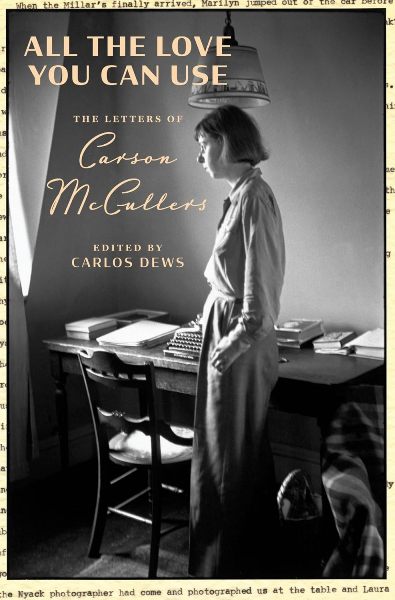
English Professor Carlos Dews has recently published All the Love You Can Use: The Letters of Carson McCullers (Manirer Books, 2026), which was presented at JCU on November 3, 2026. Professor Dews has edited more than a thousand letters written by Carson McCullers (1917-1967); this lifelong research into her correspondence is now the most comprehensive published work focused on the writer’s creative life, relationships, and literary world.
Professor Dews sat down with JCU's Office of Web Communications to talk about his book and his long-standing relationship with McCullers' literary work.
When did you first come across Carson McCullers, and why did you decide to focus your scholarly work on her? I was an undergraduate student at the University of Texas, around 1983. I had met a friend who was getting his PhD in Psychology at the time, and one day, he asked me if I knew Carson McCullers. He thought I would respond well to her work. I was a music major and a musician at the time, but I had to give up music because of a medical problem and decide what to study instead. After reading all of her novels, I became interested in Carson McCullers’ psychology and her creative process. So I decided to dedicate my life’s work to her writing.
Cover for Professor Dews' book
What about McCullers resonated with you so much? McCullers was a musician and had to give that up because of medical problems, so we had that in common. She was from a relatively small town in Georgia and was struggling with issues like sexuality, gender, and being out of step politically with everyone around her, since she was very progressive. I, too, felt very much out of step with my family and my hometown.
The first book of hers I read was The Heart is a Lonely Hunter (1940), which has a character who dreams about becoming a classical composer, so I responded well to that. She also wrote a lot about unrequited love, which touched me, too. Her writing about Southern identity, music, and politics resonated with me on many levels.
When did you get the idea to do this comprehensive edition of her letters? It was right after I moved here to Rome. I left my position as Director of the Carson McCuller Center for Writers and Musicians in her hometown of Columbus, Georgia, and a friend of mine took over the job. She and I were having an email exchange, and she said, “You know what? Someone really needs to do an edition of her collected letters, and you’re probably the person who should do it.” I started working on it right away, and that was 17 or 18 years ago.
Where did you find these letters? How long did it take? I was very methodical; I had a very rigid plan – to be as exhaustive as possible, to find as many letters as possible. I worked backwards, starting by researching the people she might’ve written to, which amounts to about 5,000 people. I then tracked down the archives, the collections, and family members of these people who might have letters written by McCullers. When I got copies of letters, I would transcribe and edit them. This was an ongoing process because I kept finding more letters. I just kept going for 17 years.
What was the biggest challenge you encountered doing this type of work? She was very sloppy with both her handwriting and her typing, but there’s a reason for that. She started writing with a typewriter when she had a stroke. Over the years, her handwriting got practically indecipherable, but I’m really good at reading her handwriting now. That was the most difficult thing: recreating her mistakes and then figuring out how to correct them. In this edition, I left all of her mistakes and added my corrections next to them. That was wildly tedious and really frustrating and took forever. It was the most time-consuming part.
How does editing letters differ from editing fiction or autobiographies? This is a decision I had to make early on: did I want the readers of these letters to be able to see them exactly as she wrote them, or did I want to edit them and fix things? It was clear from the very beginning that I needed to preserve the original version. You get a much better sense of who she is and how her health deteriorated over time, as the number of errors increases. I think it’s fundamental to keep the letters the way they are, as well as to reproduce images of some of the letters in the volume, so you can see how much her handwriting changed from when she was 17 to when she was in her 50s.
What’s the relationship between your work on Carson McCullers and the way you teach literature and writing at JCU? I’m currently teaching a seminar on McCullers, and I’m focusing on things I’ve learned from studying her writing. I could write an entire book on how my relationship to her works informs how I teach other writers. The most important thing I learned from her was how to be empathetic towards other people.
She has some literary techniques to convey this, like focalization, where the third-person, omniscient narrator represents the inner consciousness of the characters, almost as if it were a first-person narration. Even if they’re odious people doing terrible things, you still empathize with them because of the way their consciousness is represented. With this focalization technique, she engenders empathy, which makes her work all the more relevant today.
In your opinion, what makes a good writer? One aspect is the use of language. In my opinion, good writers take the language into new territories, and they are innovative. They break the rules and go where no one has gone before. They’re out there on the edge of language. Think of James Joyce and Virginia Woolf as perfect examples: the world was never the same after their innovations in language. What they did was revolutionary.
The other aspect has to do with sincerity; it’s a softer, more psychological, emotional way of achieving greatness. McCullers wrote some very straightforward, realistic novels in the middle of the 20th century that weren’t innovative in a way, but her strength lies in the psychology of her characters. She is clearly more on the emotional side of greatness. All the Southern writers I teach – McCullers, Tennessee Williams, Truman Capote – they’re all on that side. They deal with psychological and emotional things like family.
Which book would you recommend to people who have never read anything of McCullers’? Her gateway book should be The Heart Is a Lonely Hunter. It contains everything she’s ever done in her career; it’s her masterpiece. She was 23 when she published it, and she started writing it when she was 19. I’m teaching this book to my seminar students right now, and every once in a while, I stop and tell them, “She wrote this when she was your age!”
The complexities of the characters in that novel and the problems they’re facing – it’s amazing how she had that kind of insight at such a young age.
In 2001, at the turn of the millennium, Modern Library published its list of the “100 Best Novels of the 20th Century.” James Joyce’s Ulysses was number one, while Virginia Woolf was the highest-ranked woman author, with To the Lighthouse at number 15. Carson McCullers was number 17, making her the second highest-rated woman on the list, with The Heart Is a Lonely Hunter, 60 years after it was published. Her inclusion is a testament to her enduring literary and cultural significance.