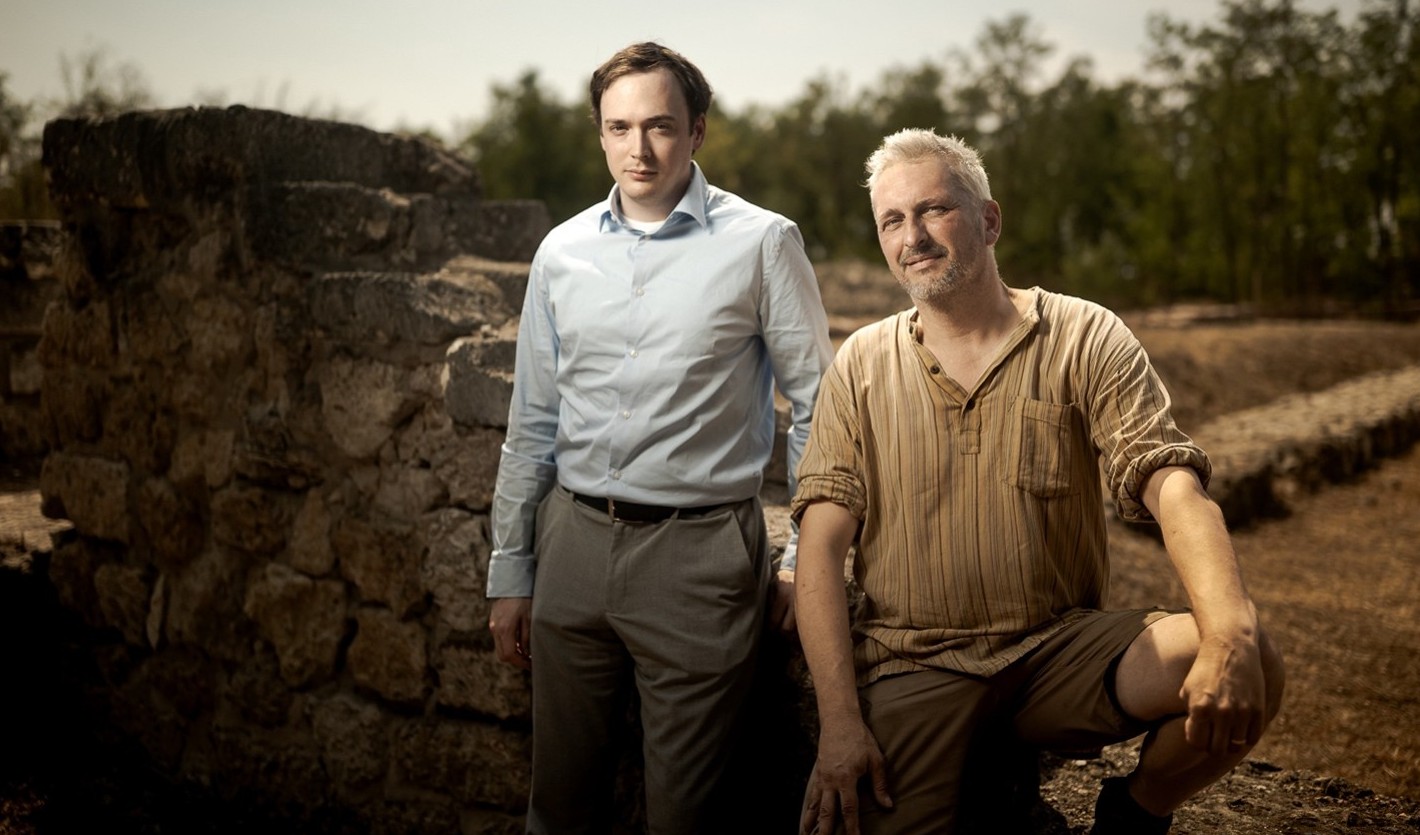
Bernát Rácz (left) and Szabolcs Rosta, director of the Museum of Kecskemét
On November 20, 2026, JCU alumnus Bernát Rácz (Class of 2021) will present his research on the Mosan enamel fragments discovered at the medieval monastery of Pétermonostora, Hungary, during the International Study Day in Brussels.
Originally from a small town in Hungary, Bernát earned an MA in Art History at JCU. Before starting his studies at JCU, he completed a BA in Art History with a minor in Archaeology at the American University of Rome in 2020. He then studied at the Central European University in Vienna, where he completed a one-year MA in Medieval Studies. He went on to pursue his doctoral degree in 2023 and is currently in his final year.
We spoke with Bernát about the fragments’ origins, artistic significance, and hidden inscriptions, as well as how new technologies are transforming the study of medieval art.
What are the key outcomes of your research on the Mosan Fragments from Pétermonostora? I began researching the fragments, which are part of the archaeological collection of the KJMK, in 2022. The artwork to which the various fragments belonged was extremely enigmatic, and, despite their discovery in 2013, there was no consensus on where it had been made or what type of object the fragments had originally constituted. This was because of their unique style and shape.
However, after a few months of research, it became evident that this was a so-called Mosan artwork, made in the Meuse Valley. I reached this conclusion when I first entered the treasury of the Royal Museums of Art and History in Brussels. The museum was the final destination of my first research trip through the Rhineland and the Mosan region. The difficulty in interpreting the fragments lay in the fact that the artist was an innovator. He was a metalworker whose creativity and skill were comparable to those of Nicholas of Verdun, surely one of the greatest artists of the 12th century.
During the International Study Day in Brussels, most of the stylistic elements will be discussed by Sophie Balace, curator of the museum’s metal collection and the main organizing partner for both the exhibition and the study day. It is a great honor to have such an expert on Mosan art present these fragments. I will supplement her discussion with a presentation of the latest archaeological findings, the technical and archaeometric analyses, and, most importantly, our computed tomography-based examination.
What makes the two newly discovered fragments such remarkable archaeological and artistic discoveries? The goldsmith who made these plaques had an immense knowledge of the art of the Meuse Valley. This artistic tradition made extensive use of antique models, creating a highly distinctive style between Romanesque and Gothic art that helped inspire the rise of Gothic art in France.
The fragments are unique in size within Mosan art; each plaque is almost as large as the famous Stavelot Portable Altar, and their quality is exceptional. Their discovery in an archaeological context 1,000 kilometers away from the Mosan heartland makes them even more fascinating. The two enamels also constitute the first significant artistic evidence from the Kingdom of Hungary attesting to its extensive connections with the Meuse Valley, which at the time was home to some of Europe’s most influential artistic centers. The connections between this part of Central Europe and the former heartlands of the Carolingian Empire have long been recognized. However, this is the first exceptional work of art to come to light that gives tangible form to the nature of these links.
The archaeological context of the fragments makes them even more extraordinary. The reliquary was brutally destroyed during the brief Mongol campaign in Hungary. We know that after killing most of the population of the town of Pétermonostora, the Mongols camped in its monastery for several weeks – an extremely rare archaeological trace anywhere in Eurasia. They smashed the liturgical furnishings into pieces and buried them, creating a horrifying yet fascinating time capsule.
Because of this destruction and the recovery of more than 10,000 metal artifacts, the site is often called the “Hungarian Pompeii.” The term “Golden Monastery” is also frequently used because of the hundreds of gilded fragments that once belonged to a vast collection of artworks.
What can this discovery teach us about the relationship between archaeology, scientific research, and art history? Art history is all about investigation and asking the right questions. If one wants to interpret an artwork, one needs to ask every possible question. Beyond style, iconography, and context, there is the question of technique and every other aspect related to how an artwork was made.
When working with the Pétermonostora fragments, we had to investigate every single detail and every tiny fragment because all the written sources concerning the monastery had been destroyed. One important element of this work was the technical analysis of the enamels. Together with my team at the Heritage Science Laboratory of the Hungarian Academy of Sciences’ Institute for Nuclear Research (ATOMKI), we were able to carry out various analyses that allowed us to determine the composition of the enamels.
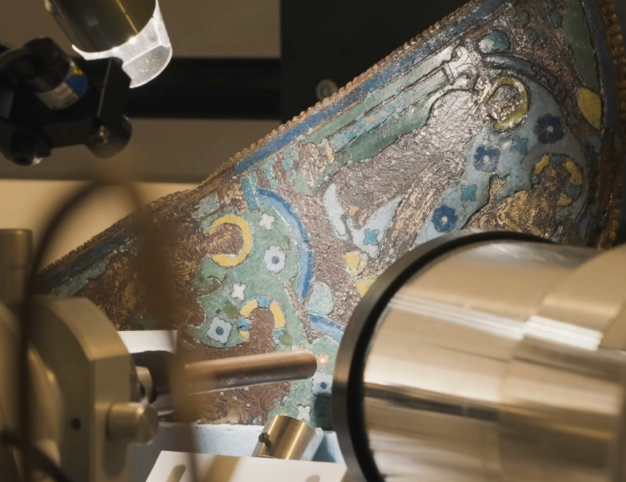
An enameled plaque from Bernát Rácz's research
How has technology changed the study of art history? In our case, technology has changed everything. Because the enamels were in such a corroded state when they were discovered, the former conservator at the museum in Kecskemét took them for various X-ray-based examinations to aid the restorers’ work. Naturally, they were also curious about what lay beneath the corrosion layer. After the plaques had been cleaned, however, the scans no longer seemed as important.
Then, 10 years later, in 2024, together with Pazirik Studio Ltd., we decided to create a full reconstruction drawing that would be as close to the original as possible. I spent many hours examining the scans. While investigating, I noticed several lines that were not visible on the surface. We realized that this was an inscription engraved beneath the enamel layer, on the surface of the copper base.
Since then, thanks to the engineers operating a large industrial CT scanner at AUMOVIO Hungary Ltd., a major corporation working with automotive components, we have discovered more than 15 hidden inscriptions. We have managed to read and decipher some of them. Most refer to the Abbey of Sint-Truiden, or Saint-Trond, and its relics. One of them names the abbot who appears to have commissioned the artwork: Abbot Wiric (1155-1180), formerly the abbey’s librarian and a great patron of the arts.
The presence of these inscriptions is difficult to explain, but it may be related to the fact that enamels were normally fired in multiple stages. The initial fired layer appears to have functioned as a mock-up of the enamel decoration. At this stage, the artwork was most likely presented to its patrons for approval of the colors. It appears that they decided to change some of the colors in subsequent layers, as we can tell from areas where the artwork was damaged.
These inscriptions not only confirm and refine our stylistic interpretations but also help us understand the object’s internal stratigraphy and the goldsmith’s working process. These are completely new findings that may contribute to our understanding of similarly outstanding treasures. These types of inscriptions were surely also placed on other elite enameled artworks.
What are your plans for the future? I hope to finish my PhD during this academic year. I also intend to complete all the projects I have begun, and I hope we will have the opportunity to publish the proceedings of our study day. There is plenty of work ahead, and I hope to continue working on similar projects.
Bernát has published on various subjects in medieval art – primarily on church treasures – in English, Hungarian, French, and German. In 2025, his book on the Mosan reliquary fragments from Pétermonostora monastery was published with Archaeopress. More recently, he turned his MA thesis, written under the supervision of JCU Professor Sharon Salvadori, into an article focusing on the mosaics of San Marco al Campidoglio in Rome. It was published in the journal Artibus et Historiae. He is a founding member of the Kecskemét Medieval Workshop, an association of scholars and volunteer metal detectorists affiliated with the Katona József Museum of Kecskemét (KJMK).