Claudio Buratti graduated from John Cabot University in 2023 with a BA in Communications and a minor in Entrepreneurship. During his studies, Claudio completed a student exchange program at UMass Boston that inspired him to build his career in the United States. After graduation, he decided to go back to Boston and combine his master’s in Business Management with his passion for basketball coaching, working as a Graduate Assistant. In this interview, Claudio discusses his experience with the college basketball industry in the US.
What led you to pursue a career in basketball coaching?
Sports have always been a part of my life. As a kid, I used to play soccer, then basketball, and watch A.S. Roma games with my dad. I fell in love with basketball, but mostly with coaching. I knew I wasn’t a good enough basketball player to make a career of it, so I decided to go into coaching. At JCU, I played with the Gladiators Team, which was definitely a fun experience. We even played in a tournament in Croatia. I will never forget what JCU allowed me to do, from meeting new people to seeing the world. In my junior year, I went on a Direct Exchange Program to UMass Boston. Those five months really changed my perspective and pushed me even more to pursue a career in the United States.
How did your journey continue after graduating from JCU?
After I graduated from JCU, I decided to become a Graduate Assistant (GA). It’s a very popular path in the US. While completing my master’s degree, I was working for the university as the GA for the men's basketball team for a small Division III school in Boston. I knew that was the best way for me to get my career going.
I started coaching in the States in 2023. Unfortunately, after 125 years, the school closed over the summer, while I was midway through my master's program. I was still able to finish it , but I couldn't coach anymore because there were no students on campus. I started to volunteer at another school in Massachusetts, Tufts University. It’s a very renowned institution, even from a basketball perspective. They are still in Division III, but we were in the top 10 in the country all season long. And after that, I decided to move on to the women's teams. Up until then, I had only coached men.
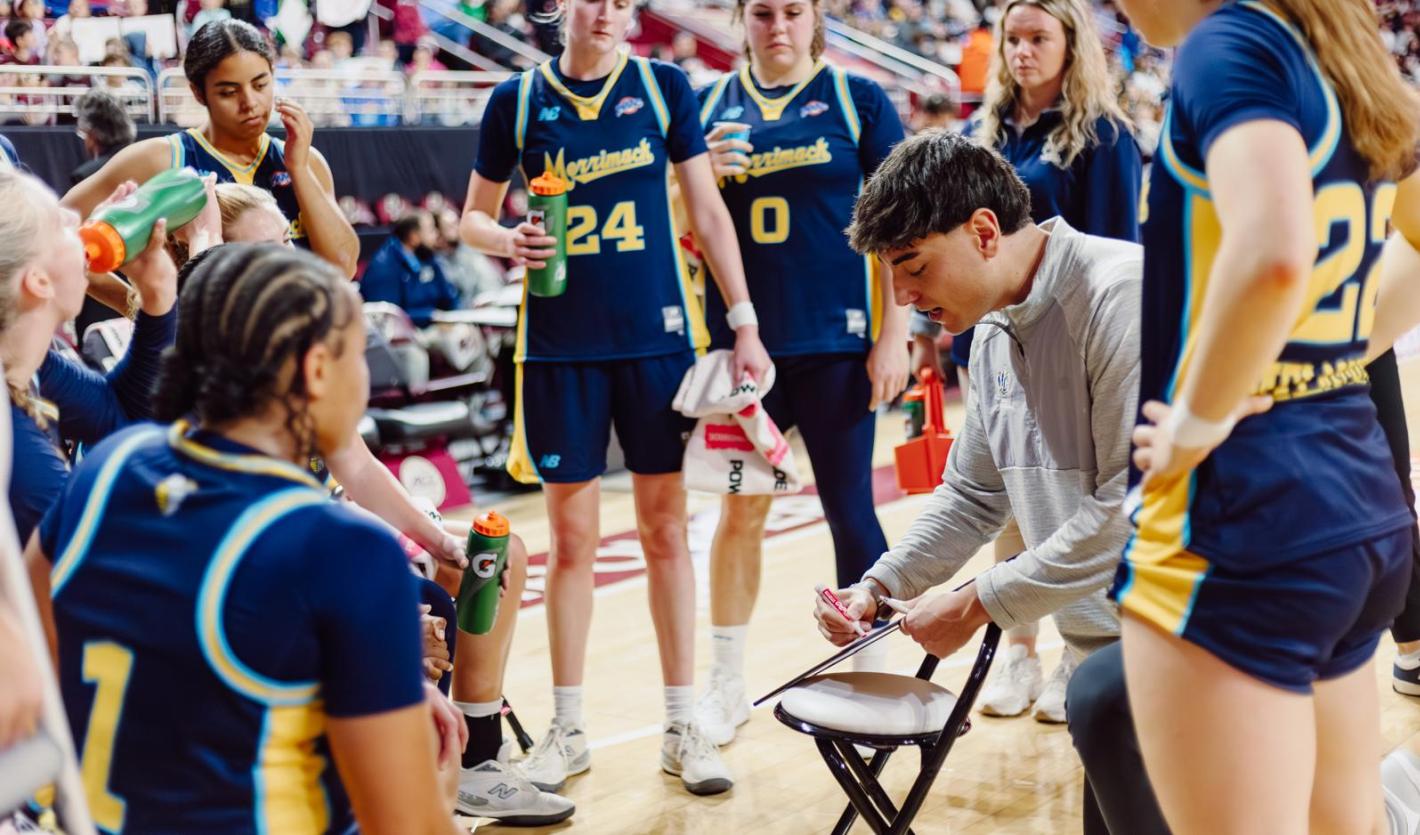
I joined Merrimack College, which is a medium-sized school in the Boston area, and after my first season, the head coach received an offer from the State University of New York at Albany, a larger school with more proven success in the basketball industry. She asked me to go with her, and that's how I ended up at Albany.
How did your JCU degree help you with a career as a basketball coach?
The connection between coaching basketball and my Communications degree might not be obvious, but I developed a set of skills, including intercultural communication and public speaking, that are helpful, especially in the modern industry. The college basketball sector is very profitable, and pretty much every Division I school in the US has money to offer to the students. The more you go up, the more money is offered. In my career, I’m merging skills that I gained at JCU with my master’s degree in Business Management.
What do you like the most about coaching college students?
I think that sports are a reflection of life. The adversities that you are confronted with in sports are the ones that you must deal with every day. Being an athlete teaches you how to tackle whatever is in front of you and hopefully overcome it. What I like most about coaching is being able to transmit values and ideas to young people.
What is the biggest difference between coaching men and women, if any?
There are multiple differences. I believe women tend to be more detail-oriented. You can feel that female athletes really don't want to make mistakes. When they do, which of course happens (and it should happen otherwise, you're not really pushing yourself), they're really disappointed in themselves, and they can feel that you're disappointed as a coach. They always strive for perfection, which at the same time could be a limitation.
Female players are more passionate, and they transmit that passion to you. They're way more expressive. For example, they often dance during practice and make you feel a part of the vibe. To be completely honest, when I first joined women's basketball, I thought it would be just a transition period, but one season changed my mind completely. I can see myself staying on this side of the industry for a long time.
Any advice for students involved in JCU Athletics who want to continue on a professional level?
If your goal is to pursue a career in the US, then my advice is to do a semester abroad. That was a mind-opening experience for me. I met a few professors at UMass Boston, and followed their advice to get into networking, sending emails, texts, and calling people. Following that approach, I was able to attend men’s basketball practices at Harvard, Northeastern, Boston University, and Boston College. All just because, as a student, I reached out to the assistant coaches. To conclude, I found a way to turn my passion into a career by being open to new experiences and making valuable connections. I encourage every JCU student to reach out to people from the industry they dream of being a part of. Building a strong network is invaluable.