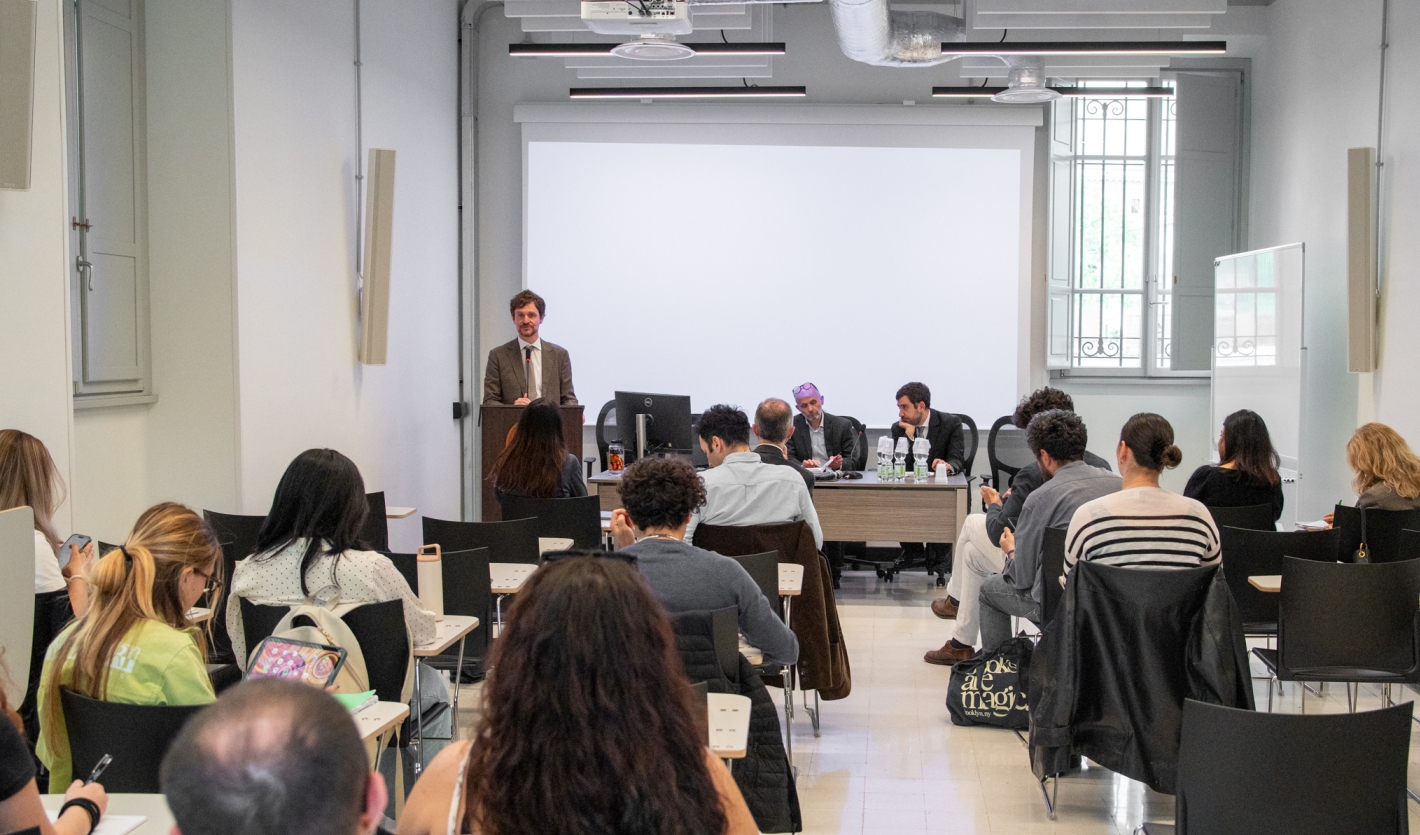
On April 20, 2026, John Cabot University hosted the workshop titled “Food Security and Global Politics.” The event brought together scholars, policymakers, and practitioners to examine how global food security is being reshaped by conflict, economic structures, and transformations in international governance.
The event was sponsored by JCU’s MA in International Affairs program, in collaboration with the Inter-University Research Center on the International Politics of Food Security (CIPolFoodS) hosted by the University of Pavia and the “Italy and the International Politics of Food Security” (ITALIM) research project at the University of Naples “L’Orientale” through the support of the Italian Ministry of Foreign Affairs and International Cooperation through the Unit for Analysis, Policy Planning and Historical Documentation.
The guest speakers were Ruth Hanau Santini (University of Naples “L’Orientale”), Simone Papale (University of Parma), Sara Moussavi (John Cabot University), and Matteo Caravani (Tufts University, Feinstein International Center).
Framing the problem: food security as a strategic issue
Opening remarks were held by Interim Dean of Academics Nicholas Startin, Antonino Tedesco (Italian Ministry of Foreign Affairs), and Michael Drissen (Director of JCU’s MA in International Affairs program). They emphasized that food security has evolved into a central concern of international politics, rather than remaining a purely humanitarian one. No longer confined to development policy, it now intersects with diplomacy, conflict, trade, and climate change. Ongoing conflicts in regions such as Ukraine, Gaza, and Sudan were cited as major disruptors of global food systems, affecting supply chains, prices, and access.
Structural inequality in food systems
Ruth Hanau Santini examined the political economy of global food systems, challenging the common idea that food crises are simply due to supply-demand imbalances. She argued that global food crises stem from structural dependency, not just supply-demand issues, with regions like Africa relying heavily on imports. She highlighted the dominance of multinational grain traders (“ABCD” firms), which profit from crises while hunger rises. She also criticized cash transfers for reinforcing market dependency, calling instead for local production and food sovereignty.
Santini also criticized the growing reliance on cash transfers as a humanitarian response. While effective in the short term, these programs can reinforce dependency on global markets and indirectly support corporate profits rather than local food systems. The argument called for a shift toward local production, agroecology, and food sovereignty, integrating social welfare with agricultural development.
Food access as a tool of warfare
The second presentation, held by Simone Papale, introduced the “weaponization of food” or “food warfare,” meaning the use of food access and distribution as tools of power and is used strategically in conflicts through blockade, destruction, capture, and contamination to weaken populations and economies. Papale used the war in Ukraine as reference, illustrating both local impacts (e.g., sieges) and global consequences (e.g., reduced exports affecting food prices worldwide).
Papale highlighted the difficulty of addressing these tactics due to limited access in conflict zones and the deliberate obscuring of such practices. He called for stronger international responses, including infrastructure rebuilding and demining efforts to restore agricultural production.
Crisis of liberal humanitarianism and local alternatives
JCU’s professor Sara Moussavi examined the crisis of liberal humanitarianism and how it’s affecting humanitarian systems. She argued that traditional humanitarianism, which is rooted in Western norms, multilateralism, and human rights, is facing both external challenges and internal weaknesses, such as rising authoritarian powers, funding cuts, and politicization.
Using Sudan as a case study, she showed how local grassroots groups effectively replaced failing international systems, though they remain underrecognized, while formal humanitarian systems struggled to operate during the civil war. These grassroots organizations, known as Emergency Response Rooms, rely on solidarity, local knowledge, and informal networks, reaching large populations with minimal external funding.
International organizations often treated these groups as temporary proxies rather than recognizing them as transformative actors, failing to adapt to changing realities.
Sanctions and their Impact on food security
Matteo Caravani analyzed the relationship between economic sanctions and food insecurity. Sanctions, widely used as a foreign policy tool, can severely disrupt food systems, even when humanitarian exemptions exist, and harm populations.
Case studies from Somalia and Afghanistan showed how sanctions contributed to severe crises, sometimes exacerbating famine conditions. Caravani argued that sanctions, especially when applied to governing authorities, can effectively become comprehensive rather than targeted, harming entire populations. He called for better policy design, coordination, and scrutiny of sanctions, especially in a context where humanitarian funding is declining.
Overall, the workshop emphasized that hunger is driven by power and politics, with interconnected crises, unintended policy effects, and weak global governance. The speakers raised critical questions about whether existing tools and institutions are capable of addressing modern food crises. They all emphasized the need for new approaches that combine local empowerment, structural reform, and international cooperation.