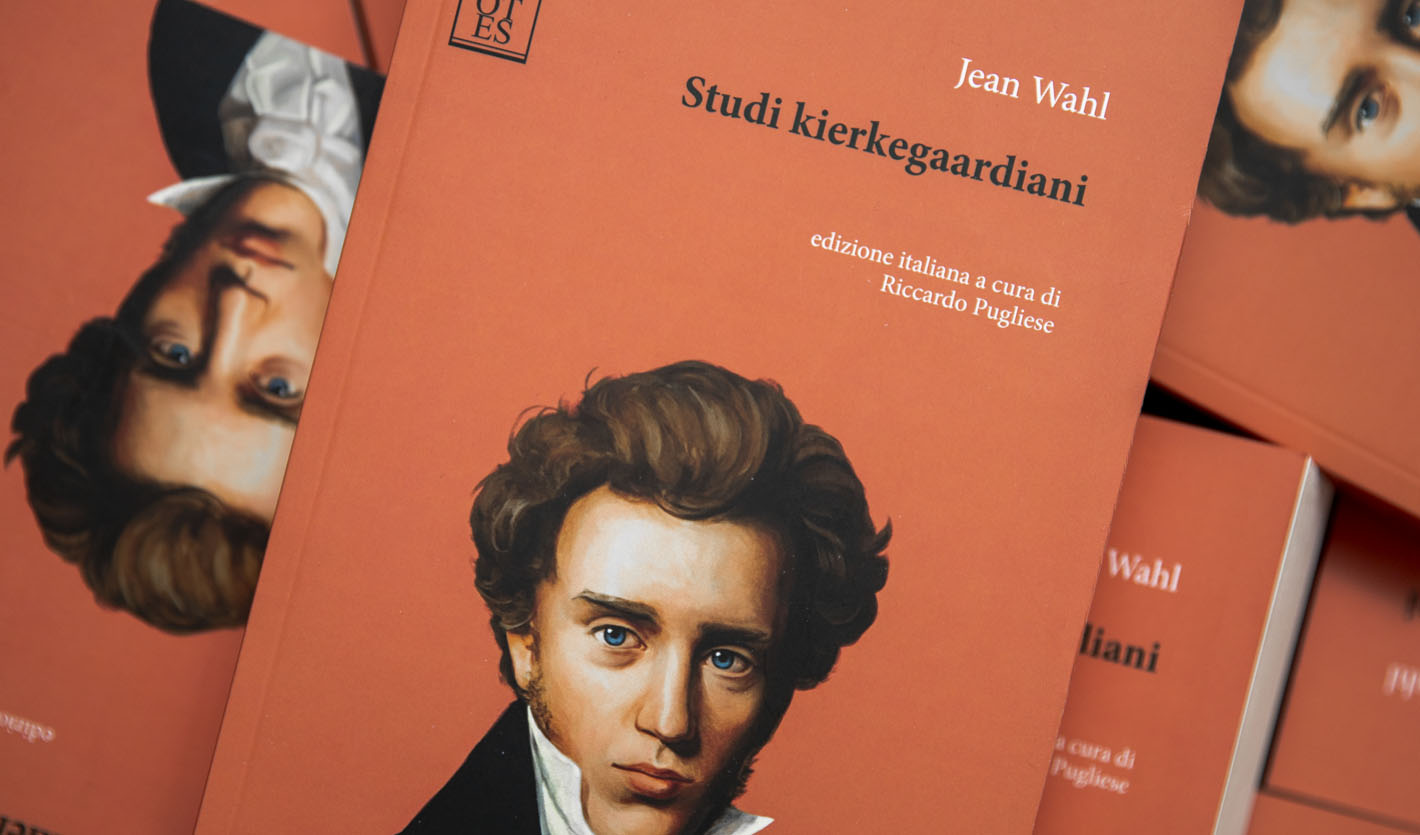
JCU’s Webmaster Riccardo Pugliese published his Italian translation of Études kierkegaardiennes (Studi Kierkegaardiani, Orthotes, 2026). The book is a collection of articles and essays on Søren Kierkegaard by the French philosopher Jean Wahl (1888-1974), first released in 1938. It examines some of Kierkegaard’s major works (Journals, Either/Or, Fear and Trembling, The Concept of Anxiety, The Sickness unto Death) and outlines their central themes, ranging from the question of pseudonyms to ethics, choice and the absolute, the overcoming of Hegelianism and Romanticism, as well as categories such as despair, truth, faith and paradox, time and God. Studi Kierkegaardiani is the first Italian translation from the French.
The Web Communications Office staff asked Riccardo some questions about his latest publication.
Why did you decide to translate this book?
I discovered the Études while preparing my undergraduate thesis on the concept of freedom in Kierkegaard. In an environment where philosophical speculation can become sterile and self-enclosed, Wahl struck me for the immediacy and passion with which he approached the complex themes of Kierkegaard’s work. Wahl, who was also a poet, exemplifies a fluid and literary style that could be compared to Plato’s. Both employ a language that is simple in terms of syntax and vocabulary, yet complex in the formulation of ideas.
The bibliography on Kierkegaard is vast. What is Wahl’s distinctive contribution within this crowded landscape?
Wahl’s study of Kierkegaard was not the only one to appear in France in the 1930s — contemporary contributions include those of Rachel Bespaloff, Lev Shestov, and Benjamin Fondane — but it undoubtedly remains one of the most significant. Wahl delves into Kierkegaard’s extensive body of work and distills its complex tensions into a series of gnomic pairings — subjectivity and objectivity, absolute and relative, the individual and the universal, choice and necessity, time and eternity, paradox and system, immanence and transcendence, understanding and existence, faith and reason.
Wahl was among the first to introduce Kierkegaard to France, at a time when the Danish philosopher was still largely unknown to the general public, and helped restore his authentic voice. Wahl’s work received praise from philosophers Karl Jaspers, Gabriel Marcel and Emmanuel Levinas, and was destined to leave a profound resonance within the contemporary cultural landscape. The attentive reader will be able to trace in the Études not only a comprehensive overview of Kierkegaard, but also of Wahl himself, identifying in it the early seeds that would shape his later writings.
Do you think Jean Wahl is gaining more recognition today?
Yes, in recent years, there has been renewed scholarly and editorial interest in Jean Wahl’s work, including new editions and re-editions. I believe it is a major step in giving this seminal thinker the attention he deserves. Wahl is a philosopher still largely to be discovered. Some of his books (and his poems) remain unpublished in Italy, and I hope that this Wahl “renaissance” can help him find a wider audience. My university professor used to say that reading Wahl is like wandering through Tuscany — you can hardly go wrong!
Riccardo Pugliese is Webmaster at John Cabot University. He holds a laurea in Lettere Moderne from Ca’ Foscari University of Venice and an MA in Classics from the University of Maryland. His research focuses on the development of existentialist philosophy, with particular emphasis on Søren Kierkegaard. He has published work in both English and Italian on themes including freedom, possibility, choice, and individual responsibility.