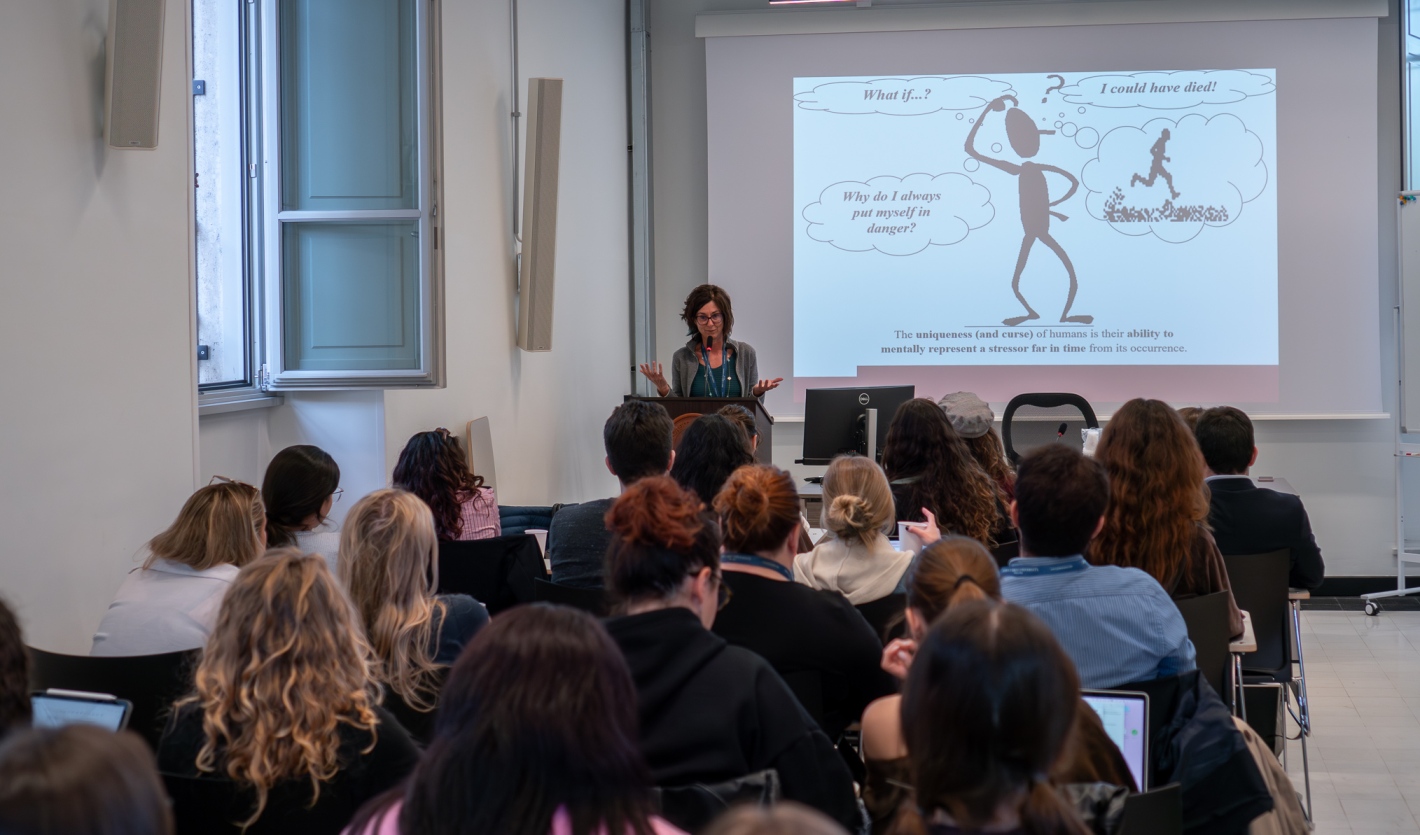
On April 8, 2026, John Cabot University hosted psychology professor Cristina Ottaviani (Sapienza University of Rome) for an interdisciplinary talk on the deep connections between mind, body, and health, explored through the lens of psychophysiology. Professor Ottaviani offered a compelling account of how repetitive negative thinking, which researchers call perseverative cognition, can shape both psychological suffering and physical disease.
Drawing on decades of research at the intersection of clinical psychology, neuroscience, and physiology, Ottaviani challenged a common assumption in stress science, the idea that physiological activation itself is inherently harmful. Instead, she argued that stress responses are fundamentally adaptive.
Human response to threats
Like a zebra fleeing a predator, Humans are designed to mount a physiological response to threat. The problem arises not when we respond to stress, but when the stress response remains chronically activated in the absence of an immediate threat. This is where perseverative cognition enters the picture.
As Ottaviani explained, rumination (“Why did this happen to me?”) and worry (“What if something bad happens?”) are forms of repetitive negative thinking that prolong the body’s stress response long after the stressor has passed, or even before it has arrived. Through these mental processes, human beings can generate physiological stress responses simply by imagining, rehearsing, or anticipating threats.
Ottaviani presented a substantial body of evidence showing that these forms of intrusive thinking are associated with sustained activation in cardiovascular, endocrine, and autonomic systems, including increases in blood pressure, heart rate, cortisol, and reductions in heart rate variability (HRV), a key marker of parasympathetic flexibility and physiological regulation.
Shared process with other disorders
One of the central themes of the lecture was that perseverative cognition functions as a transdiagnostic process, which is a mechanism that cuts across many forms of psychopathology, including depression, anxiety disorders, and even addiction-related craving. Rather than viewing rumination and worry as symptoms specific to particular diagnoses, Ottaviani argued that they may represent a shared process contributing to vulnerability across disorders. She illustrated this through a series of laboratory studies, including experimental inductions of rumination that showed how dwelling on distressing experiences can sustain physiological arousal over time. In contrast, when attention is redirected or flexible recovery is possible, the body returns to baseline much more efficiently.
The talk also examined how these processes may help explain the well-documented link between mood and anxiety disorders and increased cardiovascular risk. Longitudinal research reviewed in the lecture suggests that repetitive negative thinking may be an important mechanism connecting emotional disorders to later adverse cardiovascular outcomes.
Inhibition of threat responses
Moving from body to brain, Ottaviani described neuroimaging findings implicating disrupted communication between the prefrontal cortex and the amygdala in individuals prone to chronic worry, highlighting how perseverative cognition may reflect reduced capacity to inhibit context-inappropriate threat responses. Intriguingly, she showed that experimentally inducing repetitive negative thinking in healthy individuals can temporarily produce neural patterns resembling those observed in clinical populations, suggesting that these processes differ more by degree than by kind.
Another major contribution of the talk was the developmental and translational scope of Ottaviani’s research. It also extends to children, showing that even in elementary school populations, rumination is associated with reduced physiological flexibility. This suggests that these patterns emerge early and may represent important targets for prevention as well as treatment.
Importantly, Ottaviani did not stop at identifying the problem, but also discussed efforts to intervene. Her research has examined whether altering physiological regulation directly through approaches such as non-invasive brain stimulation or vagus nerve stimulation can reduce the impact of perseverative cognition. While these methods appear capable of modulating the physiological consequences of repetitive negative thinking, they do not seem, on their own, to eliminate the thinking itself.
This led to one of the lecture’s central clinical insights: the goal may not be to suppress intrusive thoughts at all. Drawing on evidence from so-called “third wave” cognitive behavioral approaches, Ottaviani emphasized that attempts to forcibly stop or suppress unwanted thoughts often backfire, making them stronger rather than weaker. Instead, interventions grounded in acceptance, decentering, and compassion may help individuals relate differently to these thoughts, reducing their grip.
Intervention by compassion
A part of the lecture focused on work conducted with JCU Professor Niki Petrocchi, using compassion-based interventions, including mirror-based compassionate practices designed to reduce self-criticism and increase physiological regulation. These studies suggest that psychotherapeutic methods may not only shift subjective emotional experience, but also influence measurable physiological markers such as heart rate variability.
In the final part of the lecture, Ottaviani offered a glimpse into an emerging frontier in her research: reconceptualizing perseverative cognition not only as a threat-based process, but also as something that may carry self-reinforcing, reward-like properties. This opens possibilities for understanding repetitive negative thinking through motivational and reward-based frameworks, potentially expanding how it may be treated.
Ottaviani’s lecture invited students and faculty alike to rethink stress not as a simple matter of “too much activation,” but as a question of flexibility, recovery, and the mind’s relationship to threat.
Ultimately, the talk offered a powerful reminder that psychological suffering may arise not only from stressors themselves, but also from the mind’s sustained engagement with them. And perhaps healing begins not only by calming the body, but by transforming our relationship with thought itself.