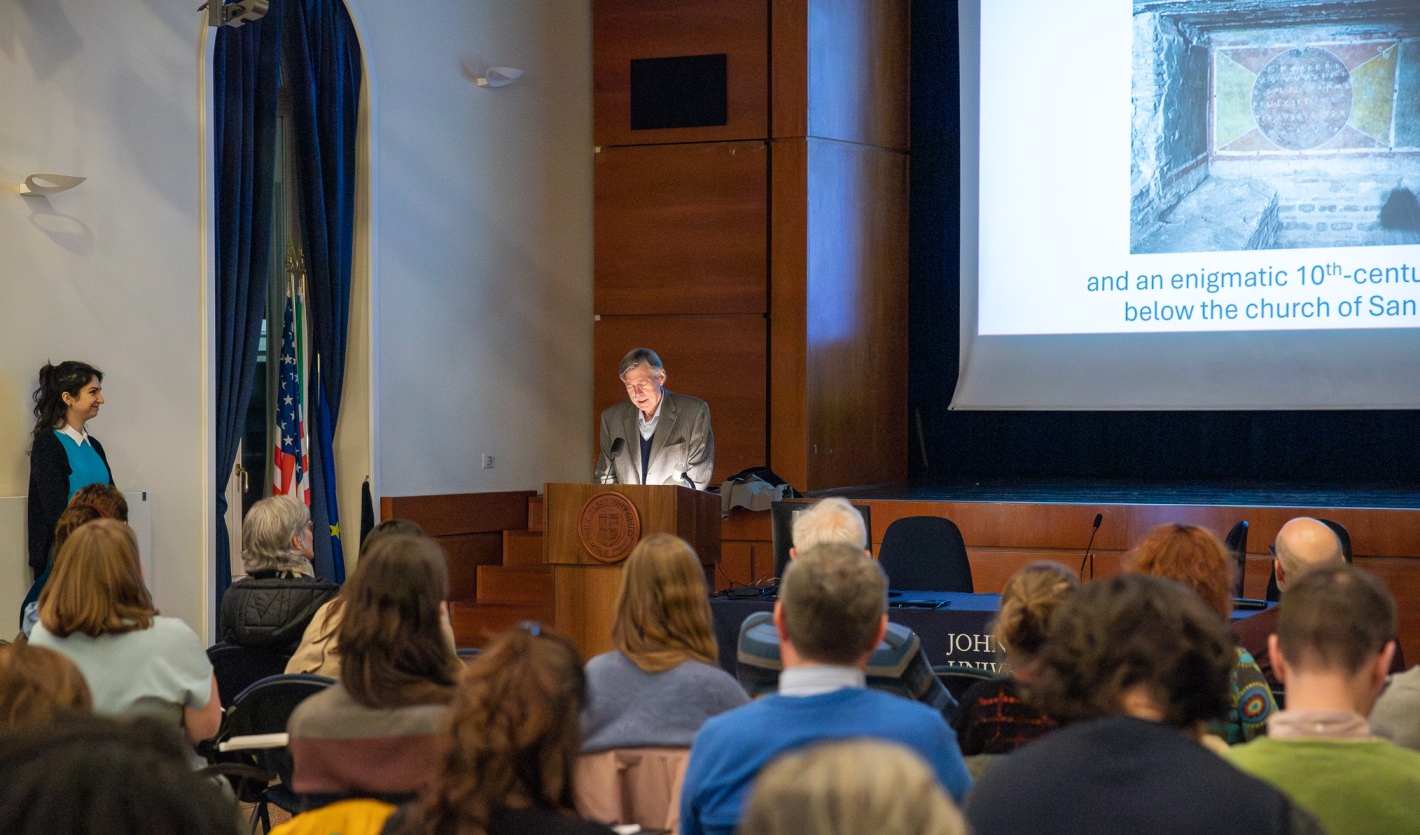
On March 18, 2026, John Cabot University welcomed historian John Osborne for a Presidential Lecture titled “The Sibylline Prophecy on the End of Rome and an Enigmatic Tenth-Century Mural Beneath the Roman Church of San Saba.”
This event was part of ArtSpeaks, an open lecture series organized by the Department of Art History with the Center for Graduate Studies. It brings leading academics, curators, artists, and other cultural professionals to JCU and the wider Roman community.
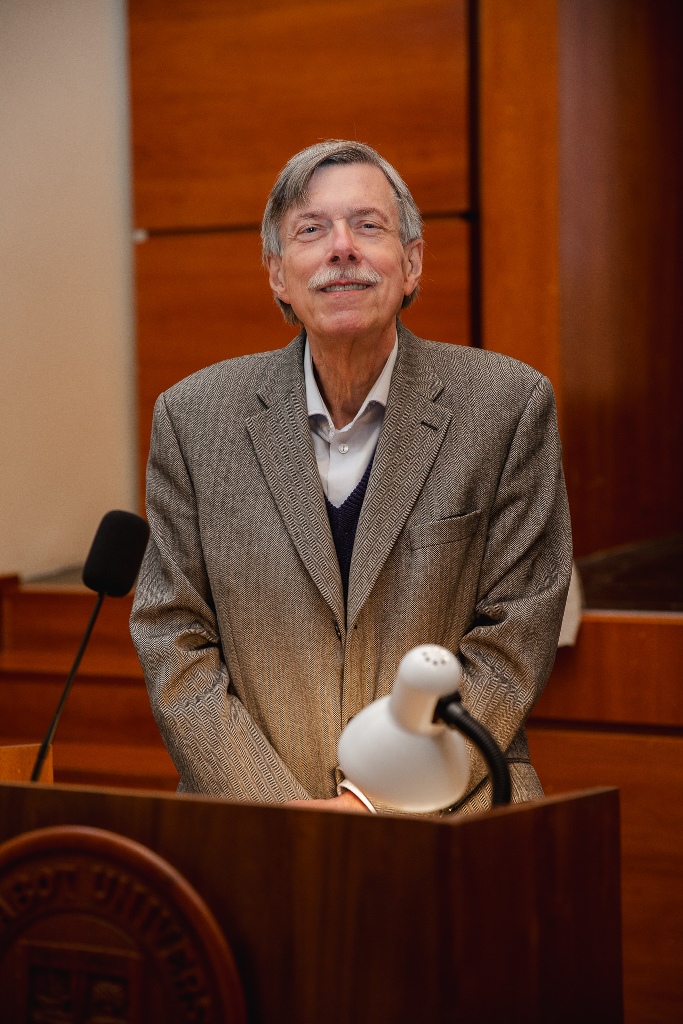
John Osborne
The early medieval church of San Saba is notable for its extensive mural paintings, some found in fragments on the floor, others still preserved on the lower walls of the original structure. Seven discrete campaigns of decoration, dating between the seventh century and the year 1000 CE, have been identified. In this presentation, John Osborne focused on a painted dado — the decoration of the lowest areas of the church wall — comprising three panels.
Two panels record the identities of the artisans who created them: Martinus monachus magister, apparently a mason, as he is depicted with the tools of his trade, and Sergius pictor, not figured but named in an inscription. If the proposed tenth-century date is correct, these findings constitute the earliest such signatures known from medieval Rome. A third panel features an enigmatic word puzzle, clearly related to the famous prophecy of the Tiburtine Sibyl concerning the eventual end of the Roman Empire.
Osborne’s presentation addressed the importance of the San Saba dado as marking a critical moment when dado designs evolved beyond fictive marble and velaria. These developments anticipated a broader use of the socle space in the central and later Middle Ages, extending far beyond a purely decorative purpose. Moreover, Osborne highlighted the relationship between the Sibylline prophecy and Roman politics at the turn of the first millennium.
John Osborne is a cultural historian of the early medieval Mediterranean, with a particular interest in the material culture of Rome and Venice. He has also written more broadly on the topography of medieval Rome, saints’ cults, cultural transmission between Western Europe and Byzantium, the Roman catacombs, and Counter-Reformation interest in Early Christian and medieval antiquities. He spends part of each year at the British School at Rome, which appointed him an Honorary Fellow in 2006. His recent publications include Rome in the Tenth Century: A History in Art (2025); Rome in the Ninth Century: A History in Art (2023); and Rome in the Eighth Century: A History in Art (2020). This series, published by Cambridge University Press, weaves together written texts and material culture, integrating the disciplines of history, history of art, and archaeology.