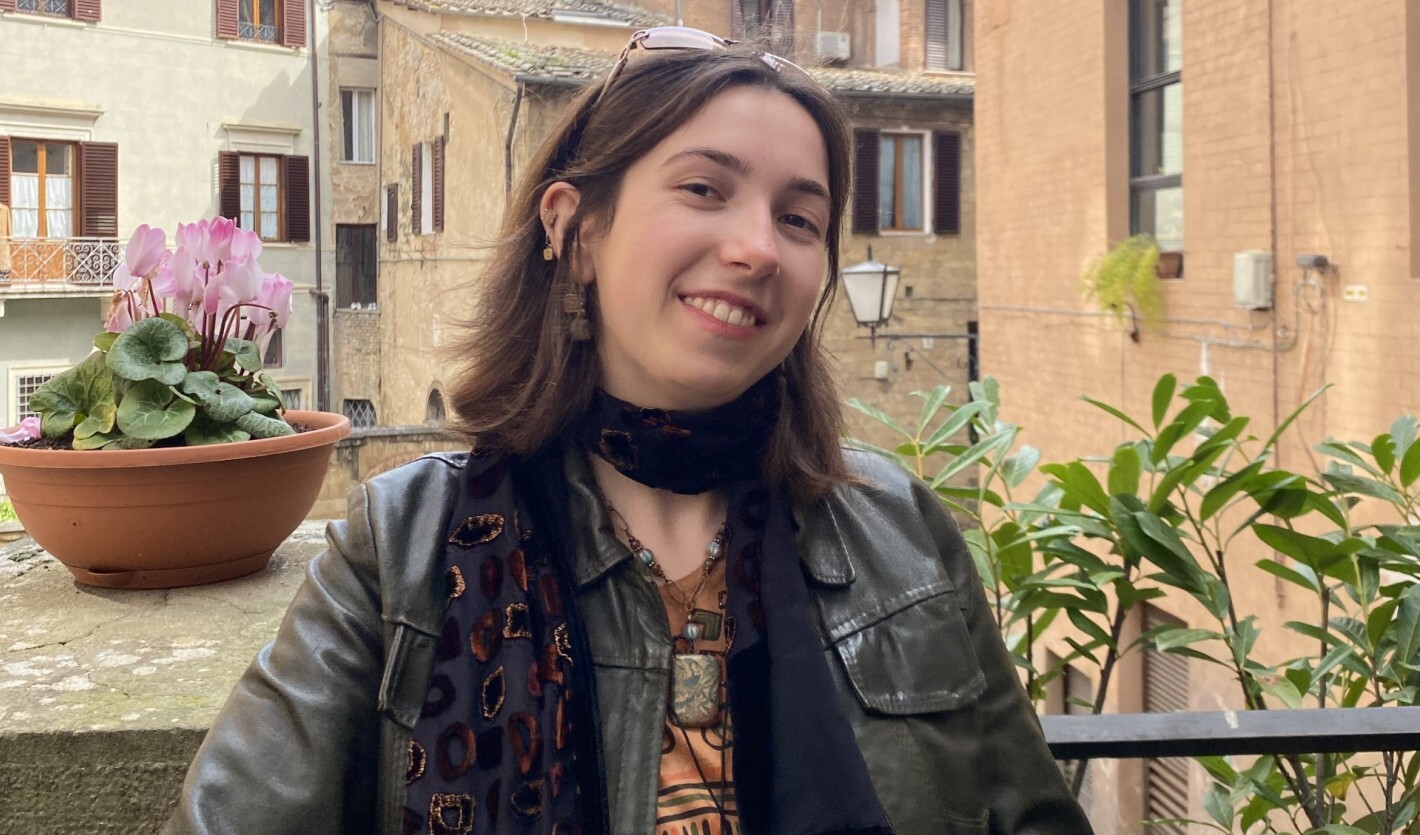
Originally from Cape Cod, Massachusetts, Alison Ladd is a senior Art History major, minoring in Humanistic Studies and Art and Design. She is Head Curator of the Art History Society, Student Senate Representative for the Department of Art History, and a Student Ambassador at JCU.
Tell us a bit about your background.
I had never been on a plane to travel to another country. So, when I told people I was moving to Rome to study Art History, they were all surprised. Cape Cod is a place where the ocean is always close, and most people know your name. It’s beautiful and familiar, but during my junior year of high school, as I began thinking seriously about college, the pandemic changed the way I saw the world. Like many people, I realized I wanted more than what felt safe and expected. I wanted to challenge myself in a completely new way. I discovered John Cabot University online almost by accident, and I could immediately feel the sense of community that defines the campus.
What inspired you to pursue Art History at JCU and to combine Art Design with Humanistic studies?
I found my passion for Art History somewhat unexpectedly. In high school, I loved both Art and History, and the idea of combining the two immediately appealed to me. What I didn’t realize was how much research, imagination, and careful thinking goes into understanding a single work of art. I quickly learned that Art History isn’t just about what you see, but about what you reinterpret, question, and reconstruct. That discovery led me to declare minors in Humanistic Studies and Art and Design. I was initially drawn to Philosophy, but Humanistic Studies gave me a broader way to explore cultural and intellectual questions that fit perfectly with my love for research. Art and Design, however, has always been a personal interest of mine. One of the great strengths of the Department is that many professors are active, working artists, which has been an incredible advantage both for my development as an artist and as an art historian living in Rome.
Who’s your all-time favorite artist and why?
I would definitely have to say Lebanese artist Huguette Caland (1931-2019). Originally from Beirut, Caland moved to Paris to pursue her art of unraveling forms. She worked in painting, sculpture, textiles, and fashion. Her goal was to blur the lines between all of these techniques. What draws me to her work is not just the range of mediums, but the spirit behind it. There is a sense of fearless curiosity in everything she made, a refusal to separate art from living. She has influenced me both as an artist and as an art historian. Her work makes me think differently about form and meaning, about abstraction and the body, and about how personal experience finds its way into visual language. In a world that often feels fragmented and fast-moving, her work reminds me that art can still be intimate, playful, and deeply human.
What is your impression of JCU so far? Is there a class or professor or anything about Rome in particular that has impacted you?
Coming to Rome was my first time living outside the United States, and although I was nervous, I quickly found a community that made the city feel like home. Studying alongside people from so many different backgrounds has been inspiring. We are all connected by a shared openness to new experiences. I am especially grateful to be part of the Art History department, where lectures never feel like routine and curiosity is always encouraged. Professor Inge Lyse Hansen in particular has completely changed the way I think about Art History. Her energy and love for ancient art and portraiture are contagious. One of my first classes at JCU was her course on ancient art, and it taught me how to see past what is missing, how to imagine the invisible. We spent hours studying fragments, ruins, and broken mosaics, learning to rebuild meaning from what time has left behind. That class stayed with me. I am now preparing my Senior Thesis with Professor Hansen as one of my readers, focusing on the contemporary reuse of ancient portraiture by the artist Francesco Vezzoli. In many ways, it feels like a continuation of that first course, like I’m still learning how the past is carried forward and reinterpreted in the present.
How did you get involved and how do you balance your extracurriculars with your academics?
Balancing academics and extracurriculars has been one of the most rewarding parts of my time at JCU. I currently serve as Head Curator of the Art History Society, Student Senate Representative for the Department of Art History, and as a Student Ambassador. These roles have taught me how to take ideas seriously and carry them into real, collaborative projects. Being Head Curator has been especially meaningful. We run a space on campus called the 4m2 Gallery, which functions as both exhibition and study space. I work closely with professional artists in Rome and with faculty, librarians, maintenance staff, and the front office to bring each exhibition to life. It is a lot of work, but seeing a space transform from an idea into something students actually study in has been one of the most satisfying experiences of my time here.
What are your plans for the future?
As I get closer to graduation, I’m thinking more about what comes next. I plan to pursue a PhD in Art History, but first I’m excited to explore the field beyond the classroom. I’m applying to internships and spending as much time as I can in the city, learning directly from the world around me. I’ve learned to trust my curiosity and follow the work that genuinely excites me. That’s the advice I would give to future students, too. Trust what you care about, stay open to where it might lead, and don’t underestimate the power of kindness along the way.