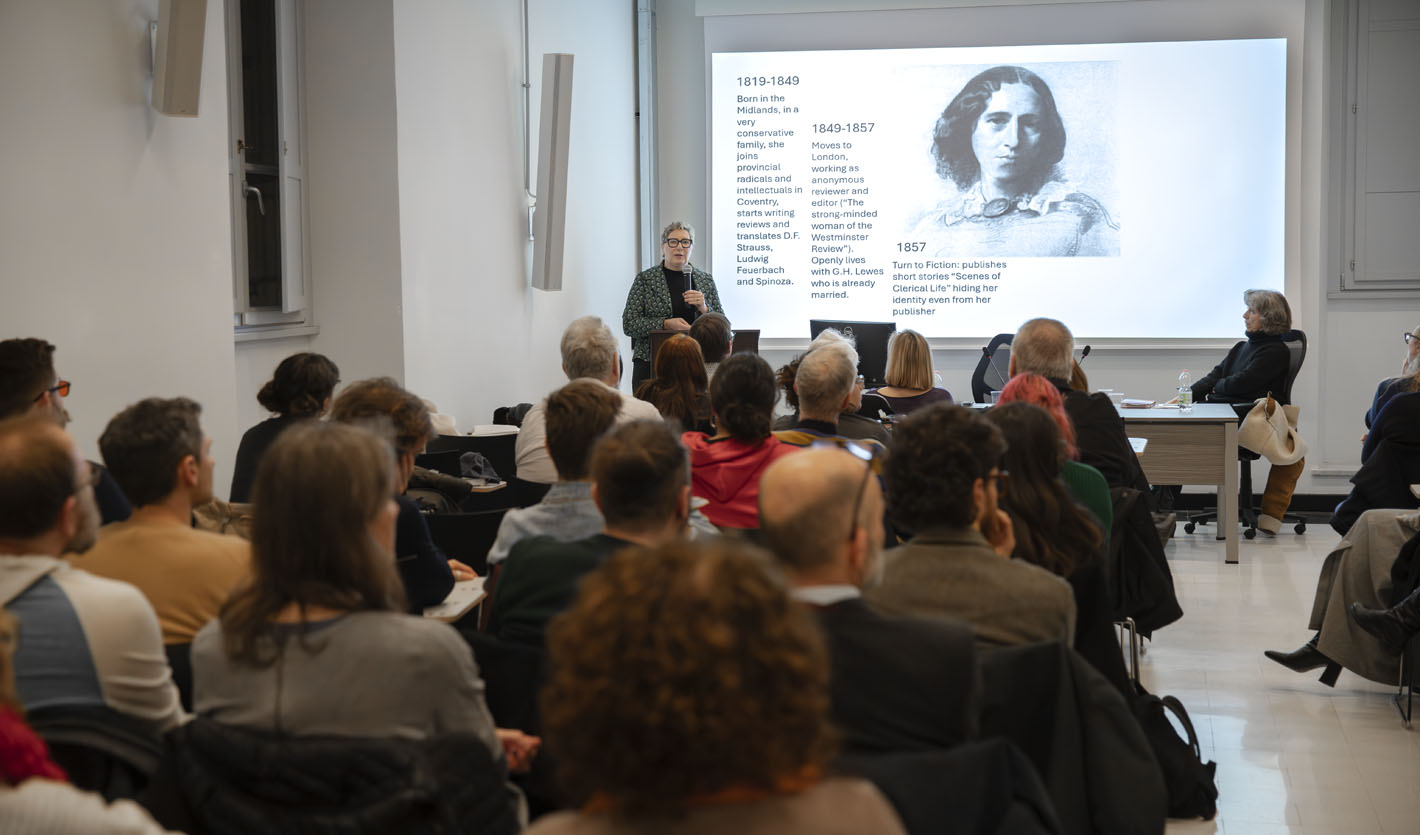
On January 27, 2025, the Department of English Language and Literature hosted a presentation of Professor Alessandra Grego's book The Myth of George Eliot: How Marian Evans Invented the Victorian Novelist (Routledge, 2026). The discussion was led by JCU philosophy professor Brunella Antomarini.
Professor Grego, who has taught English Literature at JCU for twenty years, began her talk by thanking “the incredible JCU librarians, who provided me with every single text I needed. I really wouldn't have written the book without them.”
The premise of Grego’s book is that "George Eliot" is more than Marian Evans’s pseudonym, and is actually operating like a myth, or a narrative of shared belief, to offer the Victorian readers the kind of authorial voice they would be willing to listen to. Marian Evans was a journalist, translator, and editor who chose to live her life in open defiance of Victorian conventions. Creating the persona of “George Eliot,” an educated gentleman, and providing him with a common-sensical, familiar voice, personality, and political views, Evans invented the type of Victorian novelist who was received enthusiastically by the expanding mid-century readership. The Myth of George Eliot proposes that the narrative style and structure of Evans’s fiction is the result of her studies, of her reflection on the role of literature in the political and ethical life of a nation, and on the novel as the site of a cooperation between writer and reader in the continuous work on inherited traditions. Neither the last Victorian nor the first Modernist, Evans emerges as an author reflecting on the power of collective narratives in an age of democracy.
Marian Evans' Literary Journey
Professor Grego explained that her book is divided into two parts. In the first part. “Myth and Common Sense,” Grego analyzes the development of Evans’s understanding of collective narratives, which include religion and common sense, starting from the work of the philosophers she translated, Baruch Spinoza, David Friedrich Strauss, and Ludwig Feuerbach. In this section, Grego analyzes these authors’ investigation of the development of myths within communities and their political function in constructing national identities, showing their influence on Evans’s understanding of the function of myth. Grego’s conclusion is that Marian Evans turns to writing novels and poetry, considering them as the modern medium of myths, narratives of collective value that shape people’s beliefs and actions.
In the second part of their book, titled “Demythologizing and Re-mythologizing,” Grego shows how Evans investigates common sense and myth in her novels, arguing that both are narratives of belief that are influenced by place and tradition. Drawing examples from Evans' novels, particularly her reworking of inherited types such as the knight and the damsel, Grego discussed the existing tension between crystallized myth and new myths in Evans’s fiction.
The Role of Myth and Common Sense in Victorian Literature
To support her argument, Grego referred to the work of Antonio Gramsci on common sense and of Hans Blumenberg on myth, elaborating on the idea of myth as both a necessary shared narrative that creates a community and as a form of ideological control. Grego proposes that the two voices in Evans's novels, the eminent narrator and the ungendered, disruptive voice of the narrator as nobody, embody the conflict between traditional crystallized narratives and regenerating myths of social development and inclusion. Grego showed how Evans pitched mythical characters against commonsensical characters to explore the struggle between new and old myths.
The Concept of Parrhesia and Its Implications
Grego introduced the concept of parrhesia, a form of fearless truth speaking that Evans derived from Greek tragedy and Saint Paul, also discussed by Michel Foucault as the place where belief and truth can meet, a form of speech that ruptures the discourse of common sense. A few female characters in Evans' novels, such as Maggie in The Mill on the Floss and Dorothea in Middlemarch, use parrhesia to testify to their truths even in the certainty that they cannot be heard or understood by their community, while opening a space in which the readers can challenge and renegotiate inherited myths.
Ambiguity and Common Sense
In the conversation that followed Grego’s presentation, Professor Antomarini emphasized Evans' ambiguity, her role as an observer, and the importance of common sense in her works. She highlighted the tension between opposites in the book and the importance of common sense in mediating myth and realism. She discussed how Evans's role as a reporter and observer influenced her writing and how she succeeded in composing her observations and beliefs. Antomarini emphasized the importance of common sense in holding the reader’s attention and the need for communities to challenge and construct new narratives that both criticize and embrace common sense, arguing that Evans' model of womanhood is not that of the victim but of the observer, an agent of the construction of new myths.
Grego and Antomarini concluded the discussion by emphasizing the importance of language and narrative in constructing new myths and the role of the artist in renovating language and myths.