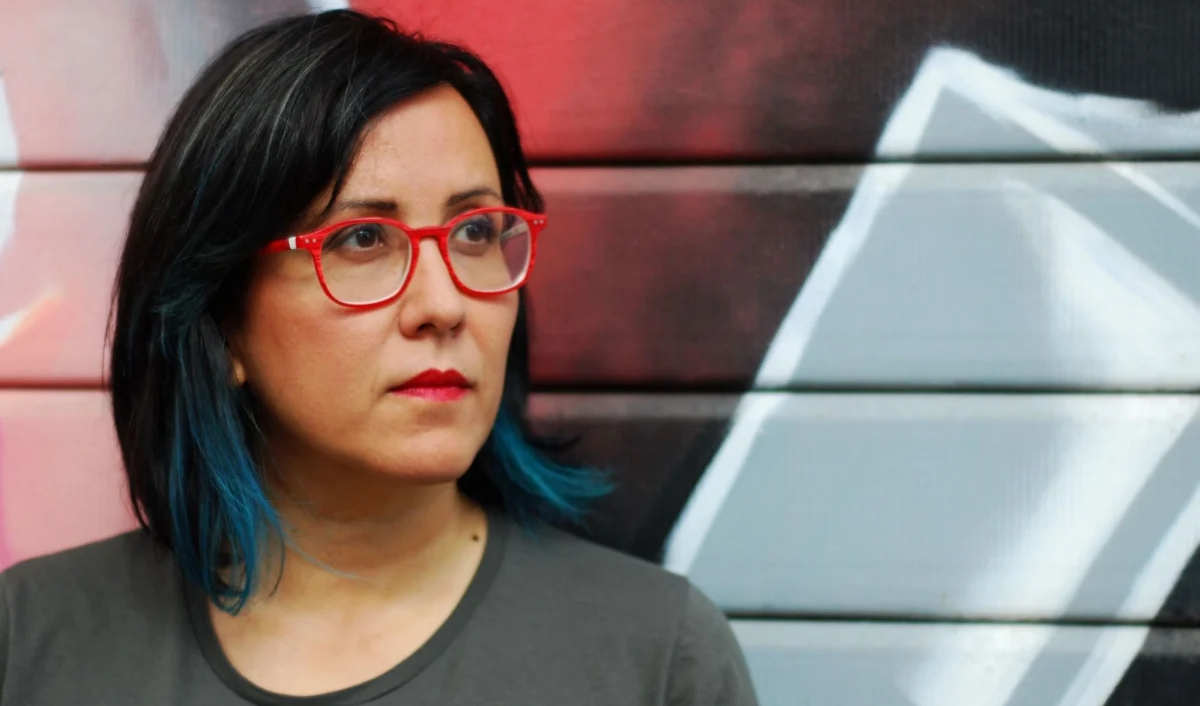
Professor Valentina Nanni has been teaching in the Department of Communication and Media Studies at JCU since 2023. She was born and raised in Rome, and after earning a degree in Contemporary Art History, she spent many years working in the art world, mainly in publishing. She was involved in the founding and editorial direction of magazines such as Exibart and Artribune, and in 2008, she moved to Milan to develop and launch the online edition of FMR (Franco Maria Ricci). In recent years, she has stepped away from journalism and art reporting to focus entirely on research, writing, and teaching. Before joining John Cabot University, she taught at Sapienza University of Rome, Politecnico di Milano, and NABA in Rome and Milan. She has authored numerous books on the intersection between art and technology. Her most recent publication is Antimacchine. Mancare di rispetto alla tecnologia (Maverick Einaudi, 2025).
What brought you to Rome and JCU?
I joined JCU thanks to Professor Donatella Della Ratta, who invited me to participate as a speaker in the Digital Delights and Disturbances talk series in 2022. On that occasion, and through subsequent meetings, I became more familiar with the University. This eventually led to the opportunity to propose a new course, Meme Culture and Aesthetics, which I continue to teach today, alongside other classes in the Communication and Media Studies department, including Digital Media Culture and Introduction to Visual Culture.
How did you find your passion for art and its connection with technology?
My passion for art began at a very early age. As a child, I always loved drawing, painting, and making things with my hands. Later, during middle school and high school, I discovered art history and began visiting exhibitions and museums, developing a strong interest in the study of forms, styles, and artifacts from all periods. The connection with technology came a little later, more specifically in the late 90s, when I first gained access to the internet. A growing interest in computers and networks gradually merged with my interest in art, encouraging me to explore the often unexpected and surprising connections between these two worlds.
Your book Antimacchine explores how individuals can subvert, repurpose, and creatively utilize digital technologies to reclaim agency and resist the narratives imposed by Big Tech. How can we “disobey” technologies in our daily lives without giving up their benefits? Which example — among artists, hackers, or ordinary users — best shows how technology can be used in a creative and liberating way?
In the book, practices of disobedience are understood mainly as a refusal to comply with prescribed modes of use. This means abandoning the idea that technological products are natural, fixed entities and resisting the assumption that their form and function are the only (and the best) possible ones. This does not mean that technologies cannot simply be used as intended, but experimenting with misuse allows us to better understand their nature and to reclaim important forms of agency. Borrowing Sara Ahmed’s words, “we know about closures from trying to open things.” In other words, we cannot fully understand how restrictive or limiting a system is until we attempt to cross its boundaries.
The examples I could mention are countless – indeed, the book itself functions as a catalog of such practices – but one notable case is Feral Robotic Dogs by Natalie Jeremijenko (2003), an open-source project that repurposes discarded or outdated toy robot dogs and releases them in packs to “sniff out” environmental toxins in the soil.
I am generally interested in how people appropriate technology, using it in ways it was never intended to be used. In my opinion, this is something artists do better than anyone else, as they are not primarily concerned with the purely functional aspects of technology. I have also focused extensively on internet culture because I believe that, for at least the past 20 years, the web has been a key site to understand much of what happens around us, for better and for worse.
What is your teaching philosophy? What do you wish for your students to take away from your classes?
I like to think of the classroom as a learning community. I always try to actively involve students in discussions around the course topics, encouraging them to connect these themes with their own personal experiences. My hope is that by the end of my courses, students will have developed a more conscious and critical approach to their use of technology, along with a deeper understanding of its history and cultural implications. Ultimately, my goal is for them to recognize technology as a cultural product, rather than a merely instrumental one.
What are your current and future projects?
At the moment, I am focusing on promoting Antimacchine in Italy through talks and public presentations. In the first half of 2026, I also have two European book tours planned for my previous book, Exit Reality (Nero, 2023), which was translated into French last spring and is scheduled for release in Spain in May.