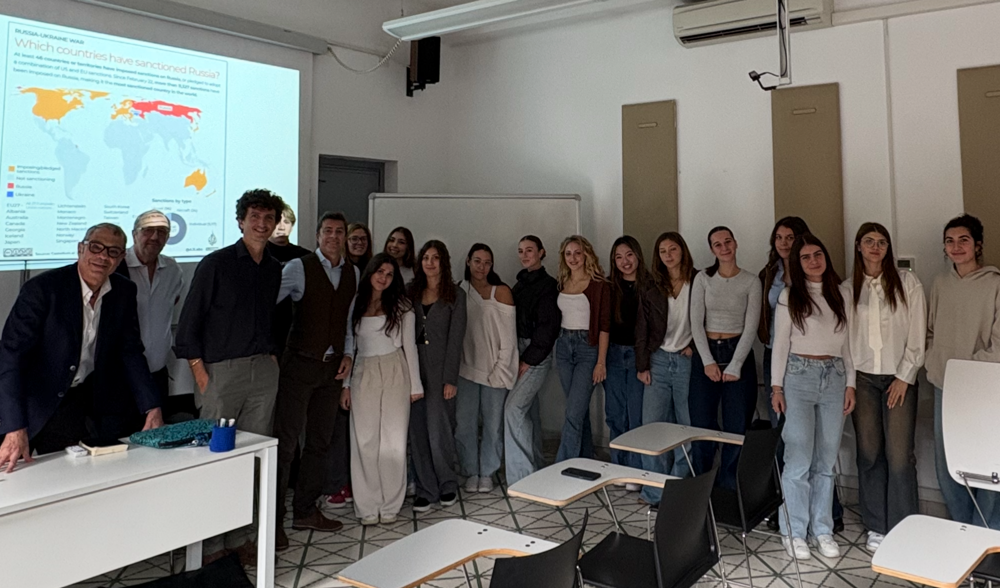
On November 18, 2025, thanks to Professor Sergio Scicchitano, John Cabot University had the pleasure of hosting a microeconomics seminar led by physicist Francesco Sylos Labini and political economist Matteo Caravani. The event centered on their book Conflict, Climate, and Inequalities: Convergence to a World Crisis, and offered students a comprehensive overview of various global challenges shaping the 21st century.
A Convergence of Crises
The discussion opened with the speakers emphasizing the central thesis of their book: today’s world is not facing isolated problems, but a convergence of interconnected crises. Geopolitical tensions, climate breakdown, media fragmentation, and structural inequalities reinforce one another, creating a rapidly evolving global landscape.
A major focus of the seminar was the alarming escalation of global inequalities, which the authors describe as a defining feature of modern “turbo-capitalism.” They emphasized that the widening gap between the ultra-rich and the rest of the world not only distorts democratic structures but also fuels environmental degradation. Those with the greatest wealth, they noted, are responsible for a disproportionate share of greenhouse gas emissions, which accelerates climate change while perpetuating exploitation in the Global South. One of their case studies was Apple, whose market value is comparable to the entire GDP of a major economy such as France, a striking example of the scale of inequality in today’s economic system.
The End of the Unipolar World
Labini and Caravani began by examining the erosion of the unipolar world order that followed the collapse of the Soviet Union. They highlighted how recent geopolitical tensions, from the war in Ukraine to shifting alliances in the Middle East, reflect a broader crisis in global hegemony. According to their analysis, the United States is facing economic stagnation, political polarization, and declining international legitimacy, while emerging powers challenge the traditional Western-led order.
China’s rapid economic and technological ascent, they explained, is central to this shift. Its expanding influence across Asia, Africa, and Latin America has redefined global trade dynamics and complicated the strategic calculations of Western powers, contributing to an increasingly multipolar international system.
Sylos Labini and Caravani explained how China’s growth signals the end of the US-led unipolar world order, contributing to a more complex and competitive geopolitical landscape. They stressed that understanding China’s trajectory is essential to interpreting today’s shifting alliances, hypothesizing a shift of resource dependence from the EU and the US to the EU and China.
Climate Change
The seminar then turned to the intensifying climate crisis, which the authors identify as the most urgent challenge of our time. Drawing on scientific evidence and long-term data, Sylos Labini and Caravani explained that the planet has already surpassed the Paris Agreement goal of a 1.5°C threshold to limit global warming, entering what they describe as “unexplored territory.”
They highlighted the disproportionate impact of the climate emergency on vulnerable populations, particularly in the Global South, where heatwaves, droughts, and environmental degradation threaten livelihoods and food security. Meanwhile, the world’s wealthiest individuals and nations continue to produce most greenhouse gas emissions, creating a stark injustice at the center of the climate debate.
The Explosion of Inequalities
The authors also underscored how inequality is directly linked to climate breakdown: those who benefit most from the current economic system are also those creating the most environmental damage, while poorer communities suffer the consequences.
Indeed, the core theme of the seminar was the dramatic rise in economic and social inequalities. They noted that today’s “turbo-capitalism” is dominated by massive oligopolies whose influence extends into media, politics, and technological infrastructures. This concentration of power has weakened democratic institutions and eroded social cohesion, contributing to political instability and the rise of extremist movements. Sylos Labini and Caravani explained how neoliberal policies, financialization, and the consolidation of corporate power have produced an unprecedented concentration of wealth.
The Illusion of Merit
The seminar also incorporated a critique of meritocracy, supported by data drawing on empirical examples: 90% of people born poor die poor, regardless of ability or effort, and 90% of those born rich die rich, regardless of their competence.
These statistics — paired with economist Joseph Stiglitz’s critique of inequality — illustrate the authors’ argument that “merit” in modern capitalist societies is largely an illusion. Structural barriers, unequal starting points, and concentrated capital make social mobility extremely limited.
In concluding the seminar, the speakers invited students to cultivate critical thinking and historical awareness, reminding them that understanding the roots of these crises is essential for imagining alternative futures. Events like this seminar represent valuable opportunities for students to engage with real-world challenges and to reflect on the responsibilities of future economists, policymakers, and global citizens.