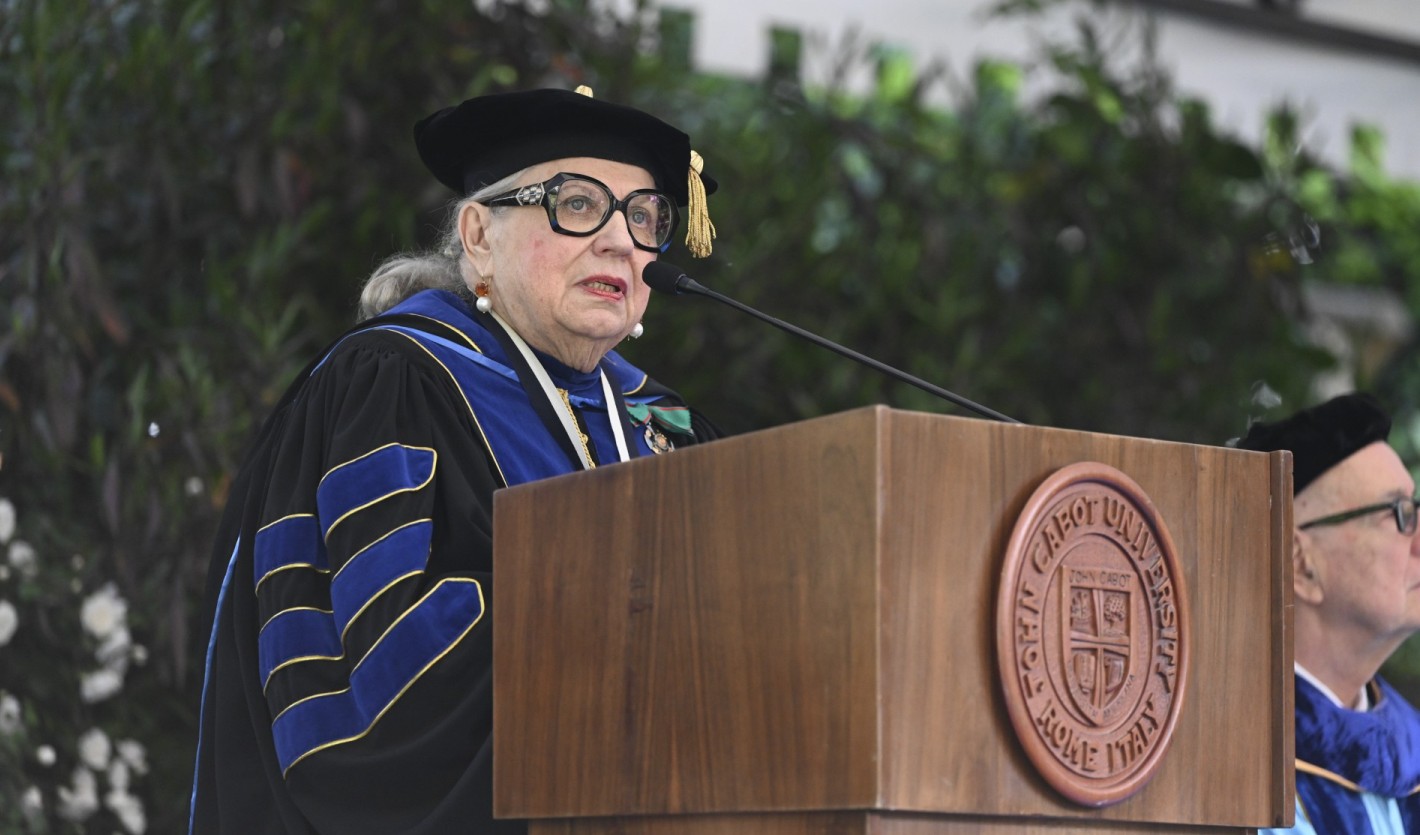
On November 18, 2025, JCU's Department of History and Humanities welcomed Francesca Sunseri (University of Palermo) for a lecture on French philosopher Gilbert Simondon (1924-1989). Sunseri offered a reconstruction of Simondon’s thought, framing him not merely as a philosopher of technology but as a thinker whose ultimate project was the renewal of humanism in a technical age. Simondon’s work — especially Du mode d’existence des objets techniques (On the Mode of Existence of Technical Objects, 1958) — proposes a new way of understanding technical objects and their place in human life.
Sunseri’s central claim is that Simondon provides the conceptual resources for imagining a new technological humanism, one in which technology is not an adversary to culture but an integral dimension of human evolution.
Overcoming the Artificial Boundary
Sunseri began by challenging a common reduction of Simondon to a theorist of machines. Although On the Mode of Existence of Technical Objects is his best-known work, Simondon’s concerns are far broader in scope. His aim, Sunseri argued, was to understand the relationships that constitute human existence. These include relationships to the environment, technical objects, and other human beings. Culture, in Simondon’s view, has historically positioned itself as a defense system against technology, creating an artificial boundary between human and technical. For Simondon, overcoming this boundary is the necessary starting point for any renewed humanism.
In On the Mode of Existence of Technical Objects, Simondon maintained that technical objects should not be understood purely through the lens of utility or labor. Rather than seeing technology as an instrument subordinated to work, he treats it as a creative mode of relating to the world. Sunseri emphasized Simondon’s rejection of both vitalism and mechanistic reductionism, presenting his thought as an attempt to rediscover a deeper relational continuity between humans and the technical milieu.
Encyclopedism as a Form of Humanism
A particularly compelling part of the talk concerned Simondon’s reflections on encyclopedism. Sunseri stressed Simondon’s provocative idea that every encyclopedia is a form of humanism: each historical attempt to catalogue knowledge reflects an attempt to articulate what counts as human freedom. But Simondon believed that modern encyclopedism remained incomplete because it severed the connection between technology and culture. The task today, Sunseri argued, is to discover a third stage of encyclopedic thinking – one that integrates technicity on its own terms rather than as a subordinate practice.
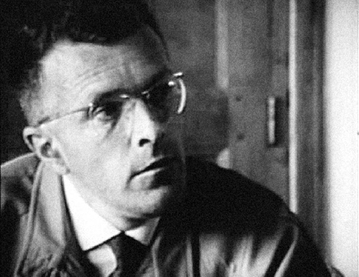
Gilbert Simondon
This integration becomes possible, Sunseri suggested, through Simondon’s notion of the “magical network.” Here Simondon describes a “mode of being” in which subjectivity and objectivity are not fully separated but form a fluid, relational field. Drawing on anthropological examples of nomadic and sedentary societies, he shows how pre-sedentary humans experienced the world through mutually-shaping relations rather than through an attitude of domination. Sedentary life then brought about the construction of fixed “magical points,” such as temples or towers, that initiated the later separation of religion (subjectivity) and technology (objectivity). Sunseri used this historical analysis to articulate Simondon’s hope for a re-enchantment of the world: a rephasing of subject and object, not through regression to the past but through renewed attention to the relational nature of technical existence.
Simonson vs. Anzaldúa: Trans-individuality and Technical Knowledge
Sunseri then proposed a comparative insight, bringing Simondon into dialogue with sociologist Gloria Anzaldúa's Light in the Dark. Like Simondon, Anzaldúa describes a form of knowledge grounded in sensitivity, interconnection, and the refusal of a rigidly rationalist worldview. Sunseri highlighted how both thinkers revalue practices that involve sensing, feeling, and relating as a countermovement towards modernity’s insistence on mastery and control. This connection also illuminated Simondon’s notions of trans-individuality: individuals are never isolated units but crystallizations of collective processes. Technical objects also participate in these processes, as they are less instruments of domination than nodes within networks of relations.
Sunseri also drew attention to the educational implications of Simondon’s work. As a philosophy teacher who also taught physics, Simondon believed that students must encounter technical objects not merely as theoretical constructs but as concrete realities. Technical knowledge should be experimental, material, and participatory. Sunseri suggested that this pedagogical insight points toward a political critique: the division of knowledge into isolated scientific and humanistic spheres risks producing corresponding social divisions. A renewed humanism would require not only a conceptual reform but an institutional one, to ensure that technical culture is not alienated from those who inhabit it.
Simondon’s Impact Today: Techno-Human Literacy
In her concluding remarks, Sunseri extended Simondon’s thought to contemporary digital technologies, including tools like ChatGPT. She argued that engaging with such technologies critically and creatively, rather than passively, cultivates precisely the relational and reflective capacities Simondon envisioned. By encouraging students to analyze, supplement, and critically engage with machine-generated texts, educators can foster techno-human literacy and reassert the participatory nature of technical culture.
In an age marked by the dominance of human attempts to control nature through technology, Sunseri’s interpretation of Simondon invites us to imagine another path: not the abandonment of technology, but a renewed attunement to its capacity to connect, transform, and enrich human life.
Francesca Sunseri is a researcher at the University of Palermo. She received her PhD in Humanities in 2024. She now directs the Philosophy of Technology section of the journal Epekeina. International Journal of Ontology. History and Critics and is a member of the board of the CCCC (Cybernetics, Catastrophe, Complexity, Chaos) collective. Her research focuses on contemporary French philosophy, with a focus on the relationship between humans and technology.