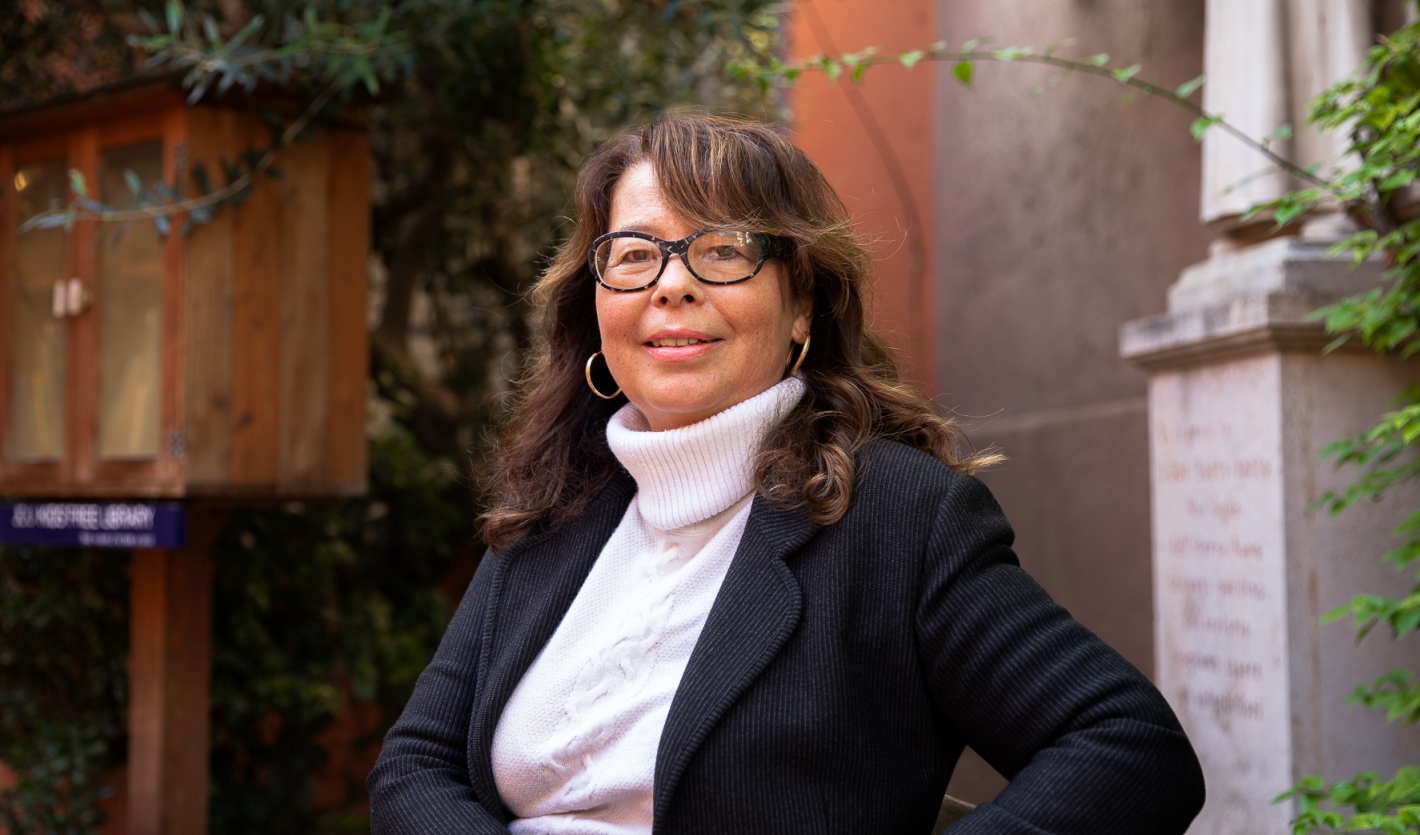
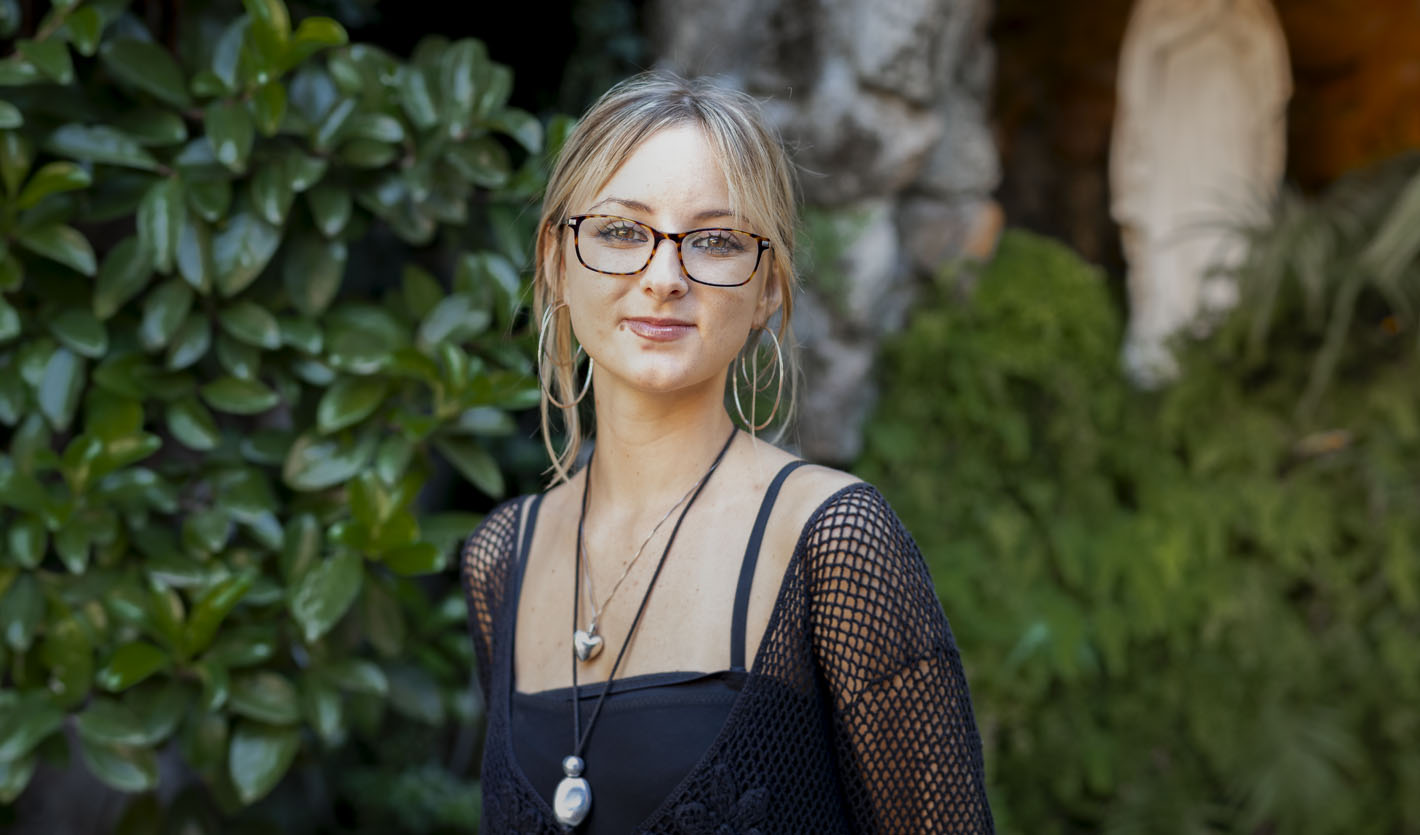
Professor Anna Tuck-Scala, who has taught at JCU since 2008, grew up in the town of Port Angeles, Washington. She has a long, intimate history with Italy, having dedicated the last 30 years to teaching art history in Rome. She is the author of a monograph on the Neapolitan artist Andrea Vaccaro and has studied Caravaggio’s impact on the city of Naples.
What brought you to Rome and JCU? How did you find your passion for art history?
Ever since I was a child, I have enjoyed traveling, reading, writing, and making art. After high school, I thought about attending an art school, but my parents encouraged me instead to get a liberal arts education. I wanted to expand my horizons by living on the East Coast and wound up choosing Cornell University. During my time at Cornell, I had a work-study job as an office assistant in the Plant Pathology Department in the College of Agriculture and Life Sciences. There, I met an Italian scientist from Naples who was doing research and would eventually become my husband. After he returned home, I visited him multiple times and traveled throughout Italy. Experiencing art firsthand, especially in undiscovered Naples, ignited my interest and curiosity. I then studied abroad in Rome and decided to major in art history at Cornell. A course on European seventeenth-century painting taught by Professor Sheila McTighe introduced me to Caravaggio. Upon graduation, she encouraged me to pursue Caravaggio and his impact on painting in Naples.
After finishing my BA at Cornell, I moved to Italy and taught English at the University of Naples but realized after several years that I wanted to continue studying art history. I returned to the USA to pursue my MA and PhD at The Pennsylvania State University, which offered a wide array of courses on Italian Renaissance and Baroque art. I wrote my doctoral dissertation on Andrea Vaccaro, a follower of Caravaggio and a leading Neapolitan painter around 1660. Afterwards, I moved back to Naples, where I heard about an opportunity to give art history lectures and tours at Saint Mary’s College Rome Program. It became my first job teaching art history in Italy. I have been teaching in Rome for over 30 years: I joined the faculty at Temple University Rome in 1999, and John Cabot University in 2008.
What is your teaching philosophy? What do you wish for your students to take away from your classes?
I have taught a wide range of art history courses from ancient to Renaissance and Baroque art. I am an eternal student with an insatiable curiosity: I continue to learn along with my students, as I investigate different topics that enrich my knowledge and challenge my perspective. The exhilaration of looking at original works of art with students and thinking deeply about them out loud has always been the focus of my teaching.
The city of Rome offers precious opportunities not only to see art firsthand, but also in situ, meaning in its original position, which is fundamental for understanding historical context. Rome is a city with many layers. By learning on-site, my students can make tangible connections on the spot to other periods, as well as to what is happening in society today. For example, this year the Jubilee has drawn many pilgrims and tourists to Rome. We can understand this phenomenon in its historical context when we study Renaissance art and the changes made by Pope Sixtus IV for the Jubilee of 1475. At the entrance to Rome, he rebuilt the Basilica of Santa Maria del Popolo, which houses a miraculous icon of Mary believed to protect the city from the plague. He built the Ponte Sisto bridge to facilitate the mass arrival of pilgrims, who had to cross the Tiber River to reach the Vatican. Studying art history should not be limited to slide lectures in a classroom. In Rome, it becomes an immersive experience, training students to be fully present, to look closely at where they are, ask questions, seek answers, and make connections between past and present. I wish for my students to become art lovers and lifelong learners, engaging directly with art and life.
You are an expert on Baroque: among the major art styles, Baroque can often feel more elaborate, historically distant, and intellectually demanding, which may make it seem less accessible to modern audiences. What aspect of Baroque is most misunderstood today? What can be done to demystify it and help it find a larger audience?
For starters, the label “Baroque” is problematic. For the visual arts in Rome, “Baroque” has primarily been associated with the Counter-Reformation in the seventeenth century, and the Church’s reaffirmation of Catholic dogma in response to Protestant challenges. A dramatic, ornate, exuberant style emerged in the works of Bernini, Borromini and Pietro da Cortona under the papacy of Urban VIII Barberini (1623-1644). Although the style itself may seem overly elaborate, theatrical, and historically distant, crowds of people today, many of whom are not religious, seek out Rome’s Baroque monuments in the historic center: Piazza Navona, Piazza del Popolo, Saint Peter’s Square, the Borghese Gallery, Piazza di Spagna, and the Trevi Fountain, among others. What hasn’t changed is people’s search for meraviglia (wonder or astonishment). Baroque artists invented techniques to influence audiences by evoking strong emotional and intellectual responses. For example, illusionistic ceiling frescoes open up Jesuit churches to heaven for believers. Bernini sculpts in such a way as to bring cold marble to life, proving his artistic mastery: Pluto looks like he is actually digging his fingers into Persephone’s soft thigh in his famous statue in the Borghese Gallery. Borromini’s San Carlo alle Quattro Fontane church, the cradle of Baroque architecture, with its undulating interior, seems to pulsate rhythmically with life and movement. We are astonished by how baroque art imitates appearances and creates otherworldly visions. At the same time, upon closer inspection, we perceive the deception and unmask it. We learn not to believe everything we see. We learn the importance of looking with critical thinking. We appreciate artifice without being “duped.” This skill is extremely valuable today in the age of digital media.
What is your favorite artist or work of art and why?
It’s difficult to pick a favorite artist or work of art, but I keep returning to Caravaggio’s Seven Acts of Mercy (1606-07) on the high altar of the Pio Monte della Misericordia in Naples. I worked on it for my MA thesis, and it was the subject of my first publication in 1993. I enjoy stepping into the quiet church from the narrow, crowded, chaotic, dark street, as if I were actually entering the painting. The distance between past and present becomes blurred. In this dramatic painting, I contemplate different acts of charity mentioned in the Gospel of Matthew, which are performed in palpable ways. Although the painting is dedicated to the Madonna of Mercy, Caravaggio shows how the people themselves save each other from suffering. He draws on examples from the Old Testament, the ancient Roman writer Valerius Maximus, and the life of Saint Martin of Tours. This painting is full of empathy, solidarity, and humanity.
What are your current projects?
For the past few years, I have been focusing on teaching. My son recently turned 21, and I have become keenly aware of the impact teachers can have on students finding their direction during these difficult times. I am preparing articles on new paintings and documents related to Andrea Vaccaro to add to my monograph, Andrea Vaccaro (Naples, 1604-1670): His Documented Life and Art (Paparo Edizioni, 2012). I am also working on three books, which connect deeply to my experiences teaching art history.