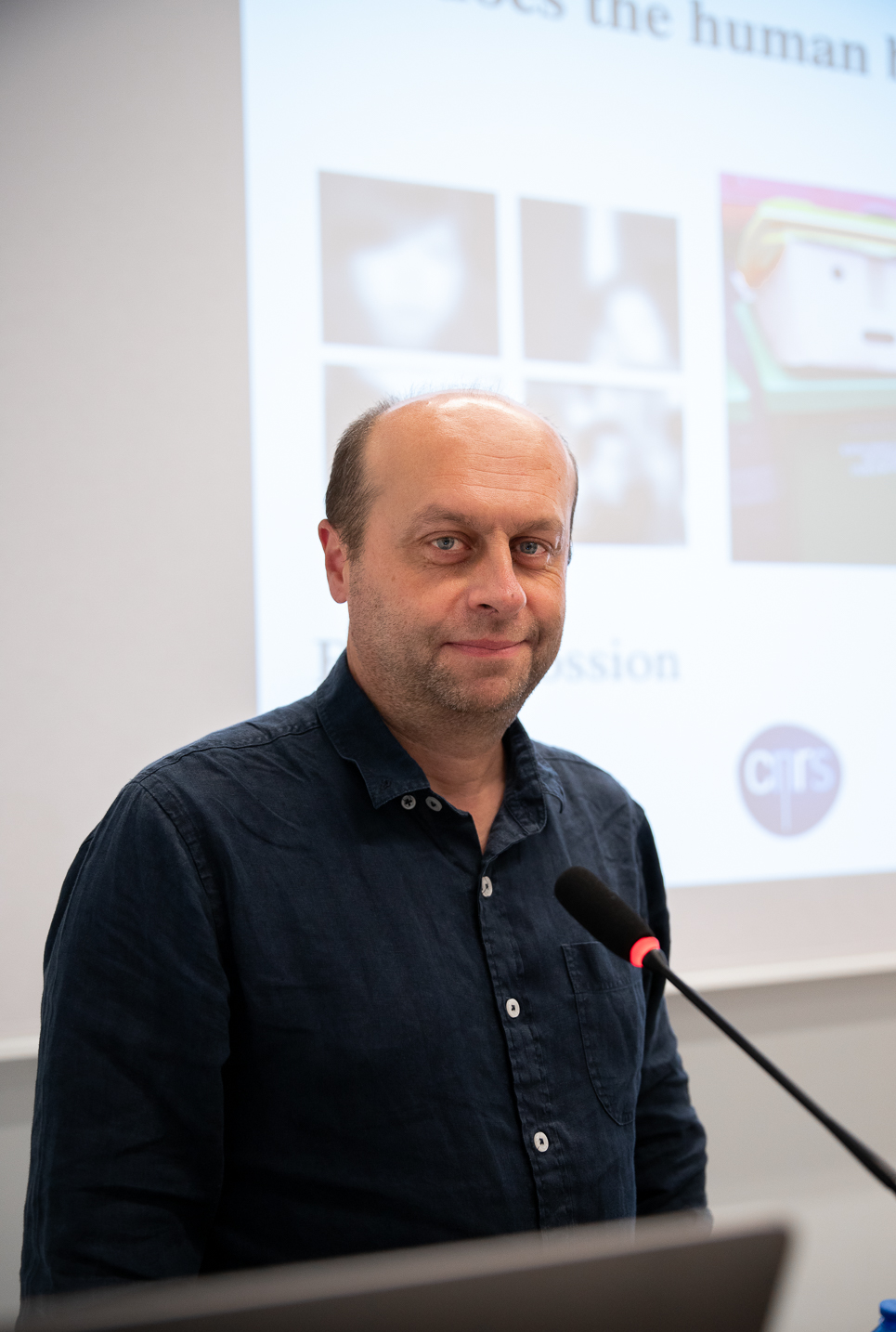
On October 30, 2025, the JCU Department of Psychological and Social Sciences hosted Professor Bruno Rossion from the University of Lorraine for his lecture titled “How does the human brain recognize faces?” Professor Bruno Rossion’s research focuses on examining how the human brain categorizes objects in the visual world. His main interest is the brain’s visual recognition of faces. During his lecture, he gave insights into how the brain is able to recognize faces and remember identities.
Bruno Rossion
Rossion began the lecture by introducing the theory behind generic face recognition, which is the ability to distinguish faces, regardless of differences in expression, orientation, or identity.
Memory as the Foundation of Perception
Rossion contested the traditional perception-memory model, which states that perception happens first and memory association comes later. He argued that perception itself depends on memory. He used the example of black-and-white “blob” images to illustrate how they are perceived as faces only when prior memories of faces are activated. Therefore, perception is a conscious and memory-driven act.
Between the age of four to six months, infants develop generic facial recognition. Rossion highlighted that sensations, especially exposure to the mother’s face, smell, and voice, build multimodal memory, which is the ability to store and retrieve information from sensory inputs and combine them into a single memory. This suggests that face recognition develops from early integration of multisensory memory.
The Uniqueness of Human Facial Recognition
Rossion discussed how recognizing a face is simpler than recognizing the identity of the face. He explained how in one study it was concluded that undergraduate college students can recognize about 5,000 faces. As humans, we see new faces every day and identities can change over time, so we are consistently forgetting old faces and learning new ones. Therefore, Rossion explained, face identity recognition is one of the brain’s most advanced recognition functions.
He continued with the discussion of the difference between the human brain and animals’ brains, utilizing a study done on macaque monkeys. The study found that macaques have face-selective neurons but are unable to recognize individual faces. While humans see faces in clouds and objects, macaques and chimpanzees do not. Rossion explained that this is due to humans having a fusiform gyrus (the part of the brain responsible for processing visual information), as well as a much larger temporal lobe and association cortex, allowing for more flexible interpretations.
Rossion concluded by summarizing that facial recognition is not a simple visual process. It is a memory-based action that depends on previous experiences. Perception arises when sensory input matches stored face memories. Although it is still unknown how the human brain processes face identity recognition, Rossion is hoping to crack the code with his collaborators in future research.