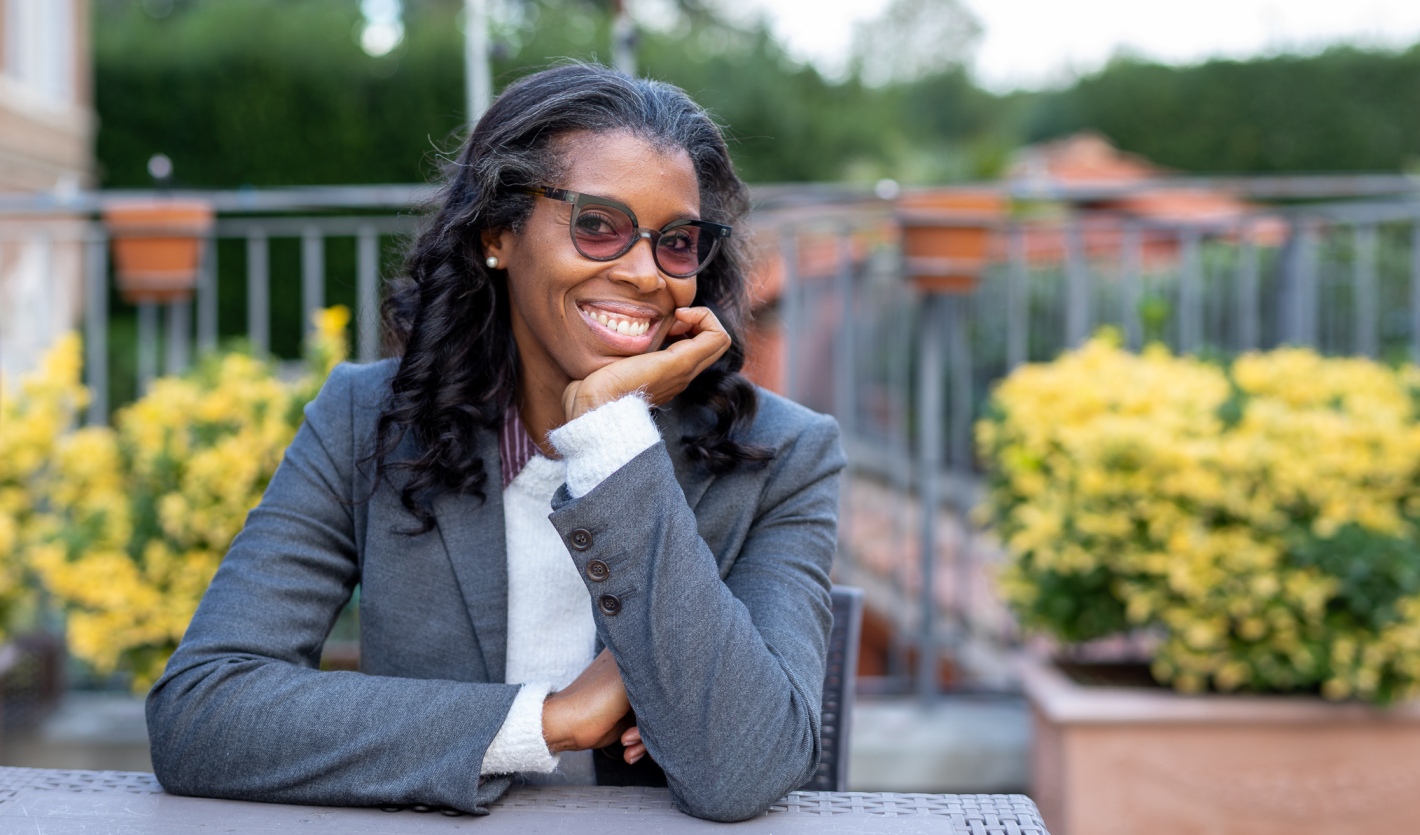
Professor Theresa Lindo joined John Cabot University in 2021. Originally from the British West Indies, she grew up in the United States. She is a faculty member in the Department of English Language and Literature and the Department of Business Administration where she teaches a range of composition and business communication courses.
Tell us about your background and how you ended up in Rome.
I completed my undergraduate studies at Boston University. After graduation, I worked in communications, marketing, advertising, and public relations. I learned a great deal from working with clients from different industries.
Later, I went to graduate school at George Washington University in Washington, DC, where I completed a dual degree program in international affairs with a concentration on the Western Hemisphere and an MBA in international business with a concentration in marketing. My career goal was to become head of marketing or executive vice president of marketing and communications for a private-sector company.
However, while I was in Washington, DC, I gained a new perspective on professional opportunities in government. One day, I entered the wrong conference room at my university and accidentally ended up at a career fair where I met a recruiter from the US Department of Commerce working in the International Trade Administration office. I still remember the thrill I felt when she explained that her office helped US companies internationalize their businesses. It seemed like a perfect role for me. I was invited for an interview, and just two days later, I was hired as an International Trade Officer.
I had been working at the US Department of Commerce for a few years when a friend told me about the Foreign Service Officer Test (FSOT), a two-part written and oral examination required to become a diplomat. It consists of a full day of written and a full day of oral exercises, including two long-form essays. At the time, I was in the middle of my graduate studies studying all the subjects that happened to be on the exam, I was working full time for the US government in international trade, and I had done technical writing for my entire career. As a result of this fortuitous combination of factors, I was one of the 200 out of 20,000 people who passed the test that year. I don't think I would have passed it at any other time in my life.
I worked in the Foreign Service for a few years, and that’s where I met my Italian partner. For family reasons, we moved to Italy, and I've been living here for the past 18 years.
After the move, I first worked at UniCredit Bank, where I was the head of marketing communications for one of their units. I had been working at the bank and then one of their subsidiaries for nine years when I got an email saying, "We're looking for a composition professor.” I had never taken a composition class, and I didn’t know it was a subject you could study in college. But I sent in my resume, and soon after, I started teaching.
I never thought that after the burnout of the dual degree program I would ever set foot in a classroom again, so I was surprised that I enjoyed teaching. Eventually I left the subsidiary and started teaching full time. I came to JCU a few years later.
What is your teaching approach?
I always explain to students that I don't come from an academic background but from field experience. I am teaching what I have experienced first-hand through many trials and even more errors. Every time I introduce any theory, I try to show how I and others use it both within and outside of academia.
Composition can be a difficult topic. To show students that writing is not supposed to be easy, I like to use a simple example of composing a text message to a potential romantic interest. It takes us 10-15 minutes to compose a five-line text message. Just the greeting takes us five minutes. Should we start with “Dear John” or “Hey John”? What should we write now? Should we remind them of who we are? Do we want to invite them out to dinner? By the time we're done, the students are in stitches, laughing, and they realize that if you care enough, writing is not easy, but it is going to be worth it.
In all my classes, I teach that regardless of how brilliant your idea is, if you're unable to communicate it clearly, verbally and in written format, it will die a slow and painful death because no one will be able to comprehend and support it. I tell my students that oral delivery is not just providing information, it’s like being on stage in front of an important audience. They have to make some sort of connection on a human level that allows the audience to feel invested in the topic. And then I make them practice and practice and practice.
How has your teaching changed in the age of AI?
There's a lot of handwriting in my students' lives now. In my composition class, I compare AI to the calculator – none of us would put a calculator in the hands of a first grader; first they have to learn how to do math. Composition students don’t use AI in the course to generate text because they need to learn how to write first. Also, I don't assign compositions to do at home anymore. Often, I will say to the students, "I know you think this is unfair that you're handwriting now. To keep you company, I will also write an essay today.” I show them the result afterwards, including the errors that I made, the edits, and the process.
On the other hand, in my business courses, I tell students that they absolutely need to know how to use AI because all their colleagues and companies will be using it. I came across research from a couple of years ago that showed that 65% of global companies are favoring new hires who know how to use AI effectively. That figure has probably increased since. I not only allow my business students to use AI, but I direct them towards certain platforms and tools that I know they can use for research. I caution them not to over-rely on AI and to use it intelligently.
What do you think makes liberal arts education valuable for students?
Liberal arts education teaches students critical thinking. The concept of liberal arts dates to a period when there were seven main subjects, and it was based on the idea that if you learned these seven subjects, you would be prepared to succeed in life. Three of the seven subjects are what I cover in composition: rhetoric, logic, and grammar. The other four are science, technology, engineering, and mathematics (STEM). At JCU, students have the privilege of studying a vast array of subjects that may or may not have a direct relation to their major. That’s the beauty of liberal arts. After graduating from a liberal arts institution, students can think in multiple directions and put together ideas in a way that they may not otherwise have been able to do.
The best classes I have are the ones where these connections happen. In Marketing, my students bring up a concept they learned in global studies; in Composition, students bring up something they learned in Philosophy class; in the International Business course, they can relate back to something they read in their Creative Writing course. Those are among my happiest moments while teaching.