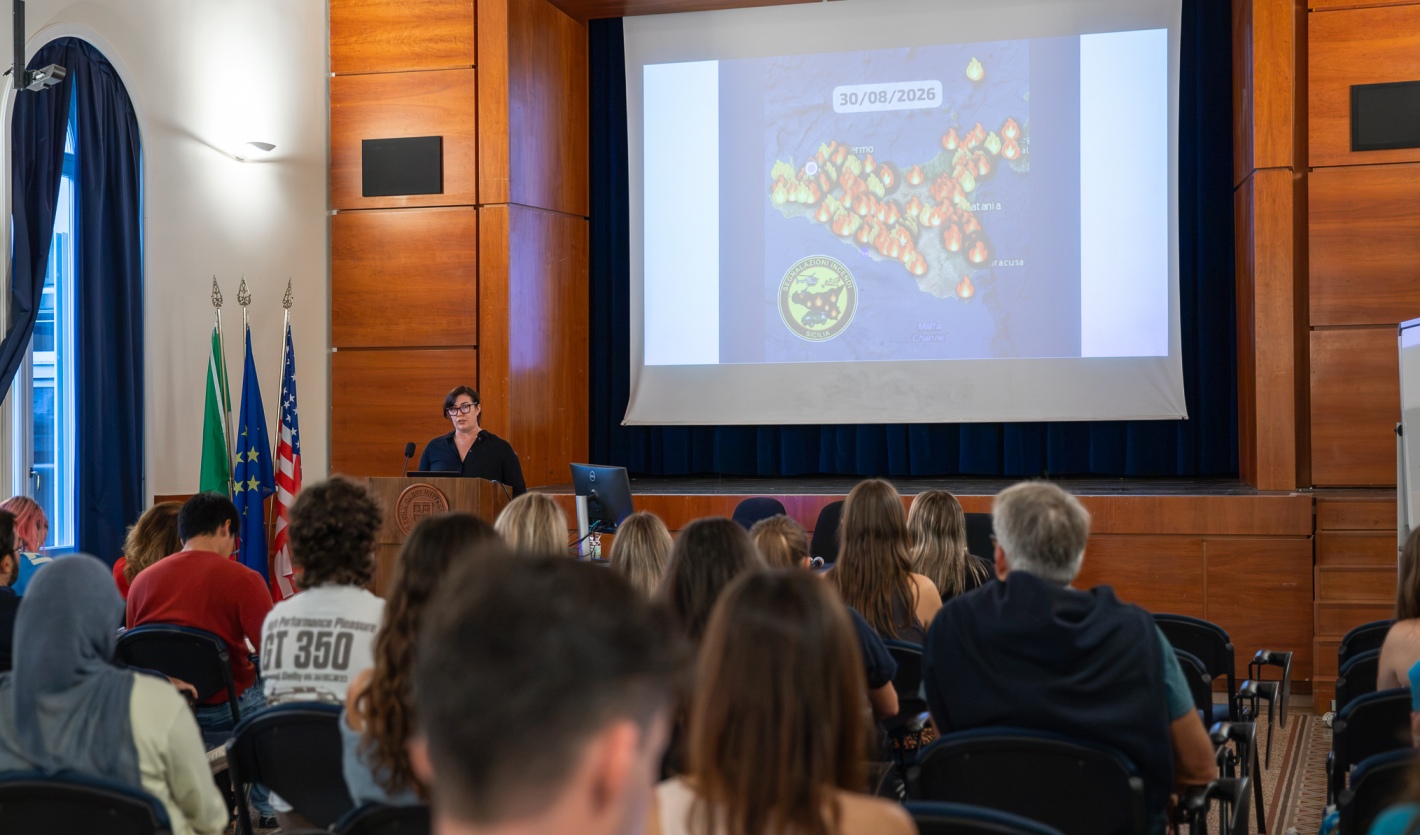
On October 19, 2026, John Cabot University welcomed Lauren Pearson, a Geography PhD candidate at the University of California, Berkeley, for a lecture on how mafia groups are socially and spatially reproducing themselves through intentional fire-setting activities throughout Sicily today. The event was sponsored by JCU’s Department of Psychological and Social Sciences.
In the last decade, the hot, dry Scirocco winds from the Sahara Desert have been causing extreme summer heatwaves across the Mediterranean, especially in Sicily. Across the island, incendio doloso (intentional setting of wildfires) has evolved from sporadic localized acts into what experts view as an organized strategy for territorial dominance. By analyzing the 2021 and 2023 wildfire seasons in Sicily, Lauren Pearson’s research proposes that the Sicilian Mafia, known as Cosa Nostra, is using both rural and urban space in ways that reflect a transformation in its organizational structure.
Fire as an Instrument of Power
In her presentation at JCU, Pearson explained how criminal organizations in Southern Italy are reshaping the physical and social landscape through fire. Historically, intentionally set fires in Southern Italy were associated with localized land disputes, vendettas, or agricultural clearing. Today, civil authorities and environmental organizations increasingly view them as an organized tactic. “Burning is an expression of power, meaning that arson is done for people to see,” explained Pearson. “Fires are set to remind people that someone is in charge. Similar to terrorist strategies, they create an atmosphere of fear and terror.”
Pearson’s research draws on police and court records, government reports, interviews, and participant observation, as well as photographic and video documentation. The 2021 fires burned over 78,000 hectares (about 3% of Sicily’s total area) and prompted a 10-month anti-mafia investigation.
Pearson emphasized that the evidence does not establish who set the fires or their precise motives. Such accounts raise questions about the possible connection between fires, land ownership, and territorial control. These “terror tactics” may help enforce control over rural territories. As Claudio Fava, former president of the Sicilian Anti-Mafia Commission, famously remarked in 2021: “In Sicily, fires are used more than bullets.”
From Rural Territories to Urban Landscapes
The 2023 fires also affected Palermo’s outskirts. Palermo’s postwar construction and the “Sacco di Palermo” illustrated how mafia influence has shaped urban space. In the Madonie region of Sicily, field observations examined Forestry Corps outposts, reforestation, fire scars, wind installations, and abandoned land.
Pearson hypothesized that repeated fires could create crisis conditions that attract emergency funding, which may be vulnerable to criminal capture; she described this as a direction for further research, not a proven conclusion.