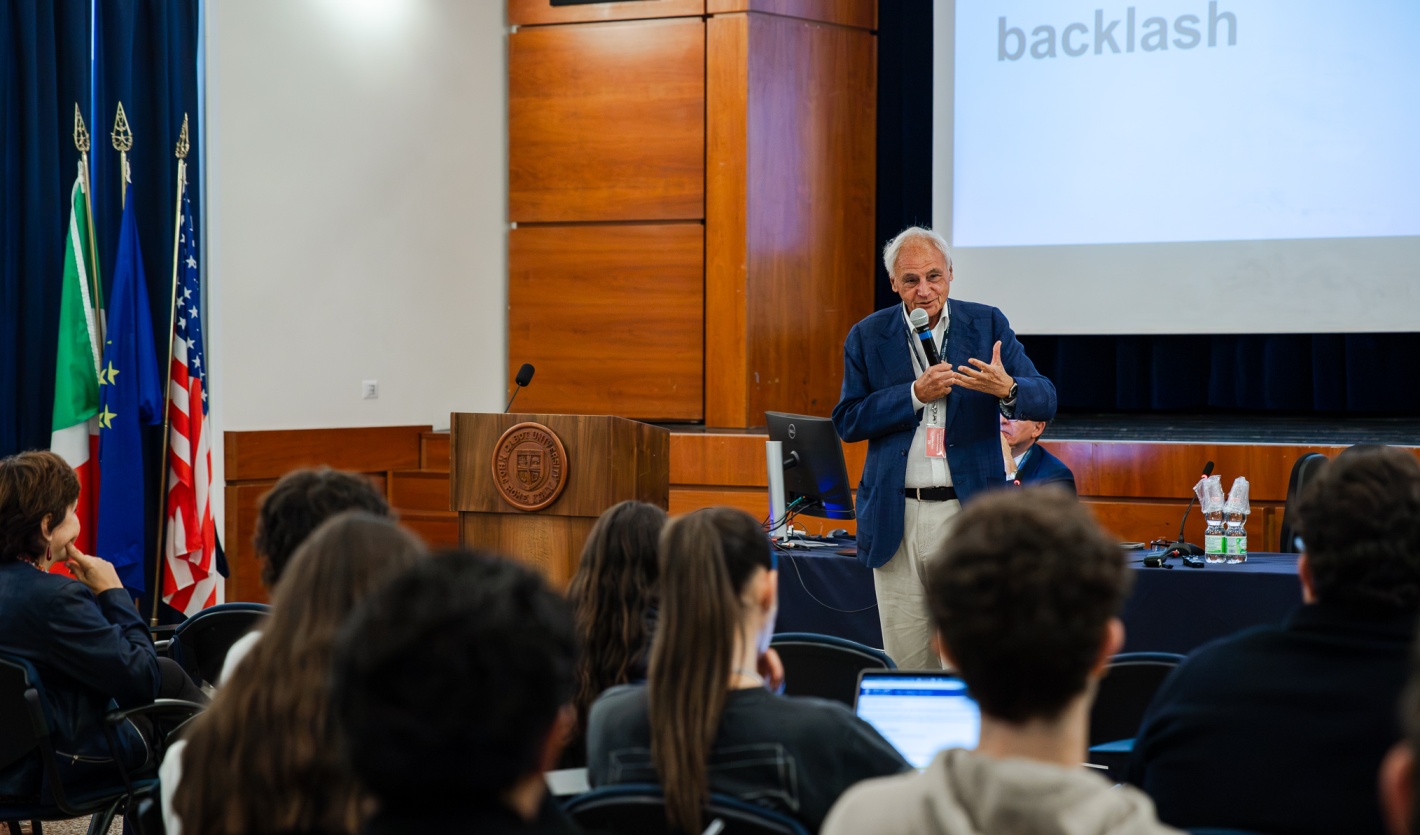
On October 6, 2026, John Cabot University hosted “Woke Capitalism or Neo-Deniers: Who Is Right?”, a discussion on climate change, corporate sustainability, and the role of business in the energy transition. The event was organized by the JCU Entrepreneurship Institute and Center for Career Services, and featured Roger Abravanel, Director Emeritus of McKinsey & Company, and Luca D’Agnese, a senior executive with extensive experience in consulting, energy, and infrastructure. The discussion drew on their recent book, Le grandi ipocrisie sul clima. Contro i burocrati della sostenibilità e i nuovi negazionisti del clima (Solferino, 2024).
Rethinking Corporate Sustainability
D’Agnese and Abravanel challenged students to look beyond the traditional debate between climate activism and climate skepticism. They presented climate change not only as an environmental or ethical issue, but also as a major economic and business challenge. Renewable energy, electric vehicles, battery technology, and new infrastructure are already creating significant opportunities for companies and investors.
D’Agnese and Abravanel introduced a “sustainability triangle” linking society, politics, and business. Meaningful progress depends on these three forces working together rather than becoming divided by broader political and social debates.
Different Paths: The US, Europe, and China
The discussion looked at how sustainability is approached differently in the United States, Europe, and China. In the US, more companies are questioning how far they should go in addressing social and environmental issues, while in Europe, ambitious climate regulation continues to raise concerns about bureaucracy, compliance costs, and competitiveness.
China was presented as an important example of how climate-related investment can also serve economic and strategic goals. Its expansion in renewable energy, electric vehicles, batteries, and electricity infrastructure reflects both the opportunities created by the energy transition and the country's interest in strengthening energy security.
From Decarbonization to Adaptation
D’Agnese and Abravanel also stressed that reducing carbon emissions is only part of the challenge. Even with successful decarbonization, societies will still need to adapt to the effects of a changing climate. Insurance, infrastructure, forecasting, technology, and public-private investment will therefore become increasingly important.
The discussion concluded with a call for a more pragmatic approach to Environmental, social, and governance (ESG). Rather than simply “ticking boxes,” companies should identify the sustainability risks and opportunities that are genuinely relevant to their business. For students entering the workforce, the message was that climate change will increasingly shape business strategy, investment, innovation, and risk management.