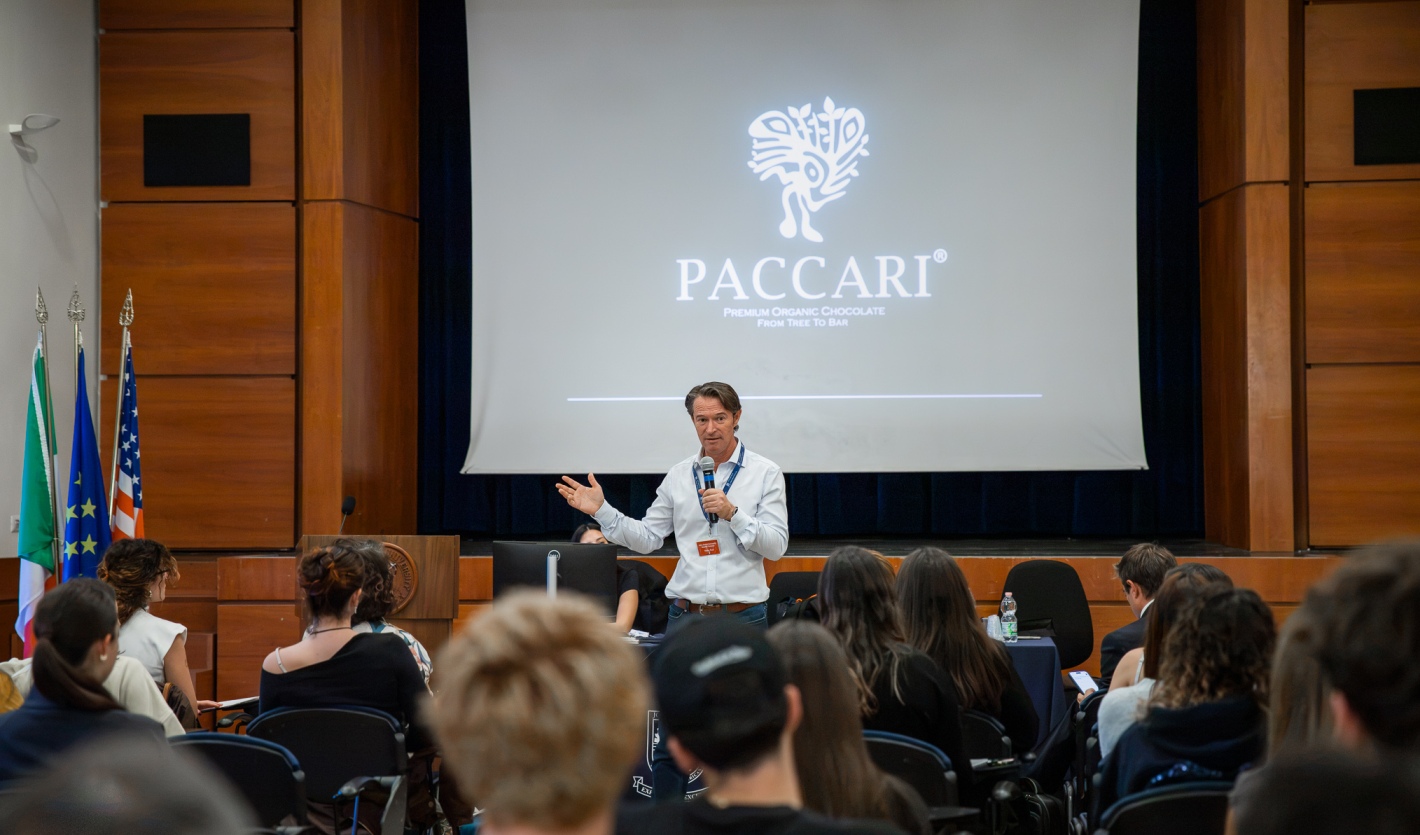
On October 14, 2026, John Cabot University welcomed Santiago Peralta, founder and CEO of Paccari, for a talk on sustainability and entrepreneurship in the chocolate industry. The event was organized by JCU’s Center for Career Services and the Institute for Entrepreneurship.
Paccari means "nature" or "dawn" in the Quechua language reflecting the company’s committment to sustainability. Recognized internationally for its ethical practices, Paccari produces organic chocolate from high-quality fine-flavor cacao using responsible sourcing and production methods. Paccari works directly with farming communities to offer authentic, sustainable, and award-winning chocolate, while respecting both people and the environment.
Community Impact and Ecuadorian Heritage
Paccari was co-founded in 2002 by Santiago Peralta and Carla Barbató, his wife and president of the company, after noticing a gap between the value of Ecuadorian cacao and the wages paid to farmers.
Paccari contributes to the development of farming communities by promoting economic stability, training, and opportunities for growth. The company pays farmers based on production costs rather than commodity-market prices, prioritizing the quality of the cacao beans and the lives of those who cultivate them.
Peralta argued that buyers should consider worker rights, environmental impacts, supply-chain transparency, and company tax practices. He emphasized the importance of stronger relationships between chocolate makers and the people who grow cacao.
By paying fair, above-market prices directly to farmers rather than relying on standard commodity-market prices, Paccari aims to reduce migration and encourage younger generations to remain in farming. Money is channeled directly into the pockets of women in local families, contributing to a 20% increase in children consistently attending school.
Peralta believes that consumer education is needed to build demand for ethical products. For this reason, the presentation also featured a chocolate tasting, during which Peralta himself provided detailed explanations of the different products.Ecuador holds roughly 80% of the world’s cocoa biodiversity and acts as a major genetic bank for fine-flavor cacao. Archaeological findings suggest that human use of cacao in Ecuador dates back more than 5,000 years. Paccari produces single-origin chocolates highlighting different regional terroirs across Ecuador and showcasing distinct flavor profiles, including notes of raspberry, wood, and spice.
Sustainable and Ethical Practices
Paccari is a B-Corp certified, CO2-neutral, organic, and biodynamic company. The company completely avoids chemical inputs, artificial additives, and palm oil to protect consumer health and the environment.
An ethical consumer report shared during the presentation highlighted large mainstream chocolate conglomerates that scored poorly on environmental reporting, worker rights, and tax conduct. Paccari was presented as a leader in ethical business practices. In this context, Peralta criticized large mass-market corporations for engaging in greenwashing, the practice of using sustainability claims for marketing while continuing exploitative sourcing and supply chain practices.
The presentation concluded with a strong call to action for students and consumers: buying a product is equivalent to casting a vote. Consumers have a responsibility to understand where their food comes from, support ethical manufacturers, and reject systems built on exploitation, child labor, and environmental degradation.