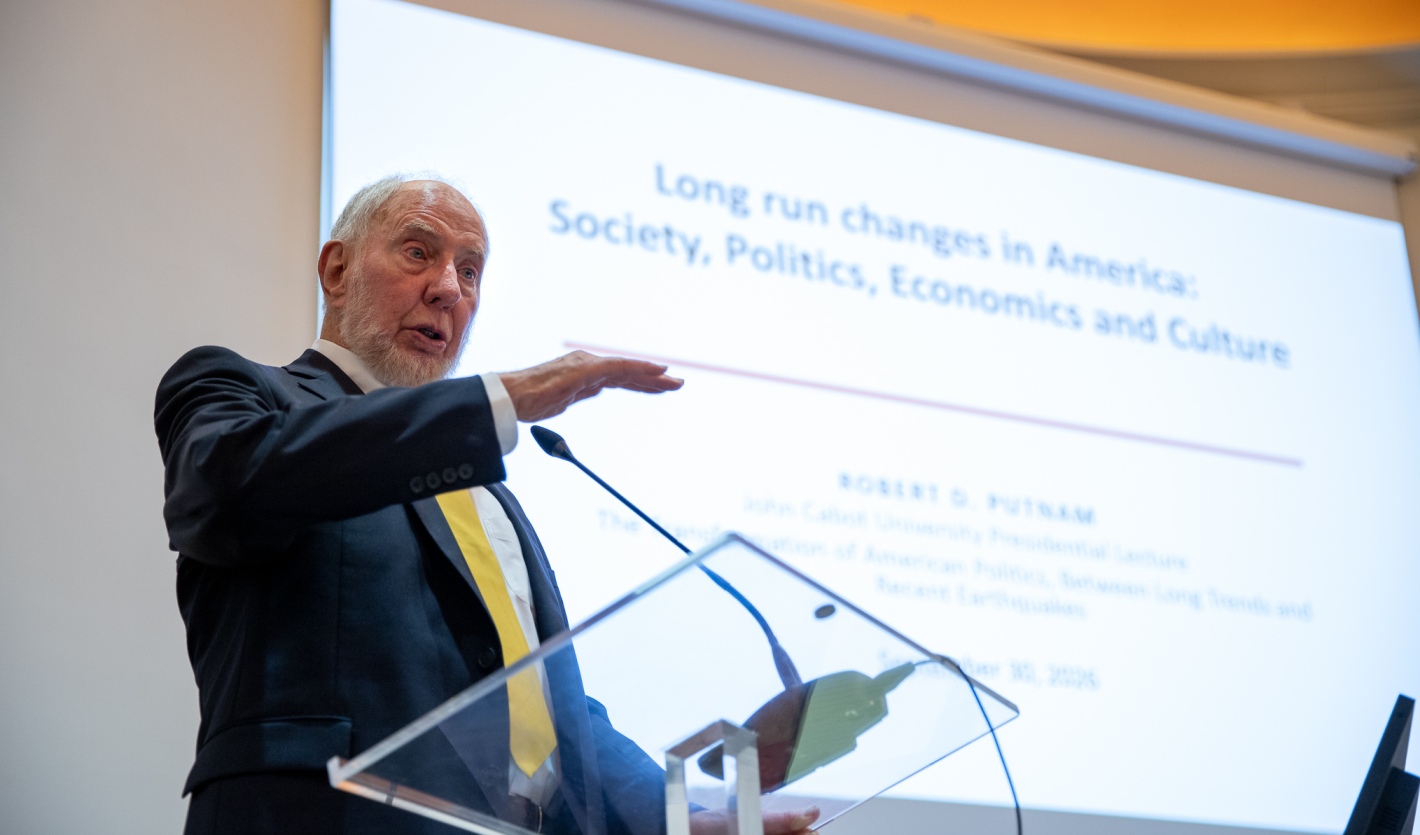
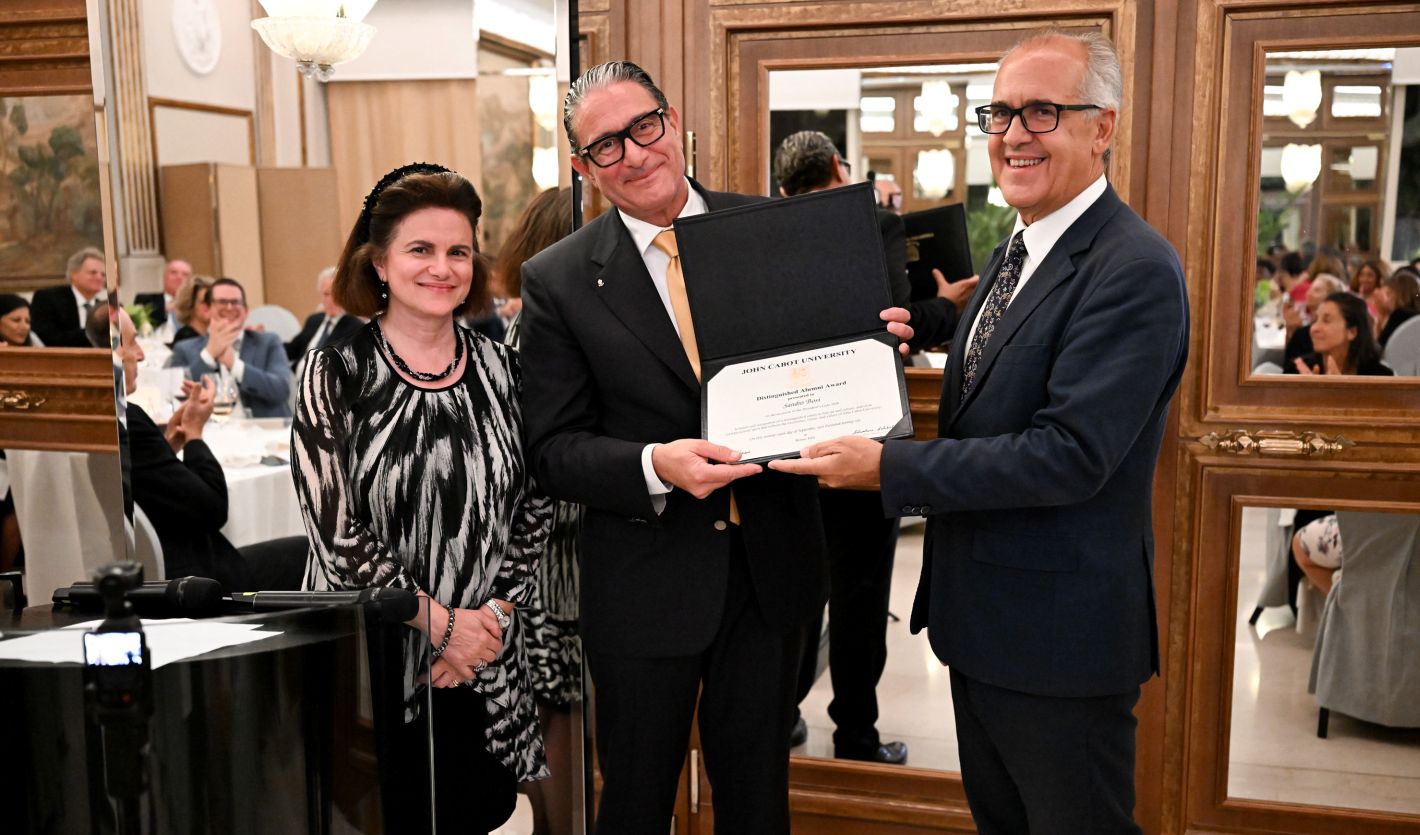
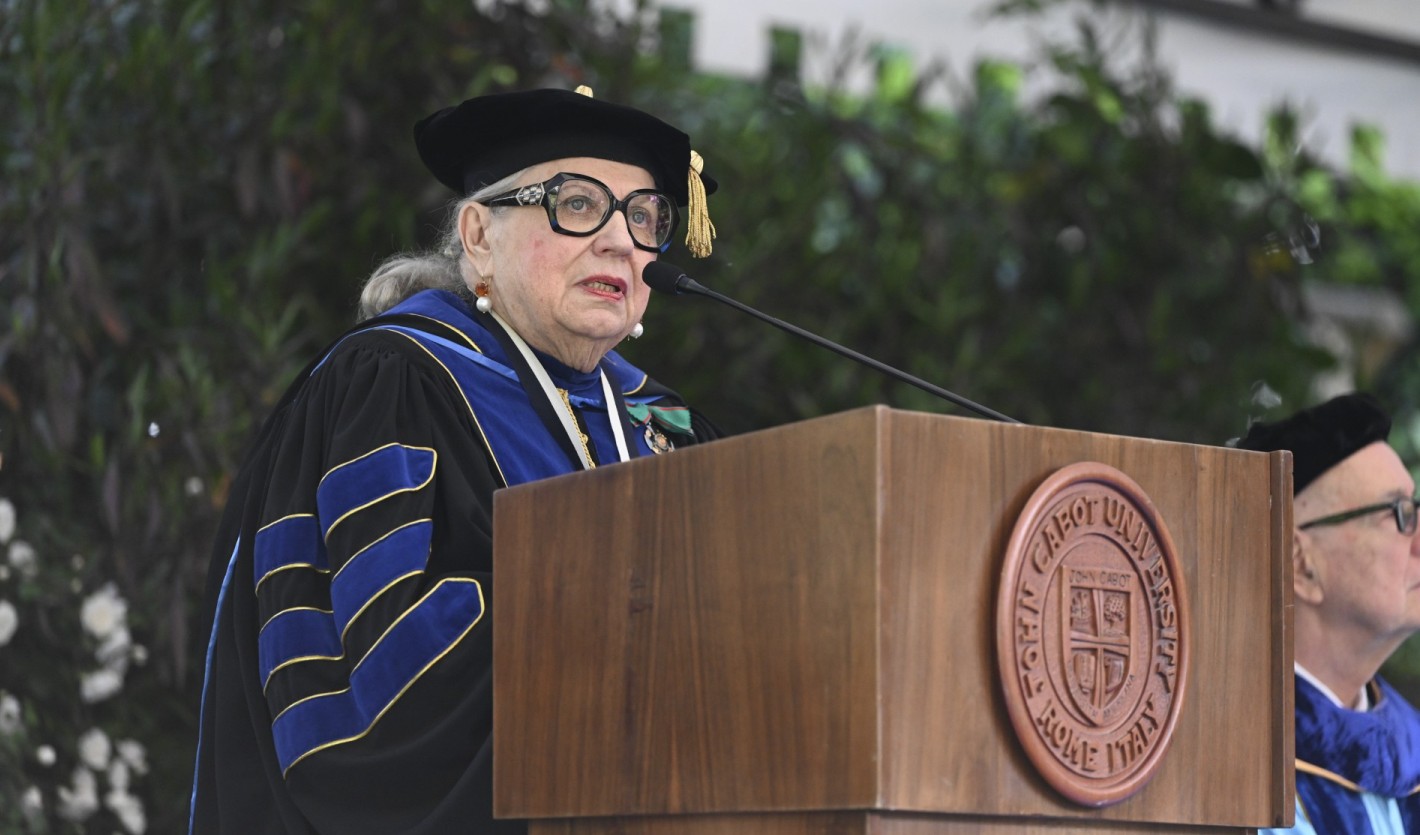
On September 30, 2026, John Cabot University had the honor of welcoming world-renowned political scientist Robert D. Putnam for a Presidential Lecture titled "The Transformation of American Politics, Between Long Trends and Recent Earthquakes." The event was the first Presidential Lecture hosted by JCU's recently inaugurated President Antonia Maioni.
President Maioni emphasized that it was a great privilege for JCU to welcome Professor Putnam, Peter and Isabel Malkin Professor of Public Policy, Emeritus at Harvard Kennedy School. She recalled being inspired by Professor Putnam throughout graduate school and during her time teaching at Harvard.
Former JCU President Franco Pavoncello, who studied and worked with Professor Putnam at the University of Michigan, gave a brief introduction to Putnam’s life and work, describing him as "a towering figure of contemporary social science." A member of the National Academy of Sciences and former president of the American Political Science Association, Professor Putnam has received numerous honors, including honorary degrees from 21 institutions, including JCU, and, in 2013, the National Humanities Medal, the United States' highest honor for contributions to the humanities, presented by President Barack Obama. His research examines democracy, community, social capital, and inequality. He has taught at Harvard since 1979, served as Kennedy School dean, and advised political and civic leaders internationally.
He is the author of 15 books, including Making Democracy Work: Civic Traditions in Italy (1993, co-authored with Robert Leonardi and Raffaella Nanetti) and Bowling Alone: The Collapse and Revival of American Community (2000), both among the most-cited and bestselling social science works of the last half-century. His most recent bestsellers are Our Kids: The American Dream in Crisis (2015), which describes the growing class gap among American youth, and The Upswing: How America Came Together a Century Ago and How We Can Do It Again (2020, co-authored with Shaylyn Romney Garrett), a study of broad 20th-century American economic, social, political, and cultural trends.
Professor Putnam began by analyzing the results of the 2024 US presidential elections, saying that although there is a widespread claim that President Donald “Trump won a national landslide” and therefore “received a mandate” for major changes in American public policy, this is not supported by the election results. Historically, presidents who won truly large popular-vote margins (Franklin Roosevelt in 1932, Lyndon Johnson in 1964, and Ronald Reagan in 1984) won by roughly 18 to 23 percentage points. Trump's margin in 2024 was about 1.5 percentage points.
According to Professor Putnam, Trump won in a highly polarized and increasingly atomized electorate. He described the trend of Americans becoming more socially isolated in his book Bowling Alone, where he argued that if the growing social isolation continued, it could create an appetite among Americans for a form of authoritarian populism. "Trump did not create that condition; he benefited from and exploited the fact that Americans were becoming increasingly disconnected from one another. That, I believe, is an important part of understanding the political environment that produced the 2024 presidential election," said Professor Putnam.
Social capital (friendships, participation in organizations, trust in neighbors and other people, and face-to-face interaction) has declined substantially since the mid-1960s. Most strikingly, Putnam noted, Americans have increasingly shifted from thinking in terms of "we" toward thinking in terms of "I."
Professor Putnam gave an example of another moment in US history when the country was highly unequal, polarized, and socially fragmented: around 1900. But during the 20th century, the country underwent an extraordinary "upswing" that led to what is known as the Progressive Era. Politics became more cooperative, inequality declined, social connections increased, and Americans developed a stronger sense of shared responsibility. Organizations such as the Boy Scouts, Girl Scouts, 4-H, and Boys’ Clubs emerged during this period. These organizations quietly taught cooperation, responsibility, trust, and civic values.
According to Professor Putnam, the important question is not simply how we got into our current situation, but how Americans managed to turn things around in the past. History shows that change is possible.
Addressing JCU students, Professor Putnam said that three lessons stand out for the future: "Go young, go local, and create institutions that build connection." The reform movements of the Progressive Era were driven heavily by young people, began locally, and gradually expanded, helping to move the country from an "I" society toward a "we" society.
Another important lesson, according to Professor Putnam, is the role of moral moments: moments when people suddenly recognize an injustice and decide to act. A powerful example is Frances Perkins and the Triangle Shirtwaist Factory fire of 1911. Perkins witnessed the tragedy, in which 146 workers died, and became deeply committed to improving workplace safety and labor conditions. She later worked with Franklin D. Roosevelt when he was governor of New York. After Roosevelt became president, she became the first woman to serve in a US Cabinet, as Secretary of Labor, and played a major role in developing and implementing New Deal labor and social legislation.
Religion also played an important role in the earlier period of reform. Catholic social teaching, for example, responded to industrialization and inequality. In 1891, Pope Leo XIII issued Rerum Novarum, addressing the workers’ conditions, the responsibilities of employers, the workers’ rights to organize, and the role of government in protecting workers.
According to Professor Putnam, the challenge today is to find the equivalent social inventions for the 21st century, especially ones that engage younger generations, rebuild relationships, and create a stronger sense of shared purpose.
"I'm trying to sign you all up for revolution," Professor Putnam told students. "And don't get discouraged early. You should measure your success in decades, not minutes."