Communication and Media Studies Professor Donatella Della Ratta has recently published the book Violenza speculativa: Come l'IA ci sta abituando all'orrore (Einaudi, 2026), which will be published in its original English version in early 2027 as Speculative Violence: The Visual Politics of AI-Powered Authoritarianism (Haymarket Books).
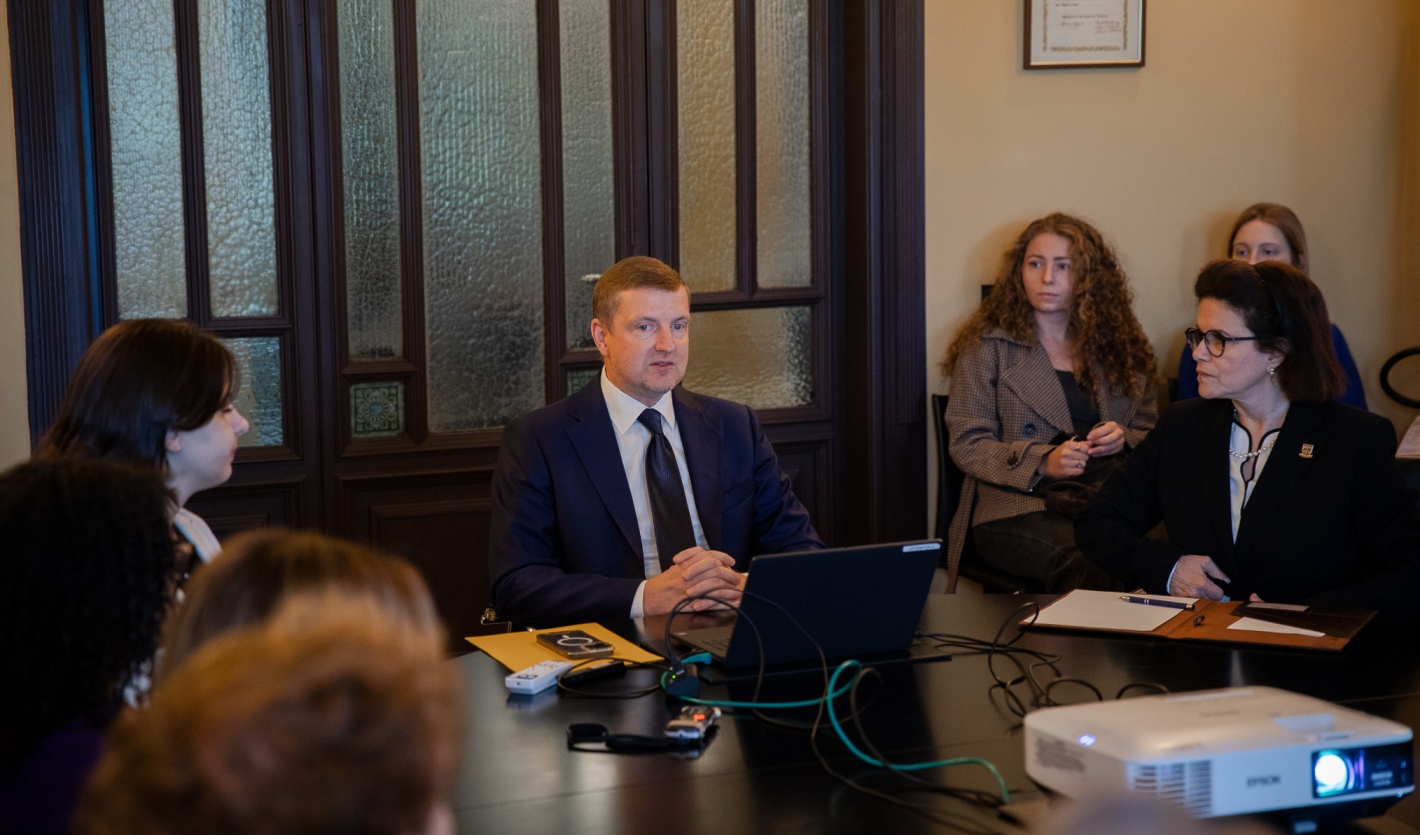
Professor Della Ratta sat down for a conversation with the Office of Web Communications to talk about the inspiration behind her book and the contemporary landscape of AI being used as a propaganda tool.
The book began with Della Ratta’s experience of encountering the genocide in Gaza through the same social media feed that carried the ordinary fragments of daily life. “I was doomscrolling to get updates on Gaza,” she said. “Images of devastation appeared alongside messages from my child’s school or photographs from a friend’s birthday party. Everything was mixed together, and the effect was deeply uncanny.” One day, she saw a video of the Al-Aqsa Mosque, a defining feature of the Jerusalem skyline, in flames. “I believed it. It was plausible. After a while, I realized it was a synthetic, AI-generated image.”
After she paused on the video, the platform began recommending more synthetic images of the same imagined future. Among them were serene visions of a future temple on the site of the Al-Aqsa Mosque. They appeared nonviolent on the surface, yet the peaceful scene presupposed the mosque’s destruction and the erasure of the history and community attached to it. This became the question at the heart of the book: not simply whether these images were true or false, but what they were already doing — what futures they were making imaginable, plausible, and increasingly familiar.
“Generative AI has helped familiarize audiences with a vision in which the destruction and displacement of Gaza are concealed beneath images of peace, prosperity, and a luxury resort,” explained Della Ratta. “What matters is not whether this imagined future eventually comes true, but the political and material work the image performs in the present.”
Della Ratta calls this mechanism “speculative violence.” The term describes images that do not simply represent violence or make false claims about the present. Instead, they picture futures made possible by destruction, displacement, or erasure, often showing the serene “after” while concealing the violence required to produce it. Through repetition and circulation, such images can make politically unacceptable futures appear imaginable, familiar, and eventually legitimate. Their power therefore lies less in whether viewers believe them to be true than in what they authorize in the present. Because they are often framed as satire, fantasy, or speculation, they may also circulate beyond the reach of moderation designed to detect factual misinformation.
Professor Della Ratta believes that AI satire is particularly dangerous. “These images do not pretend to act as factual, and are therefore more insidious,” said Della Ratta. “Many of them are ‘AI slop,’ but there is nothing to laugh about because they are weapons in a propaganda war.”
“As a citizen and as an educator, I am very critical and also very concerned about what is happening right now,” said Della Ratta. For her, responding to these images requires looking beyond fact-checking to the infrastructures and political regulation of AI. “First of all, the cost of producing AI content has an impact on our well-being and the environment. We should treat it as what it is: a weapon,” said Della Ratta. “And second, we should seriously think about regulating AI in Europe.”
Yet Della Ratta does not see political imagination or generative AI as belonging exclusively to the far right. Democratic forces, she argues, have failed to offer equally compelling images of the futures people might desire. “There is a lack of counterproposals to the vision offered by the far right, and that is a problem,” she said. Rather than abandoning the visual field, she calls for counter-images that make other collective futures imaginable: futures grounded not in erasure and domination, but in democratic desire, care, and coexistence.
“AI gives all of us an incredible power to push our imagination forward, to imagine whatever we want,” said Della Ratta. “But imagination must come first. AI can then help us translate what we desire and envision into visual propositions about the future, but the technology cannot imagine those futures for us.”
The Italian translation of Professor Della Ratta’s book will be presented on October 27, 2026, at the Feltrinelli Bookstore in Largo di Torre Argentina, in Rome. Check out the Feltrinelli website for more information.