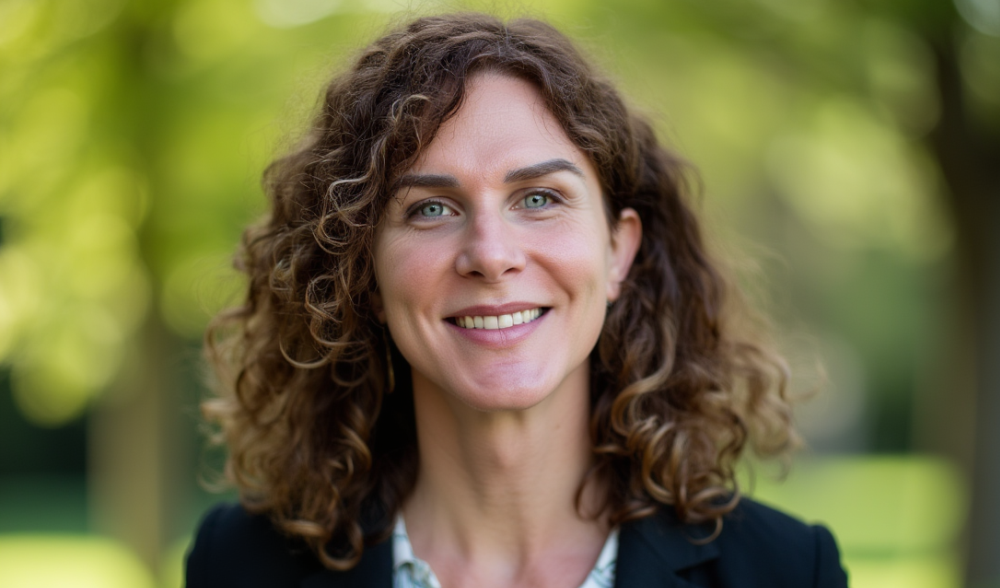
Born in Tuscany, Italy, Professor Niki (Nicola) Petrocchi has been teaching in John Cabot University’s Department of Psychology and Social Sciences since 2015. She moved to Rome in 1998 to study at Sapienza University and later completed her doctoral training between Sapienza and Boston University. A clinical psychologist, psychotherapist, and researcher, her work explores compassion, mental imagery, trauma, psychophysiology, and the study of psychological change.
What drew you to the field of psychology?
I became interested in psychology unusually early. I remember being 11 and already fascinated by meditation, visualization, and the idea that the mind could observe itself and perhaps even transform itself. But what attracted me just as much was research. I have always been interested in phenomena that are difficult to measure, like consciousness, imagery, and compassion, while also wanting to ask concrete questions about them. What happens in the brain and body? Can we observe it? Under what conditions does it change?
I completed my graduate training at Sapienza University and spent part of my doctoral training at Boston University. When I returned from the United States, I wanted to live in Italy without losing the intellectual exchange I had experienced in an American academic environment. JCU offered a bridge between those worlds. Alongside teaching, I continue seeing patients and developing my research in Compassion Focused Therapy (CFT). CFT sits at the intersection of evolutionary psychology, attachment theory, neuroscience, cognitive-behavioral approaches, and contemplative traditions. It asks a simple question: what happens when a mind learns to respond to suffering with courage, care, and wisdom rather than avoidance or self-attack?
How did your approach as a professor change over the years?
I still remember my first day teaching at JCU. I arrived with a very structured lecture and quickly understood that knowing your material is only one part of teaching it. A classroom is not simply a place where information moves from one person to another. You have to create the conditions in which students become curious enough to do something with it. When preparing a class, I no longer just ask myself, “How can I explain this clearly?” I also ask: “Where does this idea become surprising? What assumption does it disturb? What would make a student keep thinking about it after class?” Eventually, I want students to move beyond simply receiving knowledge and begin developing a relationship with it: “Do I understand this? Do I agree with it? What is missing? What would I want to investigate next?”
JCU students are particularly receptive to this kind of teaching. They have embraced the structure of my classes, including device-free sessions designed to protect attention and make room for a continuous exchange of ideas. I think there is something increasingly valuable in creating a space where we are simply present, thinking together.
In 2018, you were working on the first official manual on Compassion Focused Therapy. What is the state of the project? Are you working on anything else?
The manual was finally published in 2024 and later translated into Italian by Erickson Editore as Manuale operativo di Compassion Focused Therapy. That work led to research in other directions. We developed a manual for compassion-focused interventions for children and schools, also published by Erickson, and I recently completed a book on Compassion-Focused EMDR, which will be published by Erickson in March 2027. Research at JCU has also become increasingly important. I work closely with several research assistants in the Psychology Lab, and we recently submitted a paper to an international peer-reviewed journal with a JCU student as first author. That is particularly meaningful to me: students are not simply learning about research but contributing to it. We have also started a collaboration with Sapienza University and Professor Cristina Ottaviani on transcutaneous vagus nerve stimulation. This connects to a question that increasingly interests both me and our students: psychological change happens not only through words and meanings, but also through the body. JCU students have shown a remarkable interest in this mind-body connection, and I love that they can now be directly involved in research at the heart of this emerging field.
What advice would you give to a JCU student who’s passionate about psychology and would love to become a therapist or a researcher?
Students are often drawn to psychology because they are fascinated by people, relationships, mental health, or consciousness. Then they encounter statistics, biology, research methods, and measurement, and sometimes think: “Where did psychology go?” But that tension is part of the discipline. A good psychologist needs both the curiosity to approach experiences that are difficult to understand and the humility to allow evidence to contradict the explanation they wanted to be true. My advice to students is not to rush too quickly toward the part of psychology they already love. Some of the courses that initially feel furthest from their interests may eventually give them the tools to investigate those interests seriously.
What would you like for your students to take away from your classes? What is your teaching style?
I hope they leave with knowledge, of course, but knowledge alone is not enough. I would like them to acquire a certain way of looking. When they encounter a psychological claim, I want them to become slightly less satisfied with the first explanation. What is the evidence? What other mechanism could produce the same result? What are we not seeing? Which part of the person disappears when we use this particular theory to explain them? I also want them to embrace the idea that science is always unfinished. Theories in a textbook can appear as if they arrived already completed, but every theory was once an uncertain idea in somebody’s mind. Over time, those intuitions had to face research, criticism, data, collaboration, and sometimes failure. I would love students to experience knowledge not as a museum they are visiting, but as a conversation they may eventually enter.
Positive psychology has become more popular recently. Where do you see this field heading next?
One important development is the movement away from an overly individualistic understanding of well-being. People do not exist in isolation: we live in bodies, relationships, cultures, social systems, and ecosystems. I think positive psychology is increasingly expanding its focus to include these wider contexts. I am also very interested in emerging work on “death positivity.” Positive psychology has taught us a great deal about flourishing and living well, but the psychology of life should also help us think about mortality. Death positivity asks what it might mean to approach death with greater wisdom, dignity, meaning, and compassion, not romanticizing it, but recognizing finitude as part of human life. I find that a particularly important and fascinating direction for the field.
Is there anything you’d like to add?
I am deeply grateful to JCU because my time at the university has coincided with more than a decade of change, academically, professionally, and personally. During these years, I came to understand and express myself as a queer, transgender woman. I don’t think of that as separate from the rest of my story. Transformation is something I study professionally, but it is also something I have experienced from the inside. I am happy to see so many students at JCU finding the freedom to explore and express who they are, in so many different ways. I hope that, as a professor, I can also model something simple: that becoming more fully yourself and growing intellectually and professionally do not have to be separate journeys. I think there is something rare and valuable about an institution that can make room for both continuity and transformation.