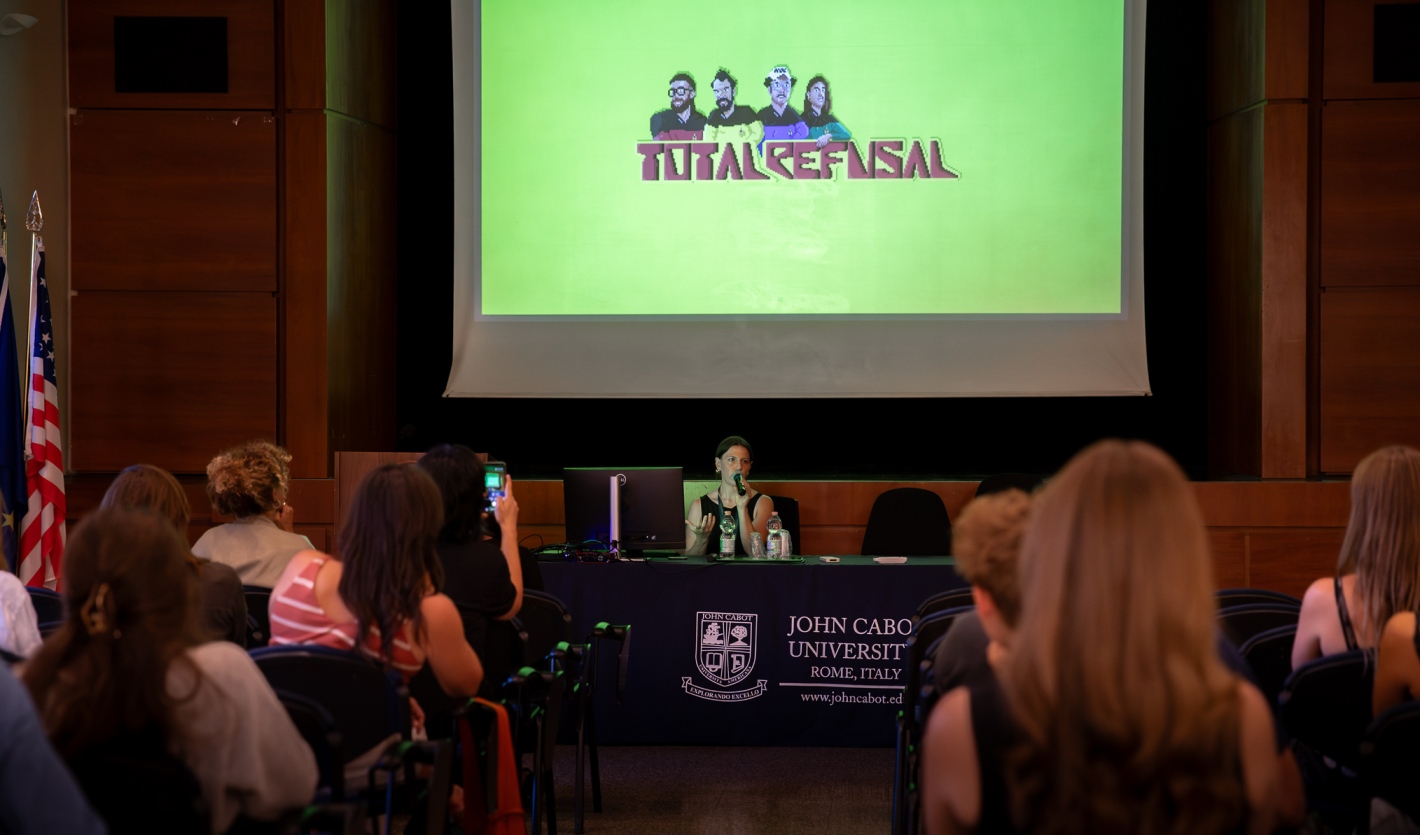
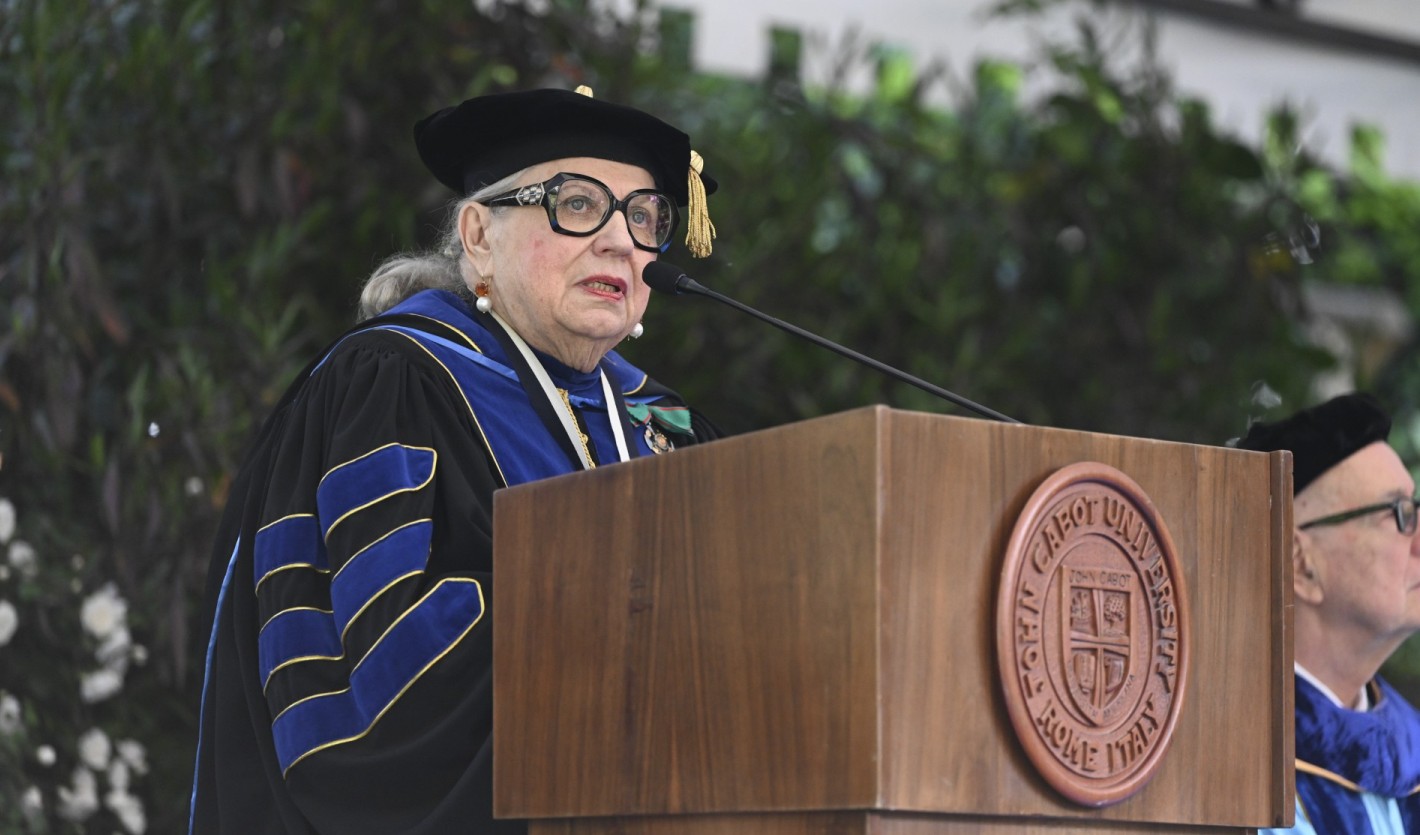
On September 28, 2026, John Cabot University had the pleasure of hosting Susanna Flock from Total Refusal for the first talk of the Fall 2026 edition of the Digital Delights and Disturbances (DDD) lecture series. JCU’s Department of Communication and Media Studies sponsors the series, and the talk was organized jointly with Re:Humanism and Roma Europa Festival.
Founded in 2018, Total Refusal is a media guerrilla collective focused on the artistic intervention and appropriation of mainstream video games, with the goal of revealing the political influence behind this media. Its members are Susanna Flock, Robin Klengel, Leonhard Müllner and Michael Stumpf. Their practice extends across films, video art, live performances, writing and education.
Hijacking Video Games to Create Manifestos
This lecture demonstrated how misusing virtual spaces can expose hidden labor, digital algorithms, and capitalist ideologies. By shifting focus from the heroic avatar to the marginalized background character, the collective reclaims video games as sites for critical reflection.
Total Refusal approaches mainstream video games as ideological environments, spaces in which particular ideas about society can become so deeply embedded in gameplay that they are no longer immediately visible.
The effectiveness of these structures, the collective suggests, lies partly in their invisibility. “Games are very good at making these implicit rules invisible,” Susanna Flock explains, even though those rules may be “deeply ideological.” It is precisely this invisibility that the collective tries to disrupt.
As a result, their films are described as “machinifestos,” political manifestos created through machinima, which is filmmaking inside game engines. Rather than rebuilding a game or modifying its software, Total Refusal uses what already exists: landscapes, physics, characters, animations, and digital architecture become raw material for their unique storytelling. “We do not alter the structure of the software or reprogram it,” the collective explains. Instead, it seeks to “artistically exploit it as a resource and reveal its inherent ideology.”
Agitation and Entertainment
A key concept is what Total Refusal calls “agitainment,” a combination of agitation and entertainment. The idea is to introduce political and theoretical analysis into the spectacular environments of blockbuster games without abandoning their accessibility or humor.
This strategy becomes clear in their project Hardly Working, an ethnographic exploration of non-player characters in Red Dead Redemption 2. Instead of concentrating on the protagonist’s missions, the project observes the background characters whose repetitive routines normally remain peripheral to the player’s experience.
These NPCs perform labor, repeat movements, and follow programmed routines with extraordinary consistency. By placing them at the center of attention, Total Refusal exposes a form of digital labor that would otherwise disappear behind the game’s more spectacular activities.
The conventional game encourages players to identify with the protagonist and to pursue objectives. Total Refusal instead asks what happens when attention is redirected toward those who populate the margins of the game world. The background becomes the subject, and seemingly meaningless repetition becomes something worthy of political and social analysis.
Moreover, Susanna Flock’s project ORBITING (currently in production) shifts its focus to intimacy. Created inside the science-fiction game Star Citizen, the machinima follows avatars attempting to establish romantic connections in a world designed primarily around gaming instead of genuine human closeness. Flock examines contemporary online dating using the video game as context.