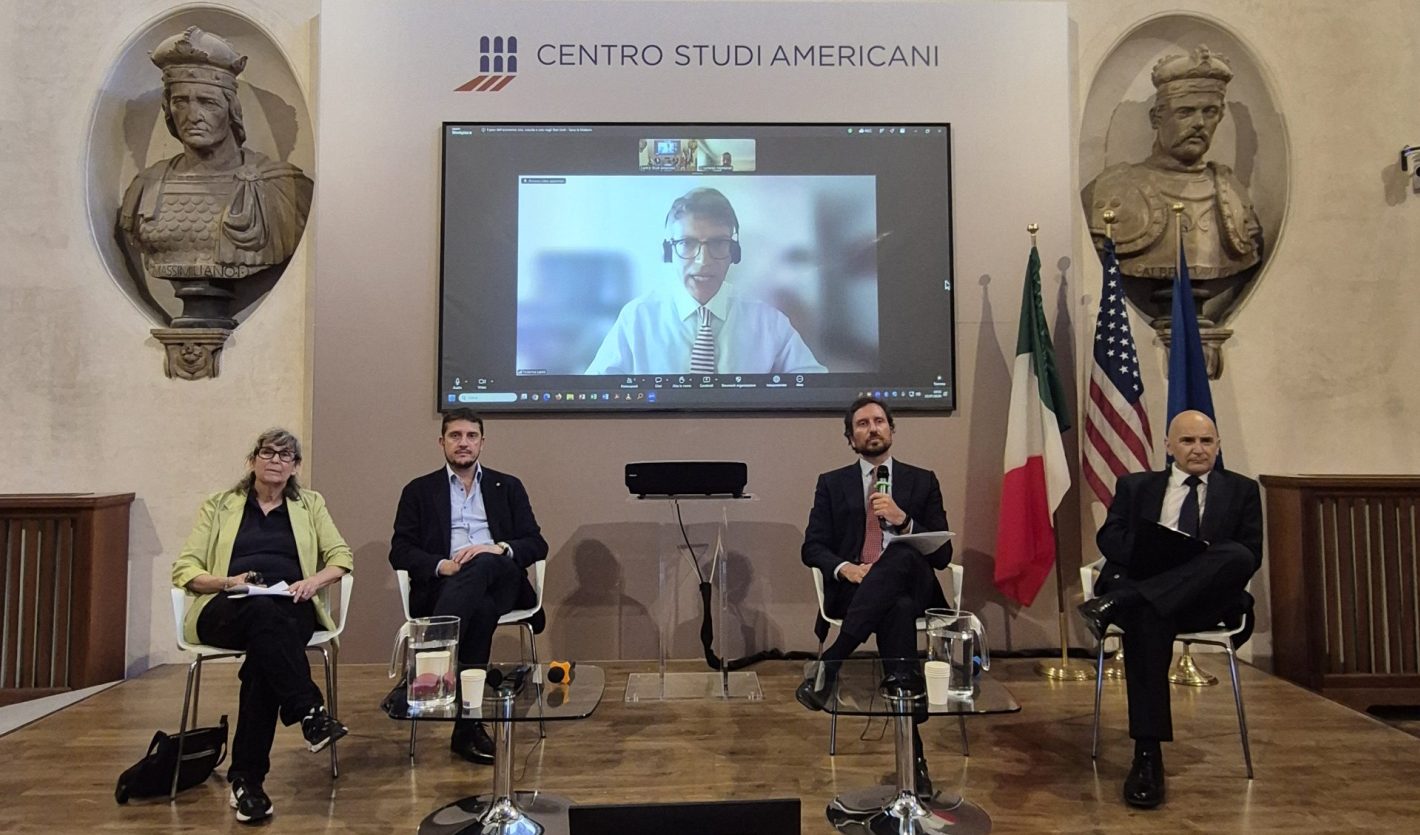
VP Mary Merva (left) at the Centro Studi Americani
On July 15, 2026, Vice President of Academics and Economics Professor Mary Merva was invited to attend the first of the series of panel discussions organized by the Centro Studi Americani (CSA), titled “Heading into the Midterms.” The panel “The weight of the economy: crisis, growth and the elections in the USA” included Davide Allegra (Advocacy and Business Services Manager at the American Chamber of Commerce in Italy), Federico Leoni (U.S. correspondent for Sky TG24), Lorenzo Montanari (Vice President of International Affairs for Americans for Tax Reform), and Lucio Martino (geopolitical analyst). The moderator was Giorgio Rutelli, Deputy Director of the Italian news agency Adnkronos. Participants were welcomed by Roberto Sgalla, Director of the CSA.
Every panelist discussed their assessment of the current political and economic situation in the USA from their professional perspective to better understand the perception of the economy and how it might influence the upcoming midterm elections.
A starling flock (credits: James Wainscoat)
The “Messy Middle” as a Starling Flock
Rather than focusing on committed Republicans or Democrats, in her talk, Dr. Merva focused on the large group of Americans in the political center, often called the “messy middle.” According to the 2026 Pew Research Center, roughly 60% of voters fall into this category, while only about 20% are firmly on the political left and 20% on the political right. These middle voters are viewed as highly adaptable and often decisive in elections.
To understand how the “messy middle” voters think and react, Dr. Merva used the metaphor of the starling flocks of Rome. Large groups of starlings move together in complex, constantly changing patterns without any central leader. The system is remarkably resilient: it can absorb a falcon attack, split apart, and reform. They are adaptable: each individual bird responds mainly to the movements of the 7 nearest birds without seeing the entire flock, and they do not consider the bigger picture.
Many voters behave similarly. Rather than carefully evaluating every national policy issue, they often respond to information and economic conditions closest to them, from within their local information environment. This reflects the adaptability and innovation that characterize our ability to respond to economic situations.
The Two Categories of an Economic Environment
The economic environment can be divided into two categories. The first is pocketbook economics: the everyday financial realities that directly affect households, such as gasoline prices, grocery bills, and investment returns. The second is foundational economic policy, which includes larger long-term issues like federal debt, Social Security, Medicare, productivity growth, and the impact of artificial intelligence on jobs. While both types of issues matter, voters in 2026 may be paying much more attention to pocketbook concerns than to broader structural challenges.
A key reason for this is growing public skepticism about government’s ability to solve major problems. If voters believe political gridlock will continue regardless of who wins an election, they may stop expecting meaningful policy solutions. Instead, they adapt to their immediate circumstances and focus on what directly affects their finances. This is a shift toward self-reliance and local decision-making rather than faith in national policymaking. In such an environment, changes in household expenses may carry more political weight than debates about long-term reforms.
Pocketbook economics may also include the stock market. While traditionally stock ownership was associated with wealthier households, ownership across all household income groups has changed significantly, accelerating after the COVID-19 pandemic. Approximately two-thirds of U.S. households now own some stock, either directly or through retirement accounts. As a result, stock market performance increasingly affects how ordinary Americans feel about the economy.
Polling evidence (Gallup 2023) suggests that stock ownership influences economic optimism, especially among Republicans and Independents. Investors in these groups are considerably more likely than non-investors to say the economy is improving. This suggests that rising stock prices may boost economic confidence and potentially influence voting behavior. In other words, financial markets are no longer seen only as a concern for Wall Street.
Three indicators may be especially important in the 2026 midterms: gas prices, grocery prices, and stock prices. If these indicators are favorable, incumbent politicians may benefit, even if larger economic issues remain unresolved. Campaign donors know this. An unusual example is called the “Freedom Fuel Network,” a chain of discount gas stations concentrated in Pennsylvania, an important swing state. This raises a provocative question: are efforts to lower highly visible consumer costs simply reflecting concern for families, or are they a new way of influencing voters in an era dominated by pocketbook concerns?
Looking beyond 2026, foundational economic issues may become much harder to ignore by 2028. Challenges such as the long-term funding of Social Security, rising federal interest costs, housing affordability, healthcare expenses, and the effects of AI on employment will eventually demand attention. Voters may decide that focusing only on immediate economic concerns is not enough and begin demanding broader policy solutions. Throughout history, major policy changes have often followed crises such as the Great Depression, World War II, and the great financial crisis of 2008. Significant economic shocks are sometimes what finally breaks political gridlock and creates momentum for reform. Until then, the behavior of the “messy middle” may continue to be driven less by grand policy debates and more by the practical realities of everyday economic life.