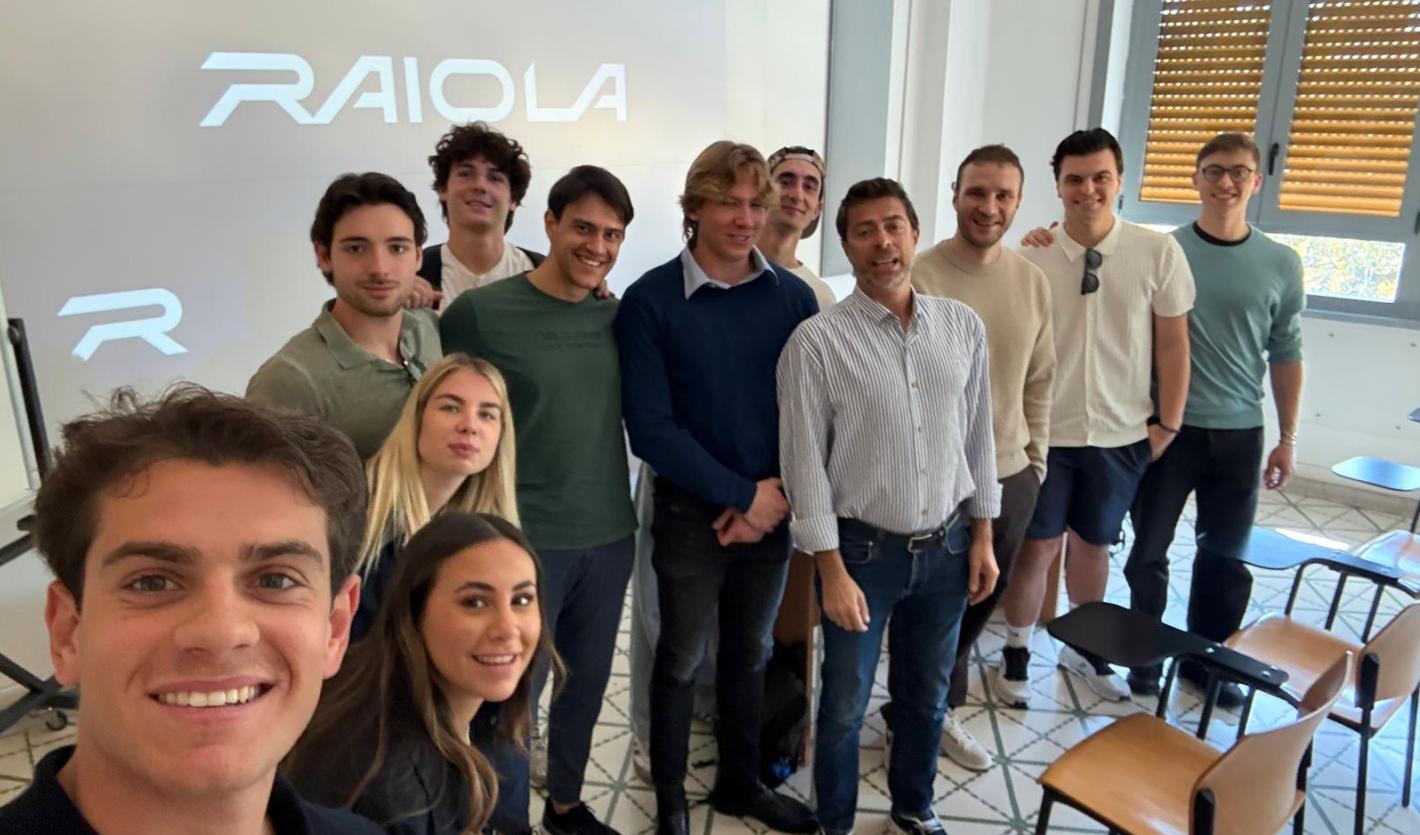
On April 16, 2026, John Cabot University welcomed Mark Nervegna, Chief Executive and Managing Director of Raiola Global Management, the agency behind some of the biggest names in the football (soccer) industry. Organized by Professor Sergio Scicchitano, the lecture gave JCU's Economics and Finance students a direct look at how one of the most influential sports agencies is changing the way it works. Football agencies have historically operated on personal relationships, phone calls, and the instinct of experienced agents. Nervegna explained how Raiola has spent the last three years building its own data systems, analytical models, and technology tools to stay ahead in an increasingly competitive market.
Nervegna brought real examples to the classroom, showing exactly how the concepts students encounter in economics and statistics courses are being applied inside his agency. Understanding data, building models, and interpreting numbers are becoming just as important in a football player transfer negotiation as they are in any other industry, and this lecture made that case in the most concrete way possible.
Staying Ahead with Transforming the Football Industry
Nervegna opened the lecture by introducing the firm's history. Mino Raiola built Team Raiola into one of the most powerful agencies in the world of football, representing players such as Zlatan Ibrahimovic and Paul Pogba. The firm today manages 223 athletes and remains guided by the family culture that Mino established. When Mino passed away, senior agents Enzo Raiola and Jose Fortes Rodriguez adapted to the changing landscape, bringing a clear-eyed view of where the industry was heading. As top clubs began hiring data scientists and building analytics departments, they pushed to keep pace with these developments.
What followed was a three-year process to build the agency's own data infrastructure, covering every stage of a player's career from the first scouting report to the final terms of a transfer. For students, the key takeaway was that even industries built on trust, reputation, and personal relationships eventually reach a point where data becomes a competitive necessity.
Building a Centralized Database
At the core of Nervegna's presentation was a detailed walkthrough of the agency's data architecture. Rather than relying on public platforms such as Transfermarkt or outsourcing analysis to third-party consultancies, Raiola built its own centralized database using an ETL pipeline, meaning Extract, Transform, and Load, developed in Python. Data is sourced from providers including StatsBomb, Wyscout, and SkillCorner, cleaned to reconcile inconsistencies in player naming conventions across sources, and loaded into the firm's CRM for immediate use by agents and analysts.
A significant portion of the lecture focused on the firm's use of cluster analysis to move beyond positional labels and identify player archetypes based on actual on-pitch traits. Using a random forest model, the team constructed five major clusters, each subdivided into more granular sub-clusters, allowing scouts and analysts to compare players against historically similar profiles and project career trajectories with greater precision.
Real-life Example
Nervegna devoted considerable attention to the fit model, the framework the agency uses to determine the optimal next club for a player at any given stage of their career. He presented students with a case study involving a 19-year-old defensive midfielder facing three possible paths. The first was to remain at his current Serie A club as a rotational player with promised minutes. The second was a loan with an option to buy, moving to a lower-tier league with guaranteed first-team exposure. The third was a permanent transfer to a mid-tier European league, with a starter role in the second team and a defined pathway to the first.
Students were invited to debate the options before Nervegna introduced the agency's cockpit model, which evaluates tactical fit, league strength relative to the player's current level, positional opportunity at the target club, and the historical development tendencies of the coaching staff.
Integrating Artificial Intelligence
In the final segment of his lecture, Nervegna outlined the agency's current work integrating artificial intelligence into its analytical workflows. By training large language models on the agency's proprietary database structure and rating methodology, the team is now able to generate player assessment reports in minutes rather than days. A locally developed application allows analysts to pull up performance comparisons, positional rankings, and club-fit profiles on demand, with the tool designed for speed and intuitive use by agents who may have limited technical backgrounds.
Nervegna invited students to think about football not as a purely opinionated market, but as an industry undergoing a structural shift toward evidence-based decision-making. For JCU students, the lecture offered an example of how skills developed in the classroom – from statistical modeling and data cleaning to financial valuation and strategic negotiation – are being applied at the highest levels of a global industry. The seminar also provided a rare opportunity to engage directly with a leading executive, making the event valuable from both an academic and professional perspective.
The journey of Raiola from informal negotiations to AI-assisted scouting demonstrates that the future of football will be shaped as much by analysts as by agents.
The lecture ultimately demonstrated that the football industry is becoming increasingly interdisciplinary, combining economics, computer science, behavioral analysis, and strategic management within a single operational framework.
For many students attending the event, it also offered insight into emerging career paths connected to sports analytics, performance evaluation, and data-driven business strategy.