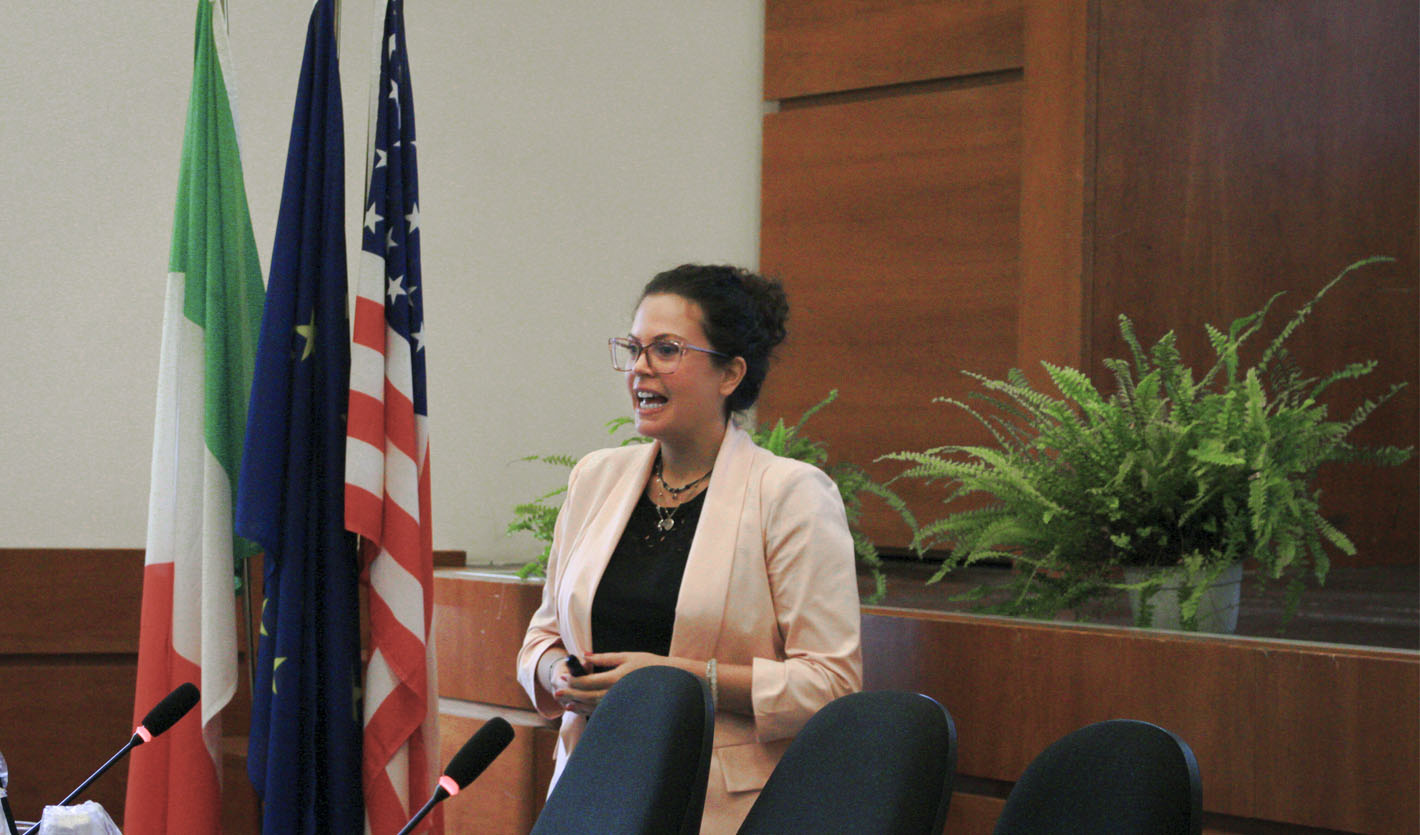
Giorgia Conte graduated from JCU in 2016 with a major in International Business and a minor in Entrepreneurship. After building a career in corporate marketing and communications, she returned to JCU as a professor, bringing her passion for mentoring and career development into the classroom.
How has life been since graduation?
I have had a steady career path for the last 10 years. I started working in the corporate world, specifically in marketing and communication. At the start of my career, I was following the path that had been designed for me. I spent all my energy on learning and developing my expertise and technical skills. I focused on growing from a professional standpoint. I had the chance to build campaigns and brands and see the many interesting aspects of the corporate world.
After working in Milan, Rome, and abroad, I decided to pursue an MBA in Business Administration at IE Business School in Madrid. This MBA ended up being the turning point in my career. During my studies, I tried to explore a bit more about myself and understand where I actually wanted to go. I realized that what I liked about my job was related more to the human side than the technical one. I knew that I loved to explain, mentor, lecture, and coach. So I decided to pivot my career.
That’s when I decided to become a professor. I reached out to JCU, and I was very lucky. I’m humbled to have become part of the JCU faculty.
How has your experience as a professor been so far?
It’s been terrifying and satisfying at the same time. Teaching can be intimidating because once you walk into the classroom, there is nowhere to hide. The students are very smart, and the standards are high. It's also a very international environment, and students are very well prepared to recognize whether you actually master the concepts or are just improvising, whether you really care about them and the subjects you teach, or if you are just going through the motions. I was under a lot of pressure at the beginning. I honestly overprepared all my lessons.
But that, for me, was also the most satisfying part! Once you get to know the students and see that they are actually interested in what you're saying, and that they appreciate the way you support them and coach them, it's extremely gratifying because you can see their growth. That’s what gives me purpose. As I said before, empowering, coaching, and mentoring people is what I like the most. Seeing it firsthand is incredibly rewarding.
What prompted you to leave your corporate career and decide to work as a freelancer? What are the pros and cons of each job?
What I loved most about my corporate job was working in a team. The last company I worked for was amazing. My colleagues were great, and the job taught me so many valuable things. At the same time, I realized that it was not for me. I really needed to focus on my purpose and reassess my priorities.
I also wanted to create something of my own. I knew that, to do it, I needed more freedom, more time, and to clear my mind of the duties and responsibilities that a corporate job comes with. And that's exactly what I did. I started to build something on my own and became a personal branding and career development coach.
What advice would you give to students who have just graduated from JCU and are about to start their careers?
First of all, stop treating your first job as a verdict on your career, because it's not going to be where your career ends. Rather, it's part of the journey. I see that, most of the time, people (myself included) tend to think that what they do after they graduate will be permanent. But it won’t be, especially nowadays, when there are so many changes happening. And the future of careers is really unpredictable due to many variables: technology is changing every day; we must consider the global geopolitical developments that are also affecting the economic stability of the world, hence the job market. In this scenario, it’s difficult to see your career path in the long term.
You really need to be patient. Take those years after graduation to experiment, understand what you like and what you don't like, and get to know as many people as possible. I want to stress this aspect because it's super important to network and build a community around yourself. But it's also very important to stick with the community that you built at John Cabot, because that's what brought me back here. Leverage it and also try to expand it as much as possible.
The second point is that you really need to master your communication skills because, as I said, technical skills can be learned and adapted. But while technical skills can become outdated, from a human standpoint, you will always be prepared if you know how to communicate, if you can explain a complex idea in a simplified way, and if you can talk to a recruiter, your boss, or a person in a position of leadership. Finally, be patient with yourself, because the most interesting careers are very rarely in a straight line, and I'm an example of that.
This is a very tough moment for the job market and for young professionals who are looking for their professional path. Do not lose hope. Just go out there, experiment, and really try to find something that makes you feel happy every day. Never stop looking for that spark that keeps you going.