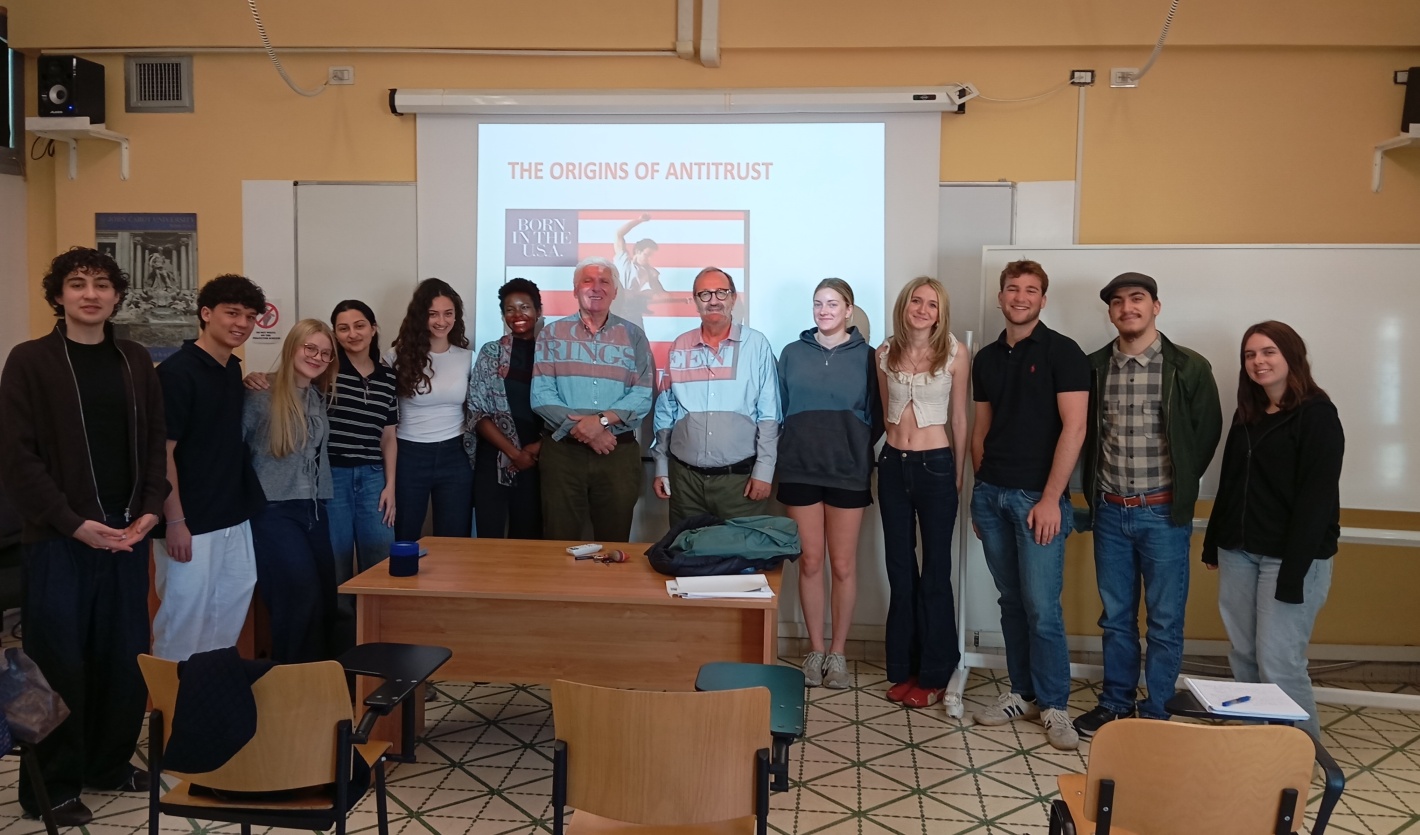
On April 29, 2026, Professor Nicola Favia’s students in his Microeconomics class participated in a lecture led by Professor Andrea Pezzoli, former Deputy Director General of the Italian Antitrust agency. The lecture was titled “The Goals of Competition Policy,” and it presented a crucial shift in how antitrust should be understood: not as an isolated discipline but as part of a broader institutional network.
Pezzoli began by outlining the virtues of competition. Competition leads to lower prices, greater quantity, and more choice. He also emphasized a second aspect: dynamic efficiency, or the “efficiency of tomorrow.” This distinction is important for understanding how markets evolve. At the same time, Pezzoli drew attention to the recurring problem; labor and social policies tend to develop reactively, often in response to economic crises or technological disruption. This creates gaps and disparities that could be avoided through earlier coordination, suggesting that welfare and competition are interconnected rather than opposing goals, although the debate is ongoing.
Friends of Antitrust
A notable part of the lecture was the introduction to the concept of “friends of antitrust,” a network of complementary institutions, including labor authorities, trade bodies, sustainability regulators, and public policy actors. For such “friends” to be effective, they must share common goals. Without alignment, even well-designed policies risk having a weak impact.
With coordination, however, antitrust enforcement becomes a proactive tool. In this context, Pezzoli introduced the humanistic approach of Italian economist Federico Caffé, who once wrote, “A market is a human creation, and public intervention is an essential and not distorting component of the market.”
This idea reframes markets as systems that require guidance rather than self–regulation, unlike the metaphor of the “invisible hand” pioneered by Adam Smith. “The implementation of competition rules in digital markets and in the pharmaceutical industry provides important examples of this interplay between antitrust, regulation, and public policy,” said Pezzoli.
This raised a complex question regarding the role of monopoly power. While traditional antitrust frameworks emphasize the dangers of monopolistic markets, Pezzoli offered an interesting analysis stating that, in the long run, certain forms of concentration can drive innovation. Large firms possess the capital necessary to reinvest in the economy through research and development, potentially generating significant social benefits.
However, these outcomes are not guaranteed. Still, this was not a defense of monopoly power but rather a recognition of its ambiguity. The same concentration that enables innovation can also suppress competition, limit opportunity, and concentrate wealth. The outcome depends on how that power is governed.
Ultimately, the lecture offered meaningful insight and even offered an unexpected measure of economic utility: friends and the importance of having them.