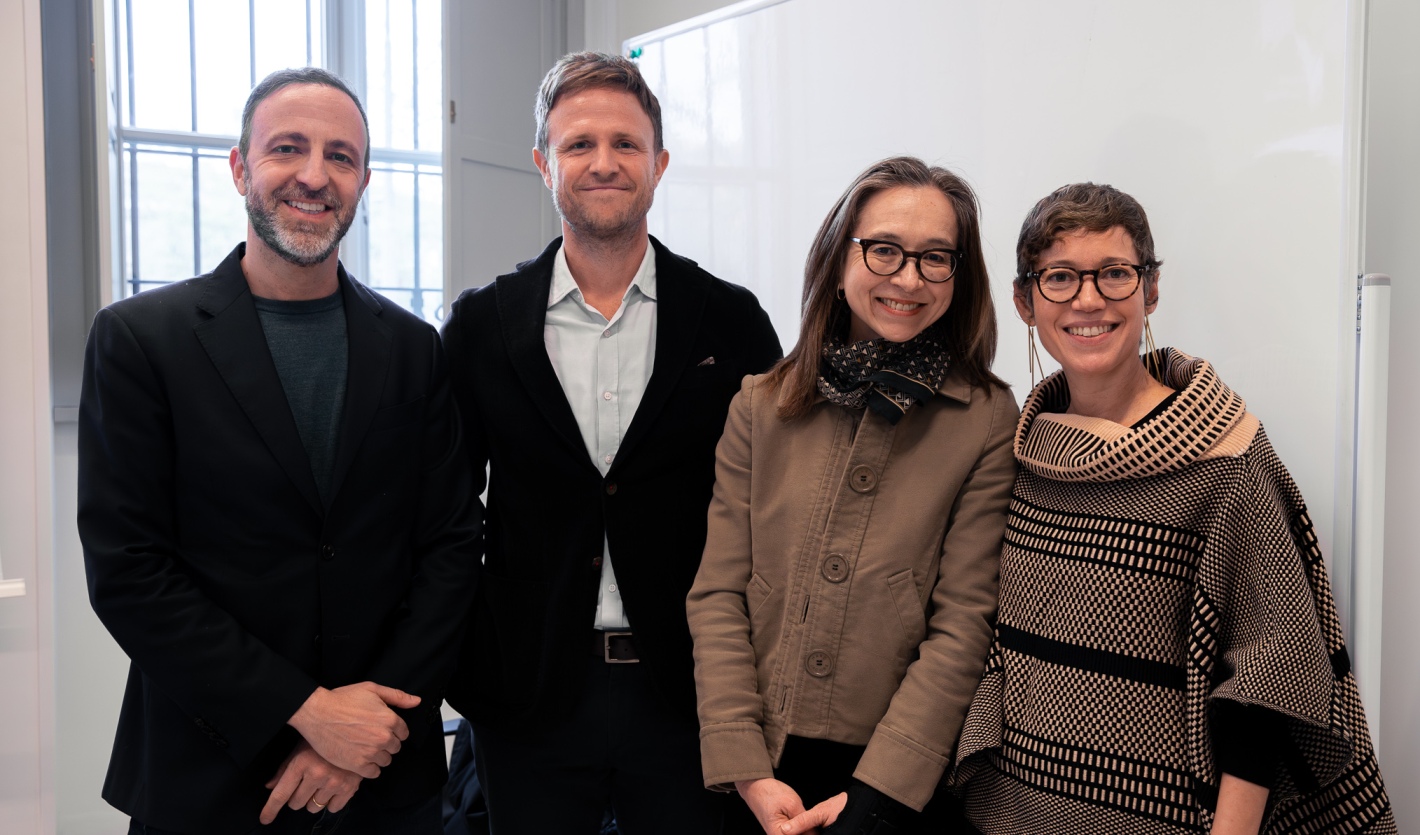
On March 30, 2026, JCU had the pleasure of hosting three highly experienced journalists, Motoko Rich (The New York Times), Chris Livesay (CBS), and Alvise Armellini (Reuters), to discuss their career paths, the current state of journalism, and its implications for aspiring reporters. The event was organized and moderated by Professor Juliana Barbassa and sponsored by the Department of Communication and Media Studies and the Center for Career Services.
About the journalists
Motoko Rich is the Rome bureau chief for The New York Times. She began her career in journalism after winning a scholarship to work at the Financial Times. During the discussion, she emphasized the importance of passion, curiosity, and hard work in journalism. As she put it, “It’s a career that requires hunger.”
Chris Livesay is a foreign correspondent for CBS News. While in college, he studied art history, and he was even considering pursuing a PhD when he discovered his passion for journalism. He transitioned from print to on-air reporting by chance, filling in at the last minute for a colleague. Drawing from this experience, he encouraged students to always be ready for unexpected opportunities.
Alvise Armellini is an Italian correspondent for the Reuters news agency. His career was shaped in part by his experience as a press officer at the European Parliament in Brussels. He advised students to seek out chances to gain experience, even if it takes them far from home.
How to approach a story
According to the guest speakers, being a journalist requires an exceptional level of observation. “To be a journalist, you need to be interested in what makes people tick,” Rich said. She also stressed the importance of talking with experts and relying on their generosity – something that can really help foreign correspondents to learn about a situation or a place that might be new to them.
“Prepare, prepare, prepare!” said Livesay. “Always be available, always be ready and on your toes, and most importantly, always be cooperative.”
To write a successful report, journalists need to “help the reader” by picturing a person who knows nothing about the subject. As Livesay explained, the reporter’s job is a service to the people: “Be an honest broker.”
Armellini advised students to engage with reporters in the region and read local newspapers to better understand the environment they are covering.
All three journalists agreed that working as foreign correspondents often allows reporters to connect closely with the communities they are covering involved and to develop a different, more objective perspective on the situation they’re researching.
How AI has changed the job
It’s no secret that shorter, more formulaic, fact-based pieces are increasingly produced by some news outlets with the assistance of artificial intelligence. This doesn’t mean there isn’t a role for journalists – it just means that journalists can focus more on long-form and investigative reporting. But even those formats are getting more concise, as journalists adapt to industry demand and audience preferences for quicker reads, the panelists said.
Armellini also noted that AI is slowly taking over tasks like transcription and translation. Livesay shared his positive experiences using AI to prepare for live TV interviews and to help interpret sensitive conversations in politically charged settings. Rich said that The New York Times does not use AI to write articles, but does use it as a tool for data analysis. All three agreed that while AI can be a valuable force multiplier, it should be used with caution and any work done by it should be verified by human journalists.
Despite all the technological change, however, Rich reassured the audience on one essential point: “The thing that has never changed about this job is that you need to talk to people to write truthfully about something.”
The challenge of covering global stories with cultural sensitivity
An audience member asked how journalists can combat Western bias when covering stories in a non-Western country. The speakers noted that shaping narratives for diverse audiences is particularly challenging when covering regions that are unfamiliar to Western readers. It is necessary to provide historical, political, and cultural context, even if doing so takes additional time and research.
The journalists emphasized the crucial role of local reporters, experts, and residents in ensuring accurate and sensitive reporting, as well as in avoiding caricatures and stereotypes. By listening to people who are familiar with local realities, journalists can deliver more truthful reporting.
Advice for aspiring journalists
The speakers agreed that, while the path to journalism today might appear to be an uphill battle, there are many alternative paths into the profession. Livesay shared his experience of persistence and networking, highlighting the importance of following up with potential employers. For Livesay, it is also important to build a personal brand by taking advantage of new media opportunities, such as podcasting and social media.
Armellini advised young journalists to help their readers by providing clear and concise information, while remaining open to feedback and continuous improvement.
Rich encouraged aspiring journalists to focus on building their skills and reputation. She emphasized the importance of hard work, enthusiasm, and being a reliable team player. Young reporters need to be resourceful and embrace the ever-evolving nature of the profession. “There are so many opportunities for those who can see past the noise,” concluded Rich.