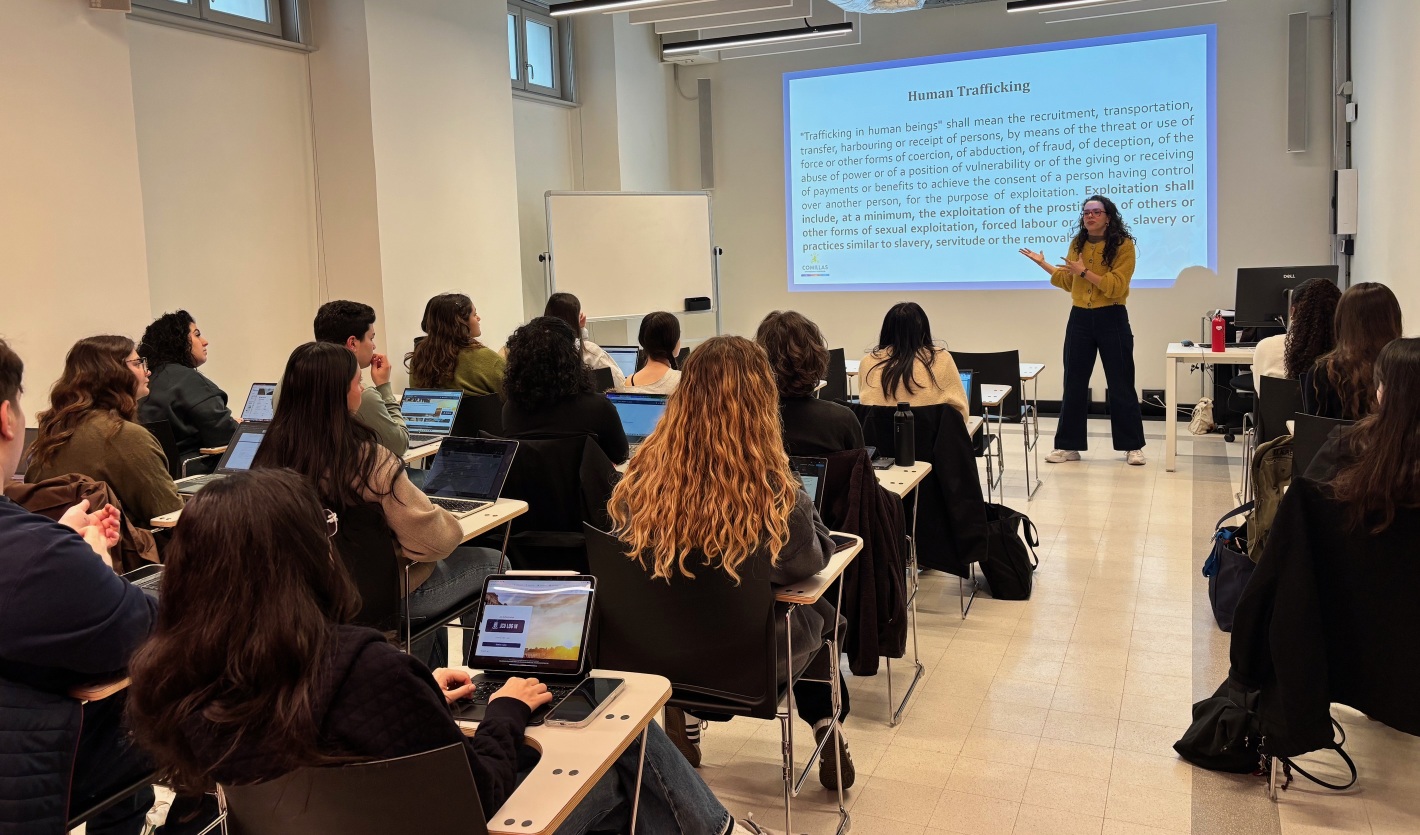
JCU's Department of Political Science and International Affairs is currently hosting Visiting Research Scholar Raquel López Garrido, who is conducting research in the field of human rights and trafficking in persons under the supervision of Department Chair and Professor Silvia Scarpa.
López Garrido is pursuing her PhD and teaches at Universidad Pontificia Comillas in Madrid, Spain. She has a background in International Relations and Human Rights and is researching human trafficking for exploitation in criminal activities, with a particular focus on victims involved in drug trafficking in Spain.
She challenges the traditional focus in this field, which largely centers on sexual and labor exploitation, by arguing that victims’ forced involvement in criminal activities is often overlooked by national authorities. This is especially true for crimes such as drug trafficking. Often, the victims of drug trafficking are not only drug users, but also women who are threatened, blackmailed or coerced into transporting these substances.
López Garrido conducted qualitative research in several Spanish prisons, where she interviewed women sentenced for drug trafficking. She analyzed the stories of these convicted individuals in light of the definition of human trafficking provided by the United Nations Protocol to Prevent, Suppress and Punish Trafficking in Persons, Spanish legislation, and the human trafficking indicators developed by United Nations Office on Drugs and Crime. She concluded that many of them should have been identified as trafficking victims.
López Garrido recently shared the results of her PhD research with MA and undergraduate students in Professor Scarpa’s courses, Human Trafficking, Forced Labor and Modern Slavery in International Law and Politics, and Human Trafficking and Contemporary Slavery.
Students were asked to analyze testimonies from convicted prisoners to better understand the differences between human trafficking, criminal exploitation, and drug trafficking. These lectures helped shed light on the invisible issue of the misidentification of human trafficking victims, especially those who have been forced to commit crimes such as drug trafficking.