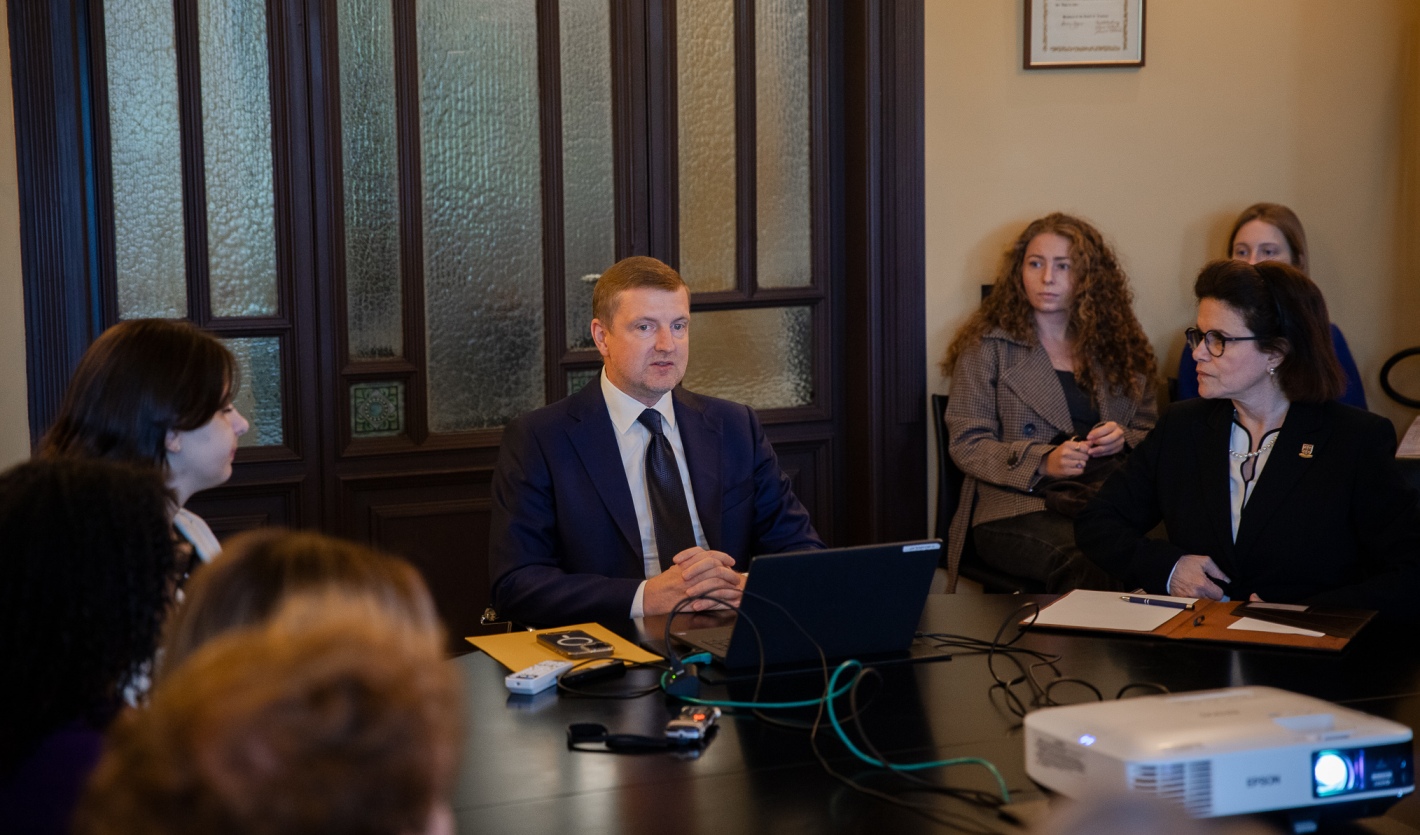
JCU's Department of Economics is pleased to announce that Professor Justyna Wieloch from the University of Łódź in Poland will be a Visiting Research Scholar at John Cabot University in Rome from April to May 2026. During her stay, she will be working under the supervision of Professor Sergio Scicchitano, Chair of the Department of Economics. This collaboration aims to foster scholarly cooperation between the University of Łódź and JCU.
Could you please share more about your academic background and research profile?
My academic background is rooted in economics and international business. I graduated in International Economic Relations and Logistics, then completed my PhD in economics, and I now work as an Assistant Professor in the Department of International Economics at the Faculty of Economics and Sociology at the University of Łódź.
Over the years, I have had the opportunity to gain valuable international academic experience. I was a two-time visiting scholar at Zhengzhou University in China, and I also cooperated with this university through online teaching. In addition, I have taken part in several Erasmus visits, which allowed me to broaden my international perspective, strengthen academic cooperation, and exchange teaching and research experience with colleagues from other universities.
As for my research profile, I focus mainly on economic integration and international trade. I am interested in trade policy, trade wars, regionalism, and global value chains. These are areas that have become especially important in recent years, considering the growing uncertainty in the global economy.
How did you first connect with Professor Scicchitano and John Cabot University?
I first connected with Professor Scicchitano during the Eurasia Business and Economics Society (EBES) conference, which was hosted at John Cabot University in 2025. That was our first opportunity to meet and speak in person, and I found both the academic environment and the discussions very inspiring.
I was also very impressed by his scientific achievements and research record. His work stood out to me because of both its quality and its relevance to my own academic interests. That impression led me to the idea of asking him to supervise me when I applied for a grant at my home university. It seemed like a very natural step, because I felt that his expertise and experience would provide valuable support for the development of my research project.
What motivated you to select JCU for your visiting research period?
I chose John Cabot University because of its strongly international character. I believe that being part of this type of environment creates valuable opportunities for exchanging ideas, building cooperation, and looking at research questions from broader perspectives. I was also attracted by the opportunity to work in a place that combines academic quality with openness to international collaboration. For me, this makes JCU a very good match for a visiting research period.
Another important reason was the high academic level of the university. JCU offers a very dynamic academic setting, and I was particularly impressed by the team in the Department of Economics. I was pleased to see such a strong and inspiring group of scholars. I felt that this would be an excellent environment for developing my research.
And, of course, I should honestly add that Rome was an important factor — it is not difficult to feel motivated when such a city comes with the academic experience.
Could you tell us about the current scientific projects you are working on that you plan to further develop during your time at JCU?
My current research is primarily focused on the consequences of trade wars and on the structure and resilience of global value chains. My work explores how international economic policies and structural changes affect trade patterns, economies, and businesses. In my recent studies, I have examined issues such as global value chain convergence and supply concentration, the effects of import duties on exchange rates, trade policy in the United States-Mexico-Canada Agreement (USMCA) context, and the relationship between economic growth and CO2 emissions.
At the same time, I am also developing a new project on rare-earth elements, which I would very much like to further develop during my time at JCU. This topic is especially important because rare-earth elements are essential for energy technologies, high-tech industries, aerospace, defence, and advanced manufacturing, while their supply is highly concentrated in China. In this project, I would like to examine how China has leveraged or may be leveraging its dominant position in this sector in the context of the trade war with the United States.
More specifically, I want to study the evolution of trade patterns in rare-earth elements, explore whether there is evidence of divergence between China and the United States, and assess the possible consequences of supply constraints or embargoes. I believe this is a very timely topic at the intersection of economics, trade policy, and geostrategy, and I would be very glad to further develop it during my time at JCU.