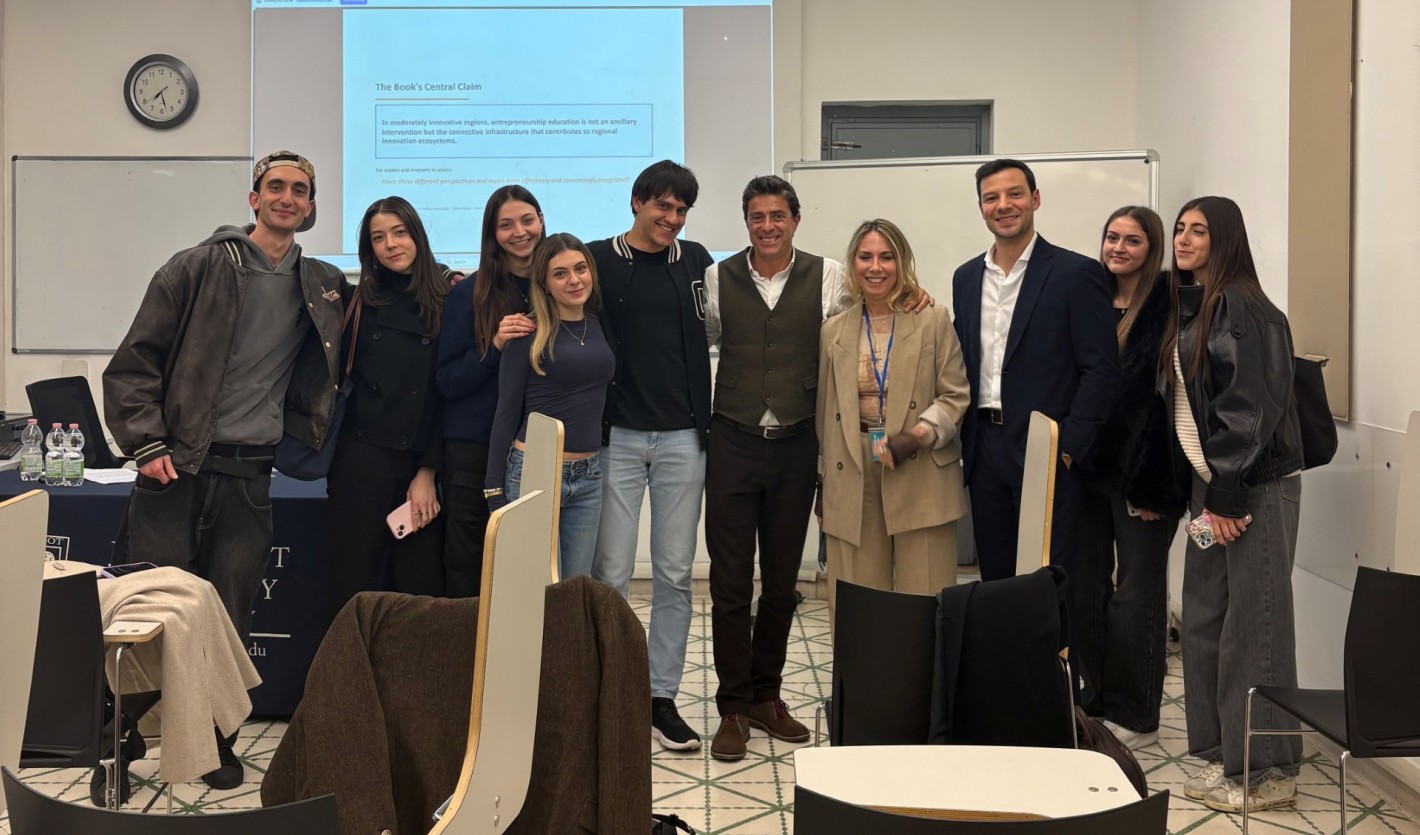
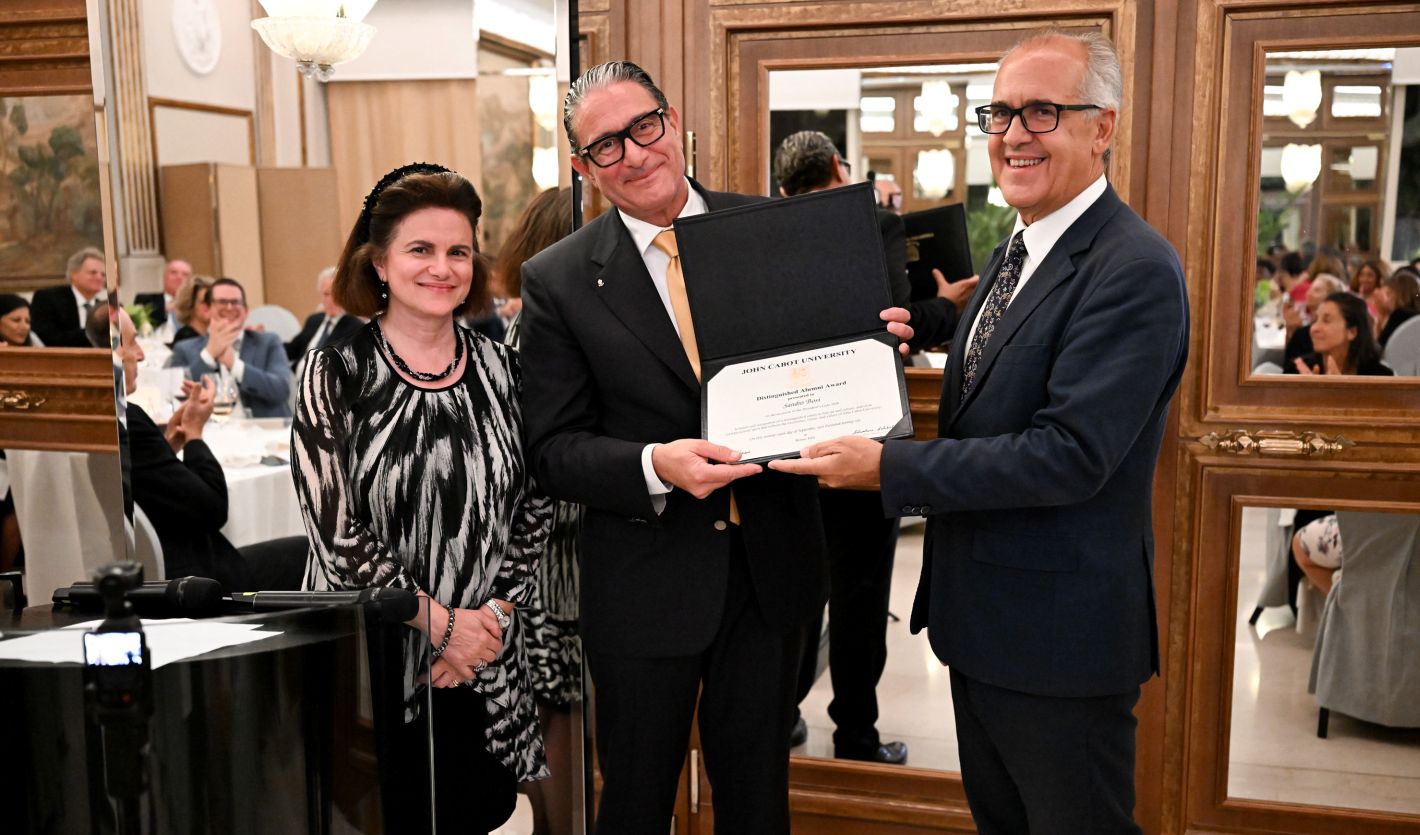
On February 24, 2026, the Economics Department at John Cabot University had the pleasure of hosting economist and public policy expert Mita Marra (University of Naples Federico II) for a discussion of her book Pathways to Innovation and Entrepreneurship (McGraw-Hill Education, 2025). The event also featured Professor Alessandro Cascavilla (University of Rome Unitelma Sapienza) as a guest speaker, and was organized by JCU Professor Sergio Scicchitano.
Students had the opportunity to learn how innovation ecosystems are built and why some areas are more successful than others in promoting entrepreneurship. They were encouraged to look beyond the conventional image of the entrepreneur as a solitary figure. Instead, they learned from Marra that innovation is often driven by complex ecosystems.
Innovation as an Ecosystem
First, Marra introduced the concept of innovation ecosystems. This term refers to the environment that enables new ideas, technologies, and businesses to flourish. It is not necessarily the result of individual creativity: rather, it emerges from an entire system that includes universities, governments, businesses, and other social structures. Within this ecosystem, universities play a major role. Not only do they provide educational services, but they also provide research, collaboration with businesses, and the practical application of knowledge.
According to Marra, universities have become an important element in innovation ecosystems, creating an environment that enables students and businesses to come together and develop new ideas. This perspective challenges the traditional view that entrepreneurship is based solely on individual initiative.
The Quadruple Helix Model of Innovation
Another key topic of discussion during the seminar was the Quadruple Helix Model, an extension of previous theories of innovation systems. The model proposes four major actors in innovation systems: universities, industry, government, and civil society.
Each actor contributes in their own unique way. Universities produce knowledge and research, while businesses transform ideas into marketable products. Governments provide regulations and funding mechanisms, while civil society contributes by providing social needs and engagement. When these four components interact effectively, they create favorable conditions for innovation and entrepreneurship.
According to Marra, regions where these four components work together in harmony tend to develop dynamic startup ecosystems. In contrast, where collaboration among these parts is weak, it may be difficult to develop startup ecosystems even with talent and ideas in place.
The Role of Public Policy
Another important topic of the seminar was the role of public policy in shaping innovation pathways. This role extends beyond funding for research and development to include regulatory, education and infrastructure policies.
For example, policies that facilitate cooperation between universities and industry can significantly accelerate innovation. Moreover, targeted startup policies can help reduce the risks faced by ventures. There are various international case studies discussed in Marra’s book that highlight how different countries implement policies in their efforts to enhance their innovation systems.
These examples highlight that successful innovation systems often emerge from cooperation between multiple institutions. Strategic public policy decisions, coupled with cooperation between universities and industries, can determine whether innovation is just theoretical or evolves into real economic opportunities.
Future Perspectives on Innovations and Entrepreneurship
At the end of the seminar, attention turned to the future of innovation and entrepreneurship in an increasingly complex global economy. Marra encouraged students to think critically about the interplay between institutions, policies, and social dynamics in shaping technological and economic change.
Professor Alessandro Cascavilla contextualized Marra’s book within the broader challenge of Europe’s declining competitiveness and the structural gap in innovation and productivity. He stressed the importance of moving beyond financial support toward deeper systemic integration among universities, entrepreneurship, and regional development.
Furthermore, Cascavilla raised important questions regarding the mechanisms behind the knowledge translation gap, the governance of university-industry collaborations as drivers of total factor productivity (TFP), the measurement of ecosystem-level outcomes, and the scalability of place-based entrepreneurship education models.