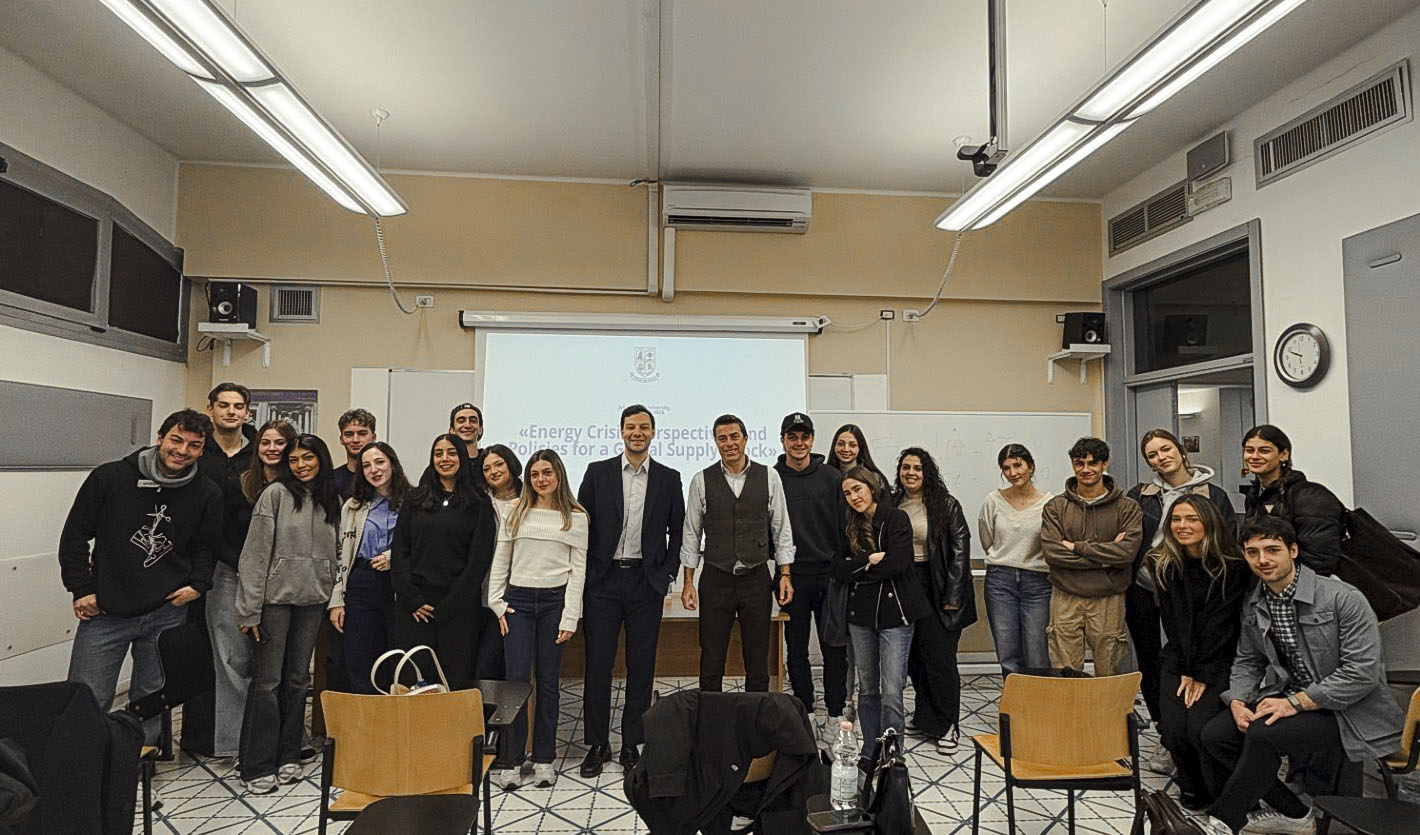
John Cabot University hosted researcher and economist Alessandro Cascavilla for a lecture on the growing global energy crisis and its potential impact on economies worldwide. Cascavilla, who, holds positions at Sapienza University of Rome and Unitelma Sapienza, presented “Energy Crisis: Perspectives and Policies for a Global Supply Shock.” The event was organized by JCU's Economics professor Sergio Scicchitano.
The seminar covered the economic theory behind supply shocks, connected to the closing of the Strait of Hormuz following the escalation of the Iran conflict. The Strait is a critical shipping passage between Iran and Oman, through which over 20% of the world’s oil and 30% of its liquefied natural gas travels. Cascavilla explained the impacts on global energy prices, inflation, and economic growth from the shock incurred from the closure.
Market data shows that the effects of the closure have been swift and severe. Crude oil prices have increased by about 14% in a single day after rising by over 54% in the past year. A spike in natural gas prices followed as well, and analysts at JPMorgan warn of prices doubling if the crisis persists. Cascavilla explained that for everyday consumers, this means higher fuel costsmore expensive goods, and a general rise in the cost of living.
Cascavilla contrasted the different impacts that the shock has for certain nations. Presenting data published in the Financial Times, he showed that energy-exporting nations like the USA and Russia stand to benefit from the higher prices. Russia earns an extra $150 million each day from oil revenue as a result of the crisis, American crude oil companies are expected to receive an excess of $63 Billion in 2026 if prices remain the same. On the other hand, energy-importing countries, especially in Europe, are in a far more precarious position. Italy in particular, Cascavilla noted, is in a very difficult situation since Italian households spend around 7.2% of their income on energy, one of the highest percentages among major advanced economies. He stressed that when energy prices rise, the impact on Italy’s economy is more severe and immediate.
He also compared the impacts on different kinds of households, highlighting that price increases hit low-income homes the hardest. Poorer families often have no choice but to work longer hours, reduce savings, and cut back on necessities when the cost-of-living spikes. On the other hand, wealthier families can withstand higher bills and cut back on energy usage.
Cascavilla then began to talk about the policy side, highlighting the trade-offs governments and central banks face. If governments try to boost the economy by cutting interest rates or by spending more, they risk making inflation worse. At the same time, tightening policy to reduce prices risks doing the opposite and worsening any recession. Using research from the crisis of 2022, he suggested that the best solution is to lower energy bills for people and businesses while simultaneously taxing the extra profits companies obtain from the crisis. Through these measures, the government will be able to fund the relief of ordinary civilians using the money taken from companies benefiting from the crisis.
The lecture was part of JCU’s ongoing series of academic events bringing current research and real-world analysis to campus.