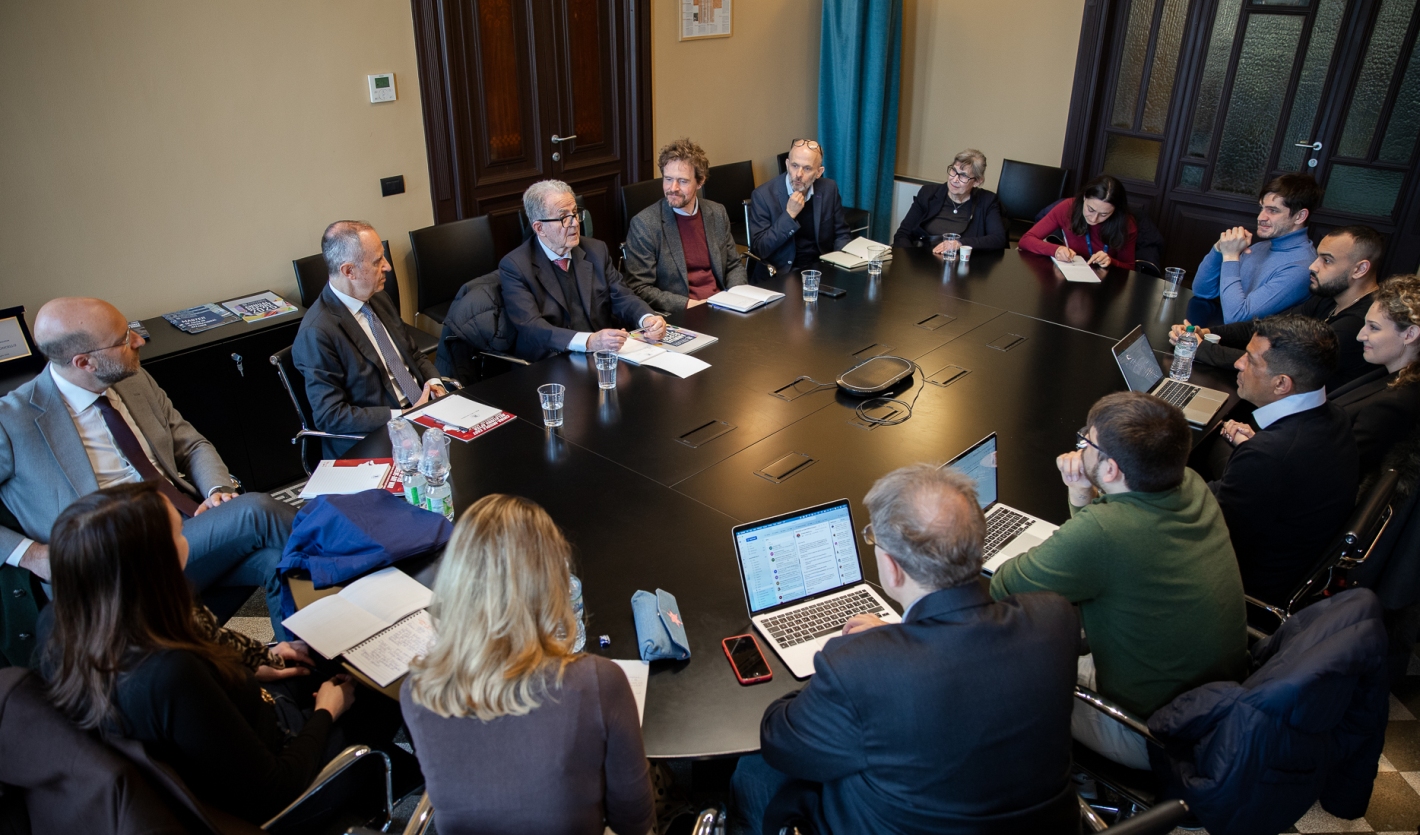
On February 18, 2026, John Cabot University welcomed former Prime Minister of Italy Romano Prodi for a practicum course with the MA in International Affairs students. Prodi’s distinguished political career, spanning five decades, includes two terms as Prime Minister of Italy (1996–1998; 2006–2008), President of the European Commission (1999–2004), and Head of the UN-African Union Committee for Peacekeeping in Africa (2008).
In addition to his academic background in economics and industrial organization and his extensive experience in domestic and international affairs, Prodi has had a distinguished academic career, teaching at institutions such as Brown University, Shanghai Business School, and Peking University. Despite his numerous achievements in local/national/domestic and European politics, Prodi considers teaching his foremost vocation and expressed his delight at being at JCU and interacting with students.
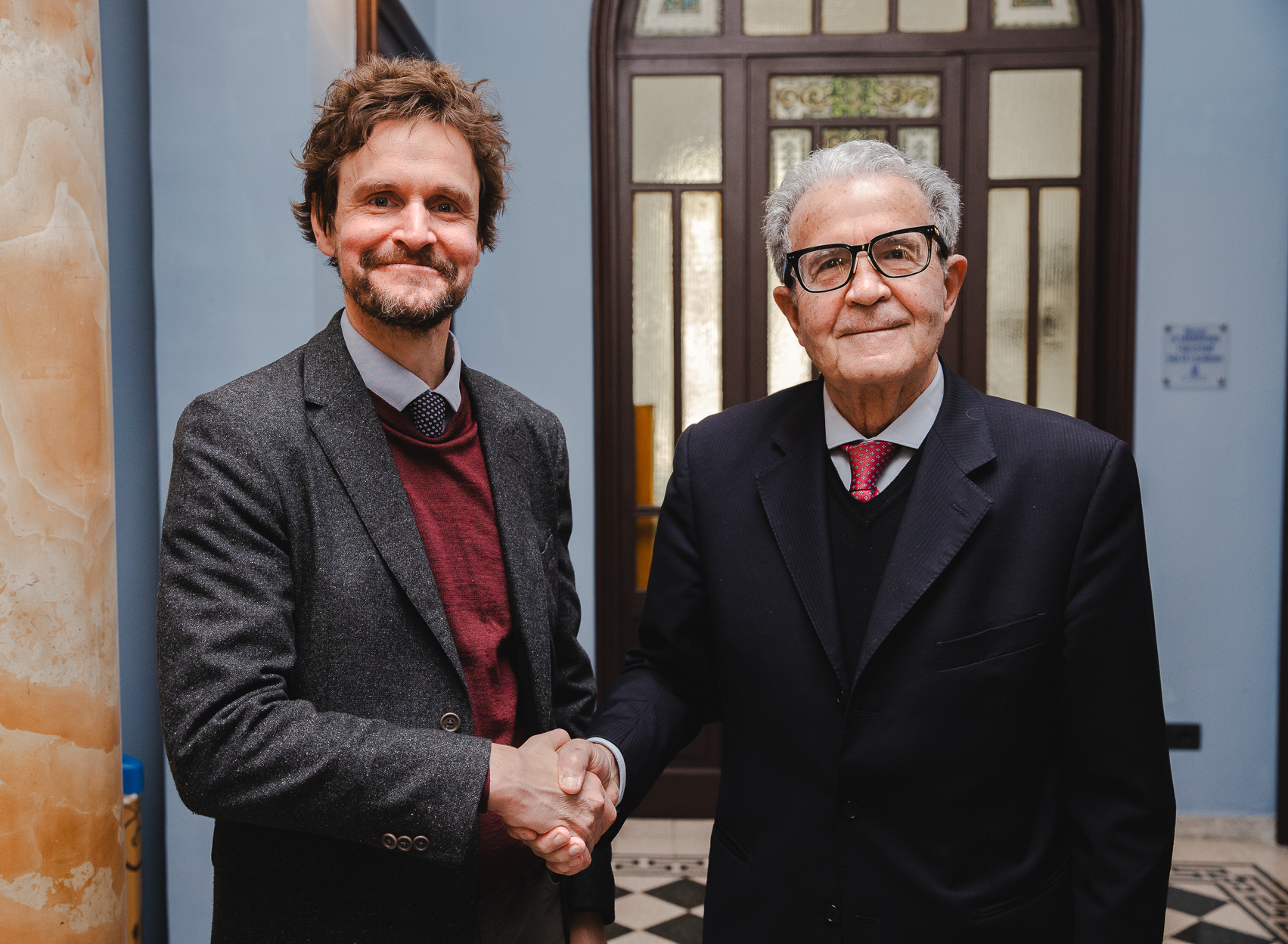
Michael Driessen and Romano Prodi
Italy’s Role in the EU and the Collective European Identity
Speaking about Italy’s relationship with Europe and its role in the European Union, Prodi sustained that, in addition to being one of the six founding members of the EU, Italy has been one of its three main pillars, alongside Germany and France. Italy’s role in the Union has been so significant that its participation is essential for any major EU decision. Even as debates continue among Italian political parties over the nature of Italy’s participation in the EU, and whether it should adopt a more federal or confederal model, Prodi reaffirmed the historical significance of the EU as a political project and stated that he sees Italy’s future firmly within the Union. In this regard, Prodi also advocated for a stronger collective EU identity, one that exists in parallel with national identities. He lamented the absence of a unified European voice on some key issues, particularly the lack of an active foreign policy, as demonstrated by the EU’s failure to effectively mediate in the Russo-Ukrainian war.
The African Continent and Trump’s Administration
Prodi then expressed his enthusiasm for Africa, calling it his “second passion.” At the same time, he shared more somber reflections on the current state of the African continent, noting that despite the younger generation’s growing anti-colonial perspective, Africa is increasingly influenced by Russia and China.
Other areas of discussion addressed the prioritization of geopolitical stability versus institutional readiness for safeguarding the integrity of the EU, as well as the Union’s strategic autonomy and digital sovereignty vis-à-vis the United States and China. Additional topics included the extent to which the United States acts reciprocally in its relations with Italy, how Donald Trump is reshaping global politics, the pervasive climate of fear in contemporary international relations, UK-EU relations, and whether political polarization reflects deeper economic and conceptual transformations.