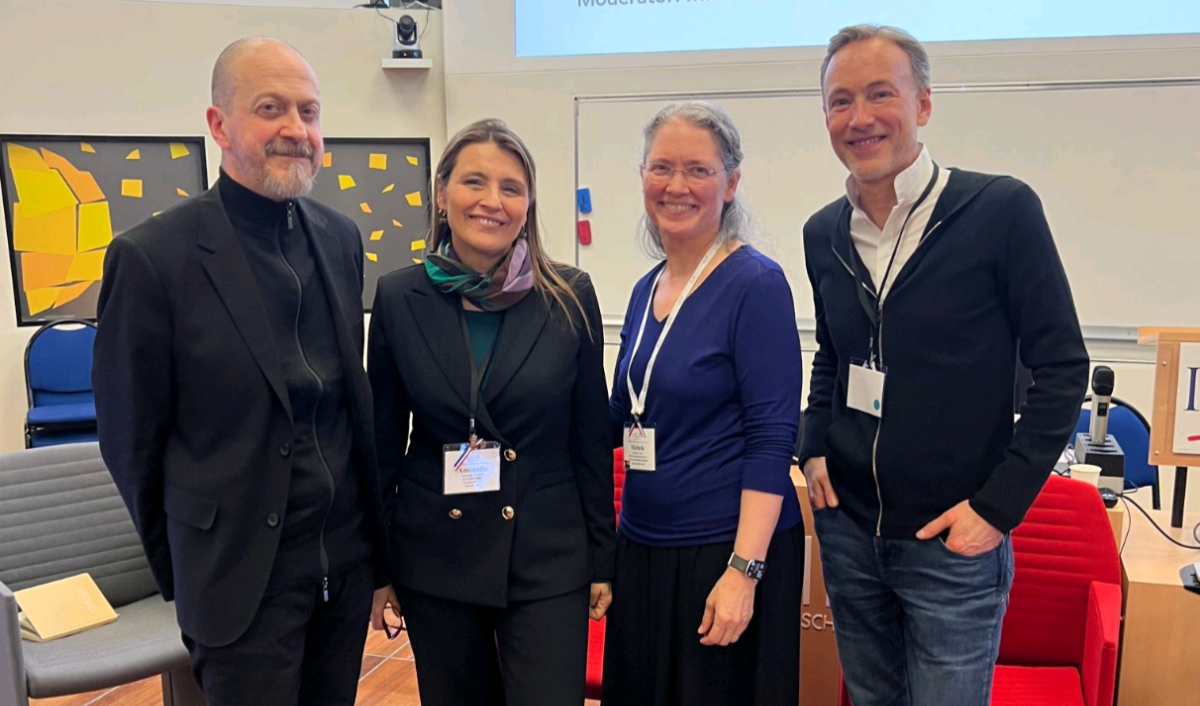
Francesco Lapenta, director of the Institute of Future and Innovation Studies at John Cabot University, recently was invited to participate in the Independent Educational Consultants Association (IECA) 2026 Symposium, held at the Grande Arche de La Défense in Paris. The two-day gathering brought together senior representatives from around 40 universities across Europe and the US, and about 80 independent educational consultants. The IECA symposium reinforced the importance of a transatlantic dialogue on the future of higher education under current technological transformations, particularly as artificial intelligence continues to reshape the global knowledge ecosystem.
The symposium consisted of leading figures in global education policy and university leadership. Director Lapenta joined discussions alongside Andreas Schleicher, director for Education and Skills at the OECD, as well as Boris Walbaum, Antonella Sannella, Michele Evard, and other senior experts. The event was organized by Katja Iuorio, Maria Castillo, and Stephanie Simpson. Participants examined how AI is reshaping the economic, institutional, and epistemic foundations of higher education systems across the Atlantic.
During his presentation, Director Lapenta emphasized that AI is not simply introducing new tools into education but is exerting structural pressure on the core architecture of the university system itself. The rapid expansion of advanced AI systems has introduced the possibility of producing written analysis, synthesis, and research support. This process is accelerating what he described as the commodification of structured cognitive production, outputs that have historically underpinned tuition models, credentialing systems, and academic authority.
“This shift carries significant implications for institutions built around the scarcity of expertise and intellectual production,” Lapenta noted during the symposium. “Writing, synthesis, analysis, and other forms of structured knowledge production are becoming increasingly abundant and low-cost. Universities are therefore entering a period of structural transformation.”
In this emerging landscape, universities, which are organized around the production, validation, and transmission of knowledge, are experiencing growing epistemic strain. The authority of the professor as the primary expert is being reframed. Even the skills often grouped under critical thinking are being produced by advanced AI systems with increasing fluency.
Director Lapenta argued that universities that fail to interpret these signals risk gradual structural erosion rather than abrupt collapse. “Institutions will not disappear overnight,” he stated. “But those that do not adapt will weaken slowly as the foundations of their economic and epistemic models shift.”
In this context, he stressed that adaptation cannot consist merely of integrating AI tools into existing systems. Instead, universities must redesign their institutional frameworks and focus on cultivating capabilities that remain scarce in an era of widely accessible machine intelligence. The central question now for higher education institutions is whether they will actively shape this transformation or be shaped by it.
Education must increasingly be understood as a long-term societal investment in navigating uncertainty, rather than simply a pathway to employment. Participants emphasized that AI is not just an additional feature of contemporary education systems but represents a paradigmatic shift that cuts across disciplines and compels institutions to rethink how learning environments are designed. Other panel discussions also underscored that the future is already present, though unevenly distributed across institutions and regions, placing a growing responsibility on universities to distribute opportunity more intentionally. In this context, fostering resilience, intellectual courage, and comfort with ambiguity emerged as critical capacities for students. As Director Lapenta noted during his talk, “the price of knowledge is to be wrong,” and preparing students to confront complex questions without predetermined answers may become one of the most important responsibilities of universities in the coming decades.