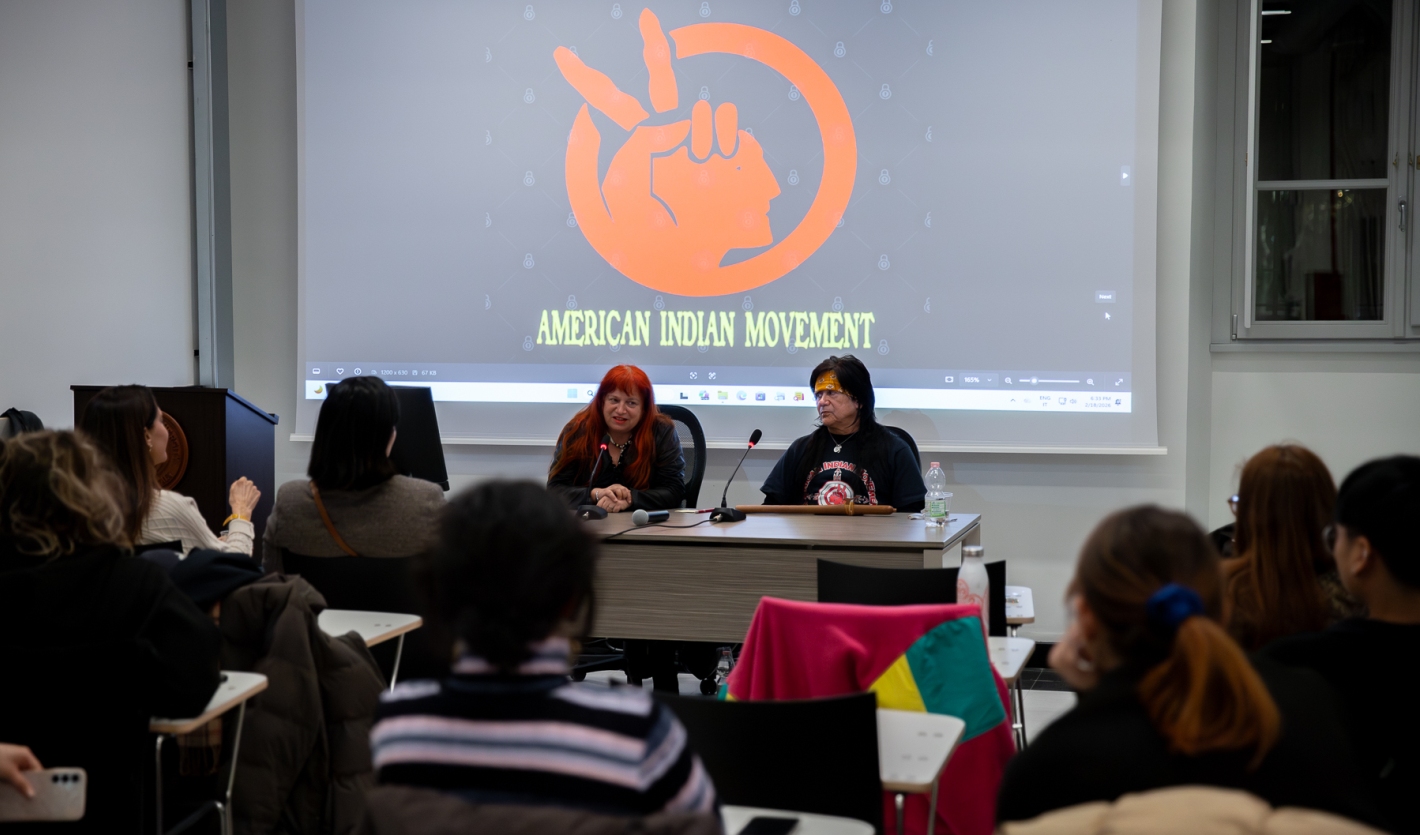
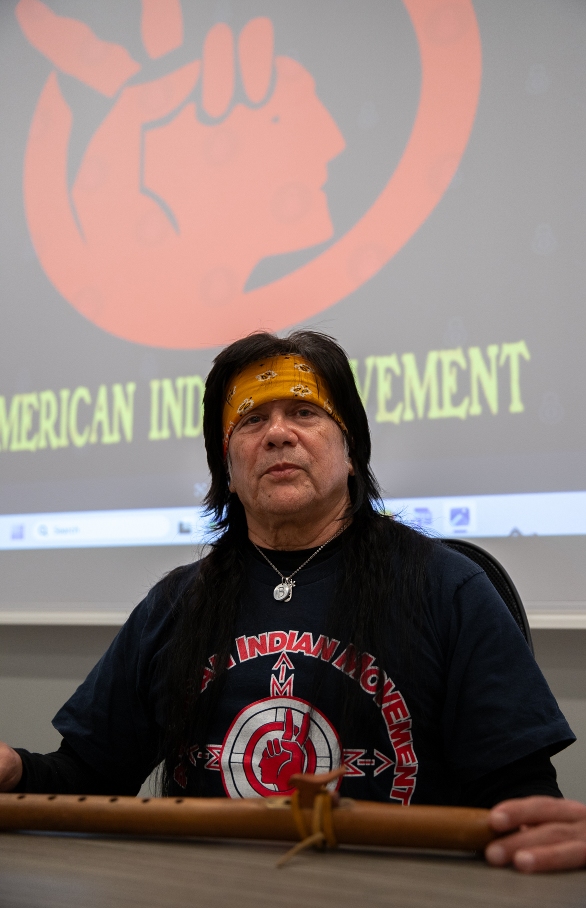
Donald "Buddy" Hatch (right) for "Healing and Freedom" at JCU
On February 18, 2026, John Cabot University welcomed Donald “Buddy” Hatch, former member of the American Indian Movement (AIM), for a lecture organized by Professor Andrea Lanzone. The event focused on the struggles of Native Americans to protect their rights and lands, and the rebirth of their cultures between the 1970s and today.
The Hatch family history represents a vital thread in the history of the Cheyenne and Arapaho tribes in Oklahoma. Buddy, son of Viola Hatch (1930-2019), one of the American Indian Movement's most influential leaders, has been on the front lines of Native American rights movements, alongside historic figures such as Leonard Peltier, Russell Means, and Dennis Banks.
In the early 70s Buddy was expelled from school for failing to cut his hair and adhere to school rules. His mother opened a civil rights lawsuit that was unsuccessful. This was a pivotal moment as the American Indian Movement, which was gaining prominence at the time, adopted Buddy and his story as a symbol of resistance.
Donald "Buddy" Hatch
After this episode, Buddy went to live with the leaders of his tribe and grew up learning about his culture. Viola Hatch founded an institute in Oklahoma for Native children who were abused by public schools or were sent to Catholic boarding schools against their families’ will.
The AIM as a movement of resistance
Buddy discussed how the massacres of Sand Creek (1864) and Wounded Knee (1890) have profoundly reshaped the history of American Indian tribes and their relationship to the US government today. “Most US laws are trying to hold us down, but today we are a nation unto ourselves, and we should start acting like it,” said Buddy.
Buddy identified in Gaza the same pattern of resistance his people have been implementing over the centuries. “What is going on in Gaza right now is just like what happened to my people,” he said. “They’re trying to move them out of their country, or assimilate them, like they did to our own children with boarding schools. You hear about this melting pot in the US, but I’ve never agreed with that definition. Yes, we share ideas, food, places, but my people must keep the memories of who we are alive.”
“There are still many struggles amongst the younger generations of Native Americans,” said Buddy. “High suicide rates, drug and alcohol addictions, and segregation to reservations. These are common issues all over the world, but when you’re alone and isolated, that problem gets worse.”
The AIM’s mission: justice and protection
“The American Indian Movement taught me that our message is one of connection to the land, and also protection of all parts of the land.” Spirituality, he explained, is based on Earth and people’s connection to it. “God or the Creator gave us all that is on Earth, and we are here as caretakers. We do not own anything.”
Buddy also discussed how for years the AIM had to fight against stereotypical portrayals of American Indians in movies. “In Hollywood, my people used to be portrayed as evil,” he said. “When I was a child, my cousins and I would play cowboys and Indians, and we always wanted to be the cowboys because they were the good guys.”
However, Hollywood is changing. “Now, we are the actors, the writers, the directors,” said Buddy. “We’re telling our own story.”
He connected this once wrongful depiction to the message of resistance that the AIM wants to send. “We have to point it out when they’re destroying our water, our land,” stated Buddy. Keeping their struggles in the public eye is how we can make sure the American colonization and its consequences will never be forgotten.