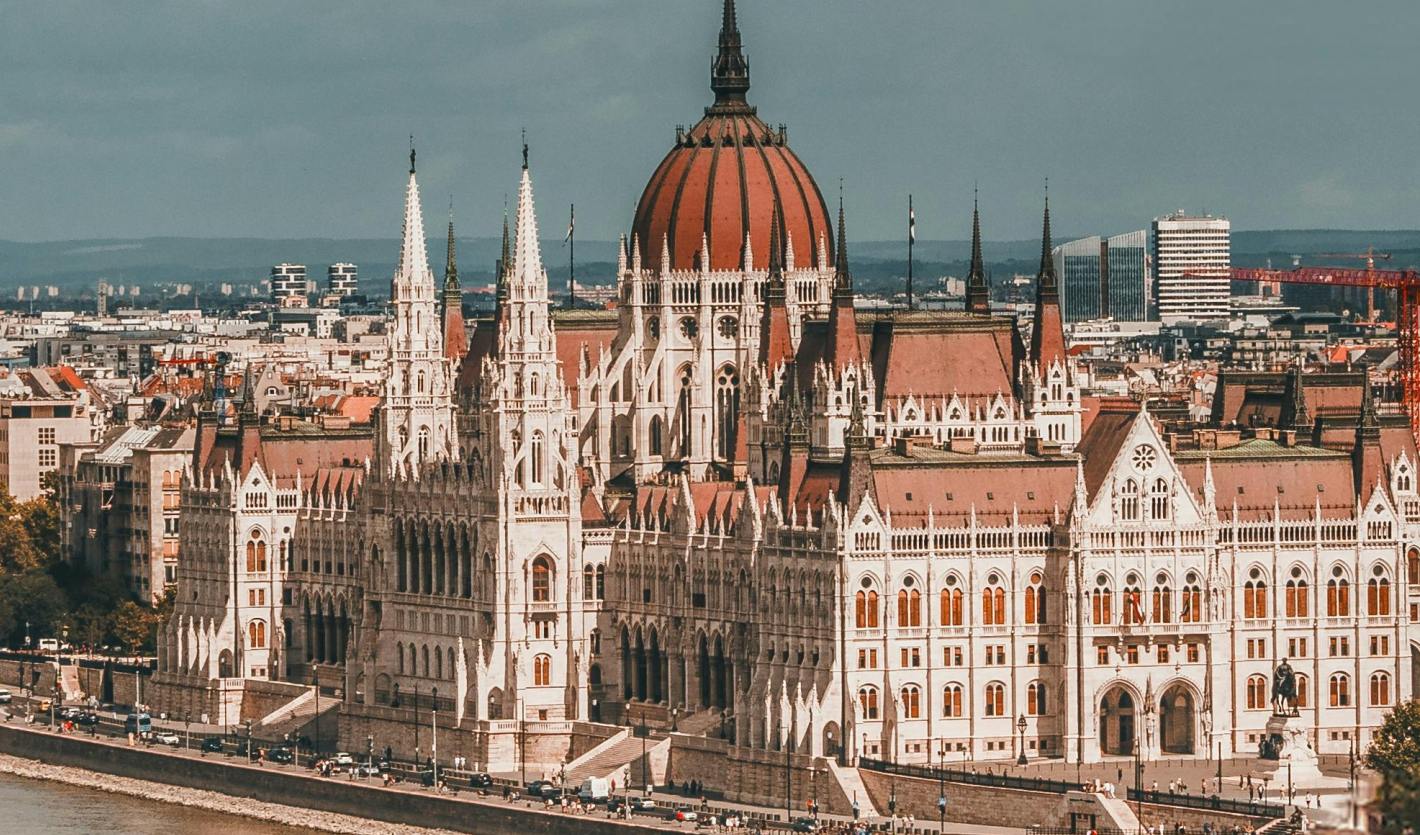
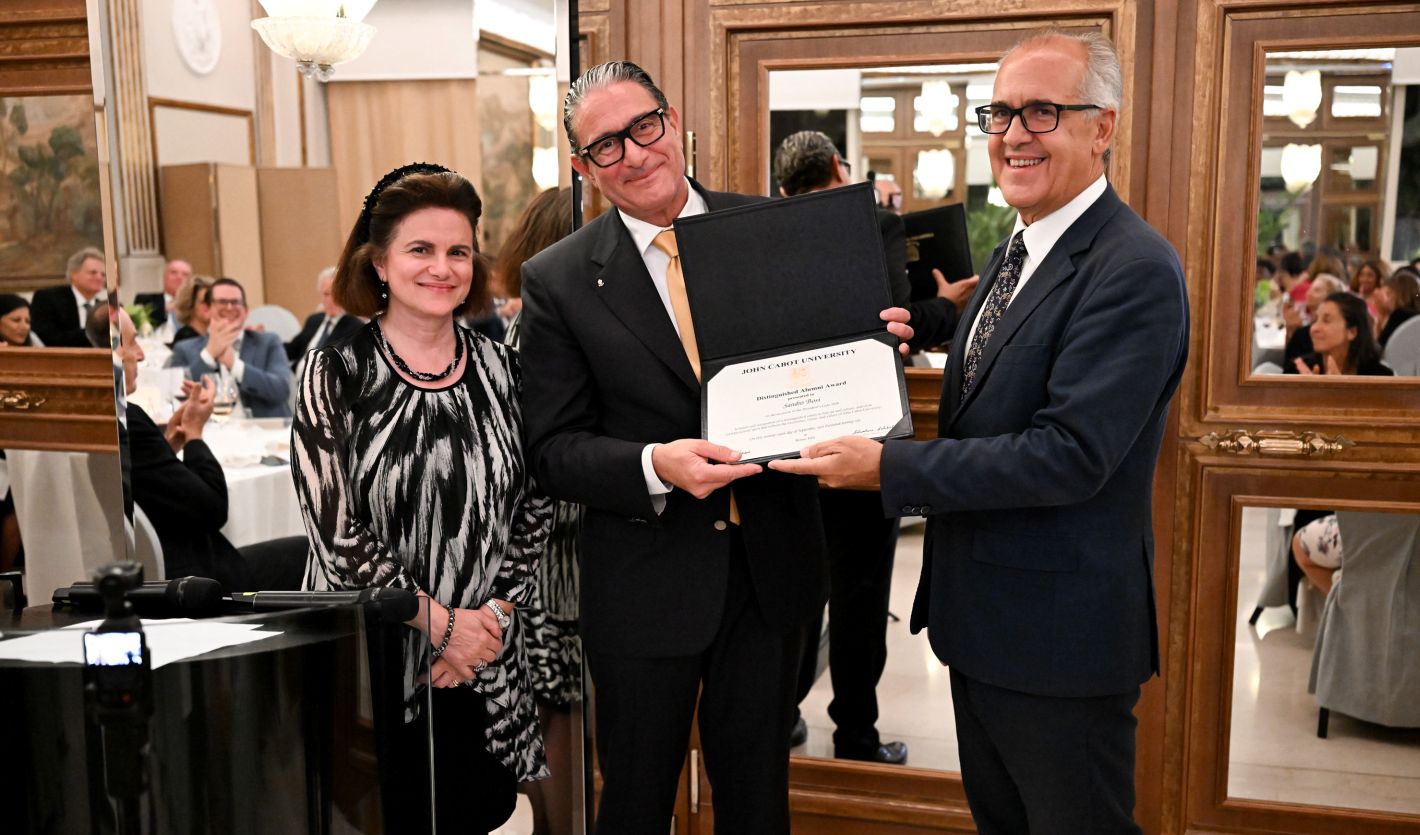
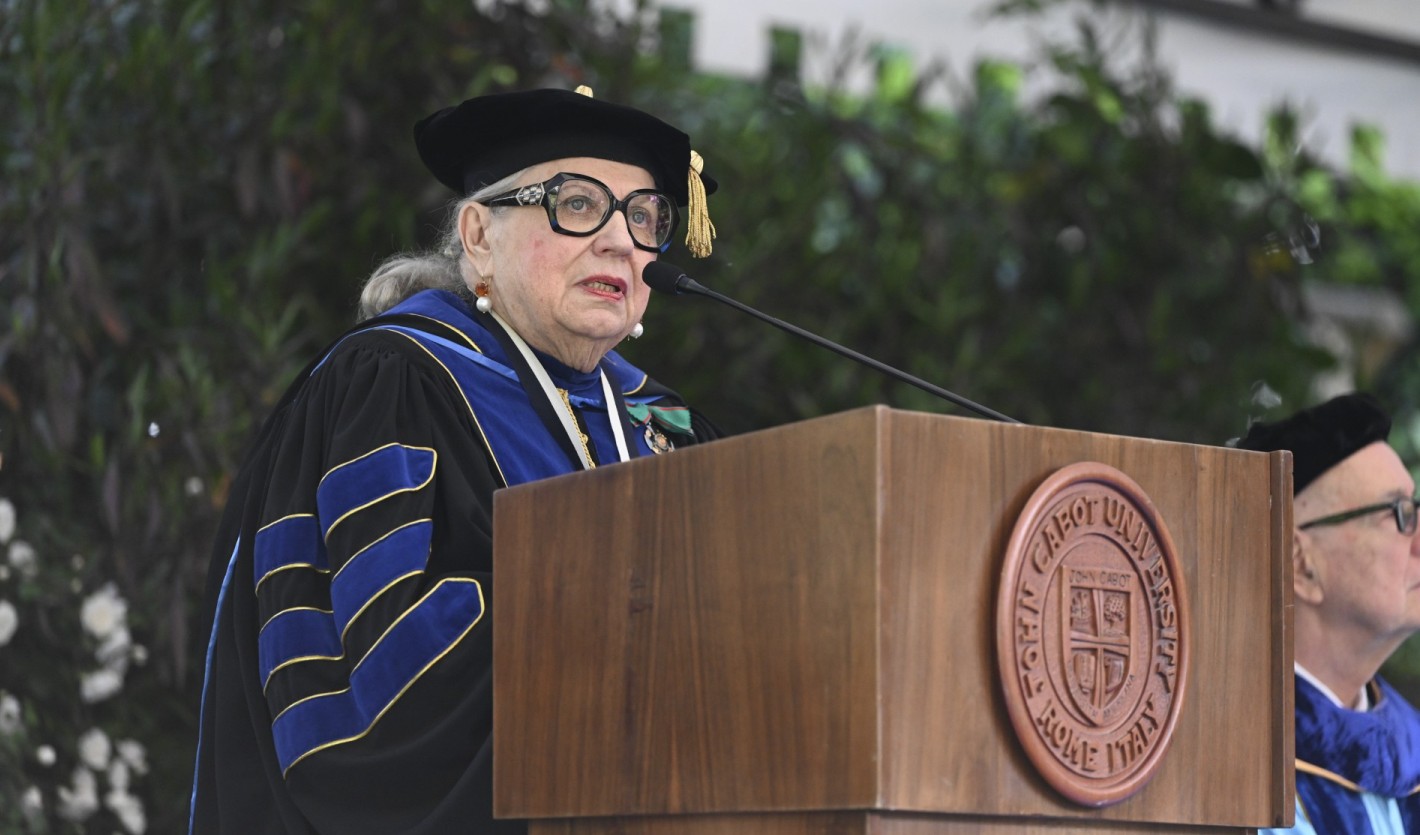
On February 9, 2026, the JCU Guarini Institute for Public Affairs hosted Professor András Nagy for a lecture on Hungary. Nagy examined Hungary’s relationship with international organizations across two distinct historical moments: the 1956 Hungarian Revolution and Hungary’s contemporary position within the European Union. The discussion was moderated by student Martina Atanasova, president of the International Relations Society, who also provided a comparative reflection drawing on Bulgaria’s post-communist experience.
The United Nations and the Limits of Multilateral Action
Professor Nagy began the lecture by situating Hungary’s relationship with the United Nations in the aftermath of WWII. Established in 1945 as a collective response to fascism and global conflict, the UN represented a new framework for international legality and cooperation. Hungary, classified as a former enemy state, was initially unable to join and only became a member in December 1955.
The 1956 Hungarian Revolution tested the capacity of the UN to respond to international crises. The Soviet intervention in Hungary raised fundamental questions regarding the UN Charter – the organization’s founding document – and the scope of collective security. Yet the organization’s structural constraints, such as the Security Council veto and the realities of Cold War power politics, limited its ability to act in a decisive manner. While investigative mechanisms were established and General Assembly resolutions adopted, enforcement proved unattainable. This pattern recurs when powerful states—particularly veto-holding members—are directly involved in geopolitical crises.
Professor Nagy emphasized that the Hungarian case illustrates the tension between the moral authority of international law and the geopolitical conditions required for its implementation. The UN’s response was further complicated by internal political maneuvering, the broader international context – including the Suez Crisis – and the newly installed Hungarian government’s insistence that the situation constituted an internal affair. The episode became emblematic of the limits of multilateral institutions operating within polarized power structures.
Post-Communist Transition and EU Membership
Turning to the post-1989 period, Professor Nagy examined Hungary’s accession to the European Union in 2004 as the culmination of a long-standing aspiration for integration into a community of democratic states. EU membership was widely understood as an external anchor for institutional reform, democratic consolidation, and economic modernization.
However, developments since 2010 have generated sustained tensions between Hungary and EU institutions, particularly regarding rule-of-law mechanisms, media pluralism, and governance practices. Professor Nagy analyzed how supranational membership does not automatically ensure alignment in political direction, and how institutional frameworks can become arenas of contestation. Hungary’s repeated use of veto powers within the EU has further illustrated the complexities of decision-making in consensus-based systems.
The comparison between 1956 and the present does not suggest equivalence between political systems but rather highlights recurring patterns in state–organization relations when domestic political transformation intersects with international institutional commitments.
Institutional Design, Political Culture, and the Question of Trust
Student Martina Atanasova’s intervention broadened the discussion by introducing a comparative perspective from Bulgaria. Reflecting on her own experience of migration and return following Bulgaria’s EU accession in 2007, she emphasized that external integration does not automatically produce internal institutional trust. Democratic transition, she noted, is not solely a matter of formal membership, but of sustained political engagement by both leaders and citizens.
Her remarks underscored several broader themes: institutional design matters, but political culture and historical legacies matter more; external anchoring in organizations such as the UN, NATO, or the EU cannot substitute for domestic accountability; structural transformation is generational in scope. Membership can be inherited, but trust must be continuously cultivated.
The discussion also addressed contemporary challenges to multilateralism, including transactional approaches to diplomacy and debates within the EU over differentiated integration. These developments raise enduring questions about how institutions maintain cohesion while preserving effectiveness.
Concluding Reflections
Across both historical cases, the event highlighted a central analytical insight: international institutions derive their durability not solely from formal rules, but from the sustained commitment of member states to their underlying principles. The Hungarian experience, viewed across 70 years, offers a lens through which to examine the interaction between sovereignty, institutional membership, and political change.