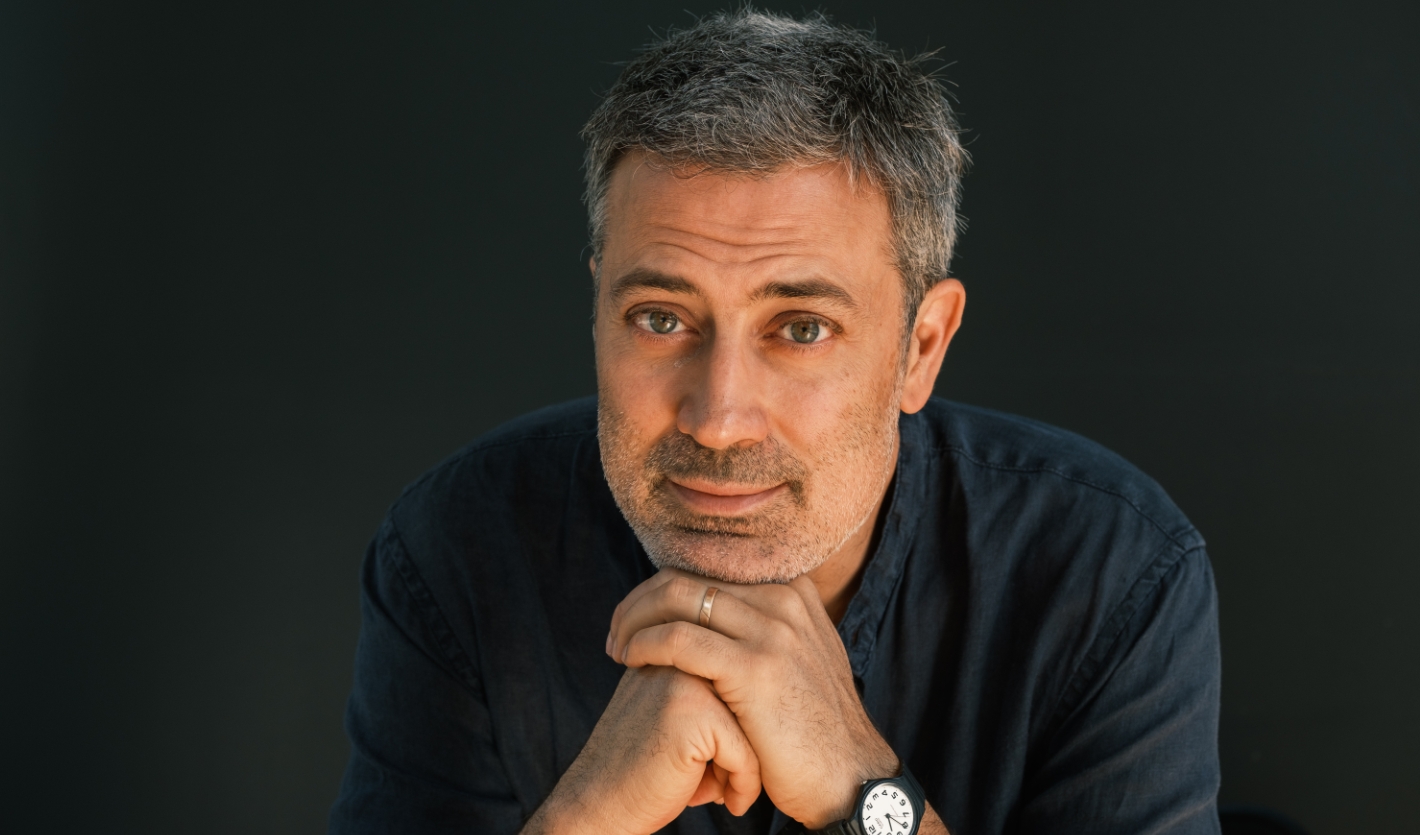
John Cabot University and the Institute for Creative Writing and Literary Translation are pleased to announce that the 2026 Writer in Residence will be Italian author Andrea Bajani. Bajani recently won the Premio Strega, Italy’s most important annual literary prize, for his novel L’anniversario (The Anniversary, Feltrinelli, 2025).
The Office of Web Communications had the pleasure of interviewing Bajani about his work — both as a writer and as a professor of creative writing at Rice University in Houston, Texas — and the inspiration behind his latest novel.
Tell us about your background.
I was born in Rome, but I’ve lived in Turin, Cuneo, Berlin, Paris, and Amsterdam, and I’ve been living in Houston, Texas, since 2020. It’s hard to say where I belong as a writer, but if I had to choose, I would say I belong to that place where all the writers I love are: the land of literature. It’s the place where you search for meaning through the only tool we have — language.
Who are the writers who have inspired and influenced you the most?
The living writers who are very important to me include Georgi Gospodinov (Bulgaria), Jenny Erpenbeck (Germany), Alejandro Zambra (Chile), Olga Tokarczuk (Poland), Juan Gabriel Vázquez (Colombia), Enrique Vila-Matas (Spain), Emmanuel Carrère (France), and George Saunders (United States). I would also include Roberto Bolaño (Chile) and Antonio Tabucchi (Italy).
They are all writers who reject the canonical definition of what a novel is. I’m interested in writers who refuse to take the bus, the official bus of the novel. They say, “Let’s go — I’ll carry a suitcase with a story inside, but I’m not sure I’m going to take the bus. I might walk, or I might fly.” For them, it’s not about finding a story and telling it in a catchy or compelling way; they deconstruct the idea of the novel they write, but they always have the reader in mind.
In general, I’d say that the writers who inspire me the most are the “weird” ones who write “weird” novels. Franz Kafka, for example, has always been considered a weird writer. But also, Marcel Proust, Milan Kundera, Peter Handke.
The literary movement that really changed my life as a writer is modernism. The first class I took in college was on modernism, and Virginia Woolf was the first author who really inspired me. Her writing is completely structured, yet not very easy to read. When I read, I want to be challenged, but I still want to enjoy it. Reading is like good food: you can’t just swallow; you need to chew and savor it. And then you want to go slowly because you don’t want to finish it and be left with an empty plate.
Tell us about your courses at Rice: Introduction to Fiction Writing and Writing the Family.
Introduction to Fiction Writing is always interesting because there’s a variety of human beings: some are obsessed with writing, some are sick of engineering courses, and so they take a class in creative writing, some used to read a lot in high school but then they stopped, and they wanted to take it up again, and so on. There is a lot of oxygen in the room, making it an intense experience.
Writing the Family is the course that inspired me to write L’anniversario. I realized that it’s a topic that everybody is interested in, one way or another. Writing about families always involves many archaic and primary emotions. Everybody comes to my class with their own pain, and they usually want to figure something out. But I never ask if what they write is autobiographical. Every time you write about families, it’s a huge mess; every emotion is in capital letters. Students want to understand why even the best families are messed up. And this mess is perfect for writing.
Congratulations on winning the Premio Strega for L'anniversario. It's a bit of a shock to learn that the anniversary is not of something festive but of a loss, a son's decision to cut off all ties to a dysfunctional family with a cruel, authoritarian father and a passive, annihilated mother. What inspired you to write it? Are people surprised by the fact that an Italian writer tells the story of someone who abandons their family?
Usually, the book that wins the Strega prize is marketed as the book of the summer — a book you can read on the beach. Because of this, people were shocked by the ending; they didn’t expect it. But people kept reading my book. First, that was reassuring for me, as a writer, as well as energizing for everybody in my field. Second, it demonstrated that it’s not true that people only want to read books that reassure them. They don’t want to be comforted by the idea that the book is exactly what they expected. They want to be challenged in their own beliefs.
L'anniversario touched a taboo — the idea that you can question the archaic institution of family and the belief that no matter what happens, you need to stay within the walls of the home. It’s like a totalitarian system that forces you to be quiet and accept the situation. The real “scandal” is that you can treat family like any other relationship. You are fully entitled to remove yourself from a situation that is dangerous for you. This is the story of a 40-year-old who decides to cut off his family. This taboo implies words like guilt and abandonment, but it’s about claiming a right — the right to feel safe.
Moreover, all of this happens in Italy, a country where family is everything; it is like a super-power, almost above the law and the institutions. But all of a sudden, thousands of readers were recognizing themselves in my protagonist, and their families suddenly weren’t all that original.
It was not planned, but it became a political book, questioning the patriarchy. Patriarchal societies are based on the idea that one person, because of his gender, can dominate another, who, for the same reason, is dominated. That’s why people have been writing about family forever. It’s also the only way we can understand it. I do believe I’m a family man: family is the most common way we can protect ourselves. But within that is a tension that evokes primary emotions.
You once said: “We bring complexity — that’s what literary authors do. It’s a cultural and political achievement because you get to spread that complexity.” Can you speak more on this?
I think that simplification is one way in which violence can find its way into our society. One manifestation of this is propaganda, which is a simplified message. Propaganda is like a lifeboat in our difficult lives. It is a fictional narrative about the supposedly good old days. Literary writing, on the other hand, is a way of contradicting and contesting official versions.
Writing is about finding your own words, and that threatens the system. The first ones who do this are poets. They reject the idea that a phrase has to continue until the end of the line. If they want to stop it in the middle, they just do it.
When did you first know that you wanted to become a writer?
I always knew I wanted to write. It wasn’t even a conscious thought: writing has always been part of my physiology, of my identity. It is my obsession, and it’s impossible for me to separate it from living. Living and writing have always been the same thing for me.
In 2016, after more than 10 years of published books, I realized that I had forgotten the reason why I was writing in the first place. It wasn’t to go around the world and listen to an audience applauding me. It eventually made me write less and worse. It made me lose my focus, which was to understand the world by writing about it. I needed fewer words to come out of my mouth and my pen, to be more in touch with reality.
So, I went back to a job in the publishing industry, then I moved to the U.S., where I started teaching. Teaching is the best of the “dancing bear” life without the stupid things that feed your narcissism; it is the exact opposite. It is about thinking through writing and reading literature, and then sharing it with a new generation of young people who come from a different culture and language.
What is your relationship with your translators? What is the relationship between your work as a translator and your work as a writer?
I like working with my translators. Last year, at the Frankfurter Buchmesse, I ran into five of them. They were all together, walking towards me. It was so strange: they were all different versions of myself — different genders, ages, languages, and personalities — but they are my voice in other countries. It was fascinating.
The job of a translator is very challenging. They have to rewrite the story in their language while also maintaining the author’s voice. Translating is based on empathy and trust, which is the opposite of today’s world, where trust is a scarce commodity.
As a translated author as well as a translator myself, I believe that translators are the ones who know the book best, even more than the author. They probably subtract a bit of mystery because they have to make it work in another language, and to do so, they have to understand what’s written on a deeper level. That’s why I’m a bit intimidated by them. They are always able to find my mistakes and inconsistencies. Should the writer then be allowed to fix the mistake? I was stuck on this question, but then I decided to almost never fix mistakes.
What are you looking forward to as JCU Writer in Residence in Summer 2026?
I’m looking forward to enjoying all the things I said about teaching and writing. I am happy in Houston because I like the feeling of living in another language. In a way, it is the perfect definition of fiction: something completely true that is crafted— it’s not natural. I also like to give myself the chance to express my other selves, which can’t find their place in only one language.
Language is so “bossy:” it is connected to the way you grew up and all the experiences you’ve had, and so you are kind of stuck in a version of yourself; whereas, in another language, you can bring all the things you want to the surface. There are so many other options. All of this is particularly enabled in an international university like JCU.
How do you view the future of books and literature?
Literary trends are unpredictable. For instance, if you check the best-seller list right now, you’ll see a lot of “alien” genres: romance, published YouTubers, and more. We’re not used to seeing that. We have the impression that the publishing system has “poisoned” literature. But from another perspective, the farther we get from “good literature,” the better for literature itself: there will be a moment when people will be eager for good literature again.
We are in a terrible moment — and this is evident also on a political, cultural, and sociological level — but I have the impression that despair usually brings good art. It’s not a comforting thought, I know, but it is what it is. I mean, some of my favorite books were written around the time of World War I, which was one of the worst times in human history. I can’t say that I’m confident, but statistically, it’s in moments of crisis that good things show up.
Do you think that good writing can be taught? If yes, how?
I grew up without creative writing programs in school; it’s a pretty new concept in Europe. You can become a writer by having Woolf and Céline as teachers, just by reading.
If you don’t necessarily have a creative writing talent, or you haven’t studied it, you can still write; you just might need more work and practice to make it professionally.
If you have the chance to be a writer — and I might be biased here — your life is going to be so much better. You will have the chance to understand and create something. It’s like cooking, but with ingredients that are in your soul; you make something out of what you have inside yourself and what you have experienced. This is what I hope that my students take away from my classes.
Some of them will be good writers, but not because of me. You become good at it only thanks to you, not thanks to your parents or your teachers.
It’s a chance for everybody. If you are a biologist and you also write, you will be a more thoughtful biologist. It’s a way of living twice as much.