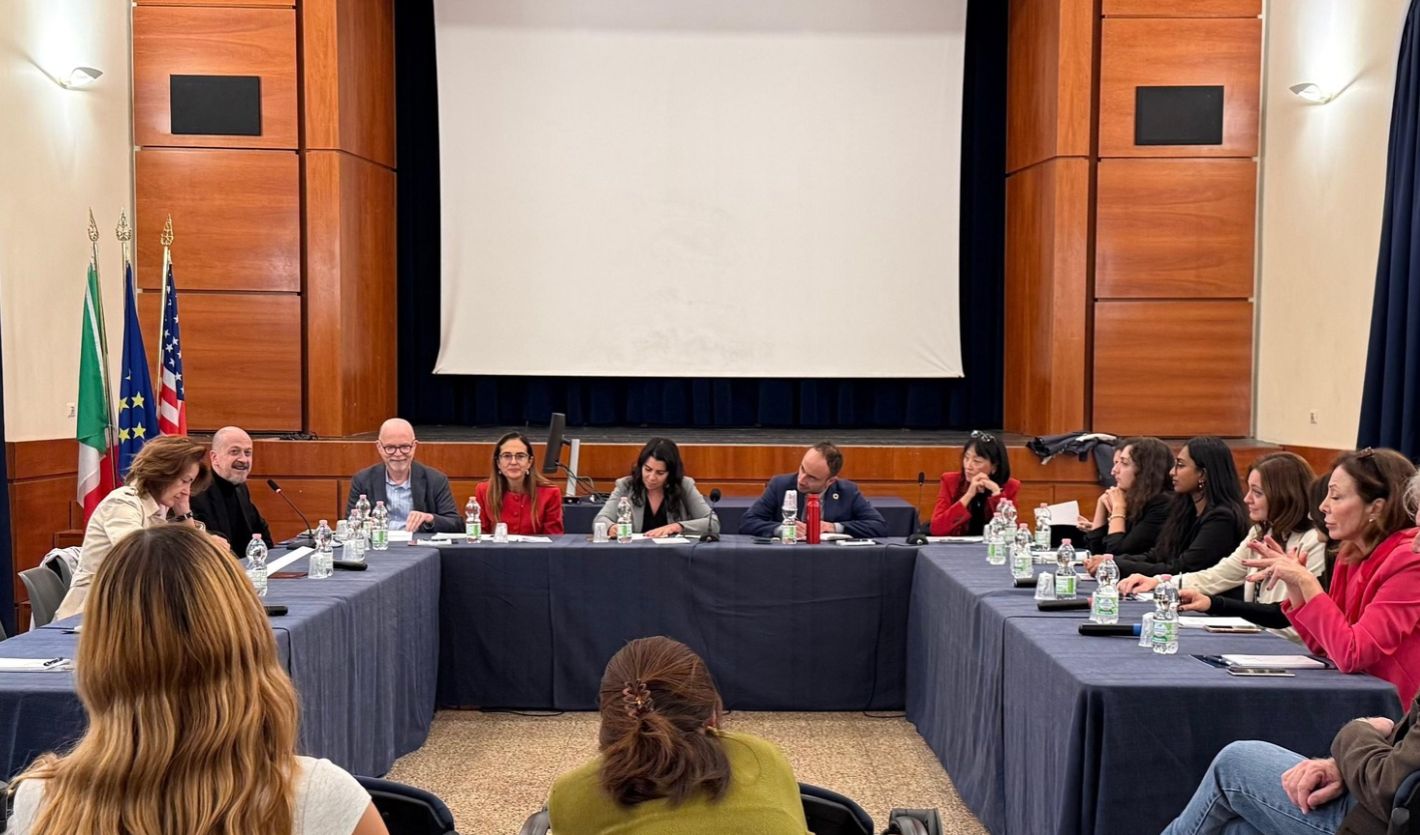
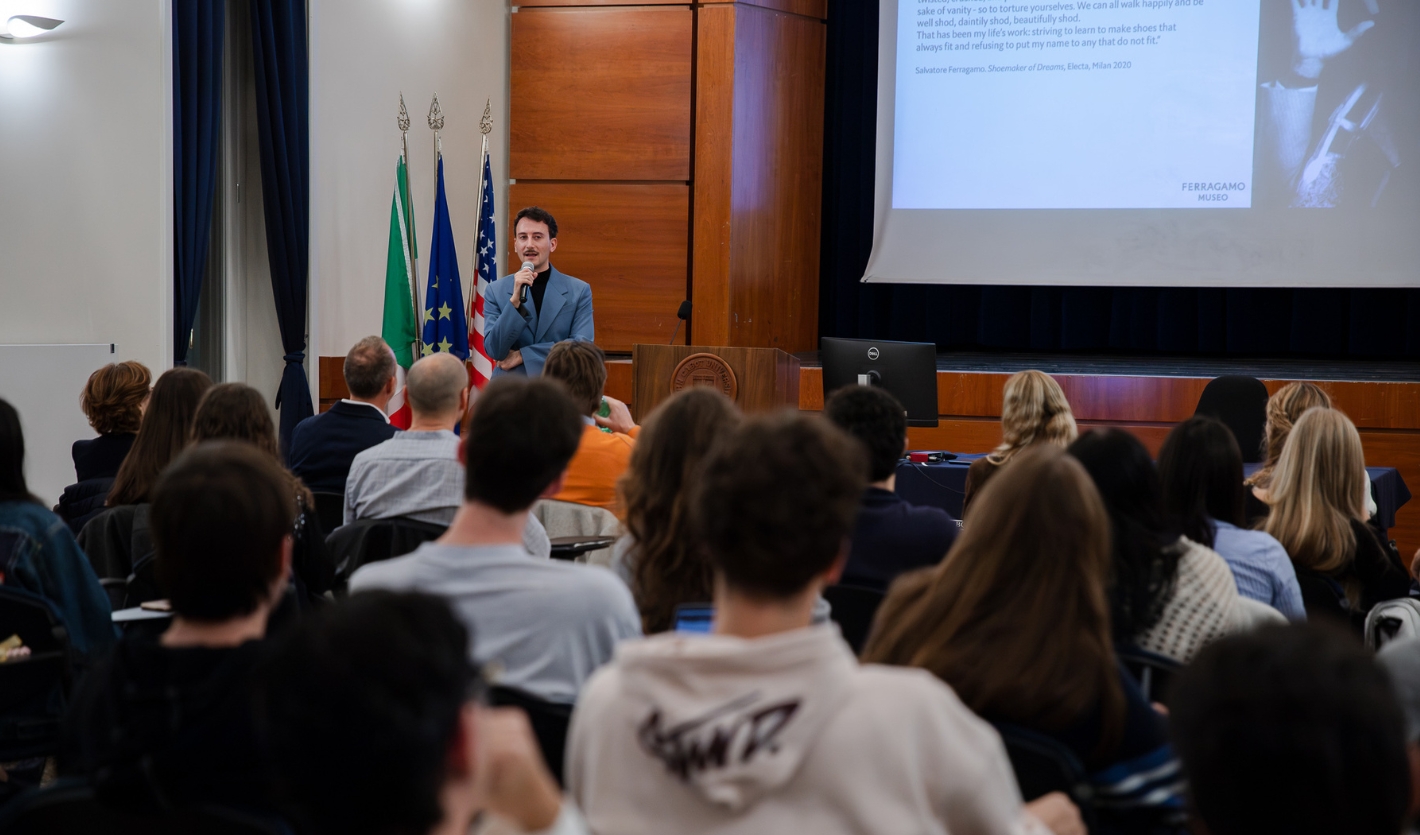
On October 23, 2026, John Cabot University's Institute of Future and Innovation Studies (IFIS) hosted “Foreign Policy Futures: Innovation, Inclusion and the Changing Architecture of Global Security,” a policy roundtable organized as part of the 2026 Festival della Diplomazia, in collaboration with Women in International Security (WIIS) Italy. The event brought together representatives of international organizations, academic institutions, diplomacy, and public policy to examine the relationship between technological innovation, social inclusion, political representation, and international security.
Chaired and moderated by Francesco Lapenta, director of IFIS, the roundtable addressed a central question confronting contemporary international governance: how can technological innovation and more inclusive political and institutional structures contribute to building societies that are more resilient, equitable, and secure?
Women's Representation, Social Justice, and the Distribution of Power
A central dimension of the discussion concerned the role of women in political, economic, and institutional life. Participants examined gender-responsive policies, the Women, Peace and Security agenda (a global policy framework established by the United Nations Security Council), and broader efforts to strengthen diversity and representation in decision-making.
The conversation extended beyond questions of formal representation to address the structural conditions that determine access to opportunities, resources, rights, and political influence. Social justice, economic inequality, cultural expectations, institutional barriers, and historical patterns of exclusion emerged as interconnected dimensions of the same challenge.
Particular attention was given to the distance between the formal recognition of rights and the conditions necessary to exercise them effectively. Legal equality and institutional commitments, while essential, do not necessarily translate into meaningful participation or a more equitable distribution of power. In foreign policy and international institutions, these differences influence not only who participates in decision-making but also which priorities, experiences, and interests are reflected in policy outcomes.
Technological Transformation and International Governance
The roundtable also examined how artificial intelligence, digital infrastructures, and emerging technologies are reshaping economies, political systems, and international relations.
Technological innovation offers significant opportunities for economic development, institutional modernization, and expanded access to knowledge and services. Its consequences, however, depend on the institutional environments in which technologies are developed and deployed. Participants considered the implications of technological change for the concentration of economic and political power, access to resources, and the emergence of new forms of inequality.
These questions raise broader concerns about the capacity of existing governance structures to respond to transformations that increasingly cross national, disciplinary, and institutional boundaries.
An Interdisciplinary Dialogue Across Institutions
The roundtable opened with contributions from: Clara Mi Young Park, Gender Team Leader in the Rural Transformation and Gender Equality Division of the Food and Agriculture Organization of the United Nations (FAO); Serena Lippi, Minister Plenipotentiary, Diplomatic Adviser to Italy's Minister of Education and Merit, and President of Associazione Donne Italiane Diplomatiche e Dirigenti (DID); Loredana Teodorescu, President of Women in International Security (WIIS) Italy and Senior Fellow at the Istituto Affari Internazionali (IAI); and Carmine Soprano, economist at the University of Rome Tor Vergata and Visiting Senior Fellow at the London School of Economics and Political Science (LSE).
Their opening perspectives established connections between international development, gender equality, diplomacy, economic policy, and institutional governance, providing a foundation for the wider discussion.
The exchange continued with contributions from: Paul Nemitz, former Director for Fundamental Rights and Union Citizenship at the European Commission's Directorate-General for Justice and Consumers (DG JUST), and member of the Advisory and Scientific Council of IFIS; Rithika Clifford, a student at SDA Bocconi School of Management and Policy and a Business Analyst at Vision Think Tank; Francesco Grillo, Director of Vision Think Tank, Lecturer at SDA Bocconi School of Management, and Fellow at the European University Institute (EUI); Patrizia Feletig, Member of the Advisory Council of the Guarini Institute for Public Affairs at JCU; and Francesca Todini, Senior Financial Journalist and News Anchor at La7.
Further contributions came from Mariangela Barletta, Research Fellow at the Istituto di Studi Politici S. Pio V and Member of WIIS Italy; Fabiola Bono, Policy Officer for European Affairs at the Italian Ministry of Environment and Energy Security (MASE) and Member of WIIS Italy; Silvia Scarpa, Professor of International Relations at JCU; and Licinia Pascucci, Researcher in Sustainable Development and Climate Change affiliated with the University of Cassino and Southern Lazio (UNICAS) and IUSS Pavia.
IFIS and the Future of Interdisciplinary Policy Dialogue
The event reflected the mission of IFIS to foster interdisciplinary analysis of the technological, political, economic, and social transformations shaping contemporary societies.
The collaboration with the Festival della Diplomazia and WIIS Italy connected academic research with professional expertise and ongoing international policy debates, bringing together institutions and individuals whose work addresses different dimensions of increasingly interconnected global challenges.