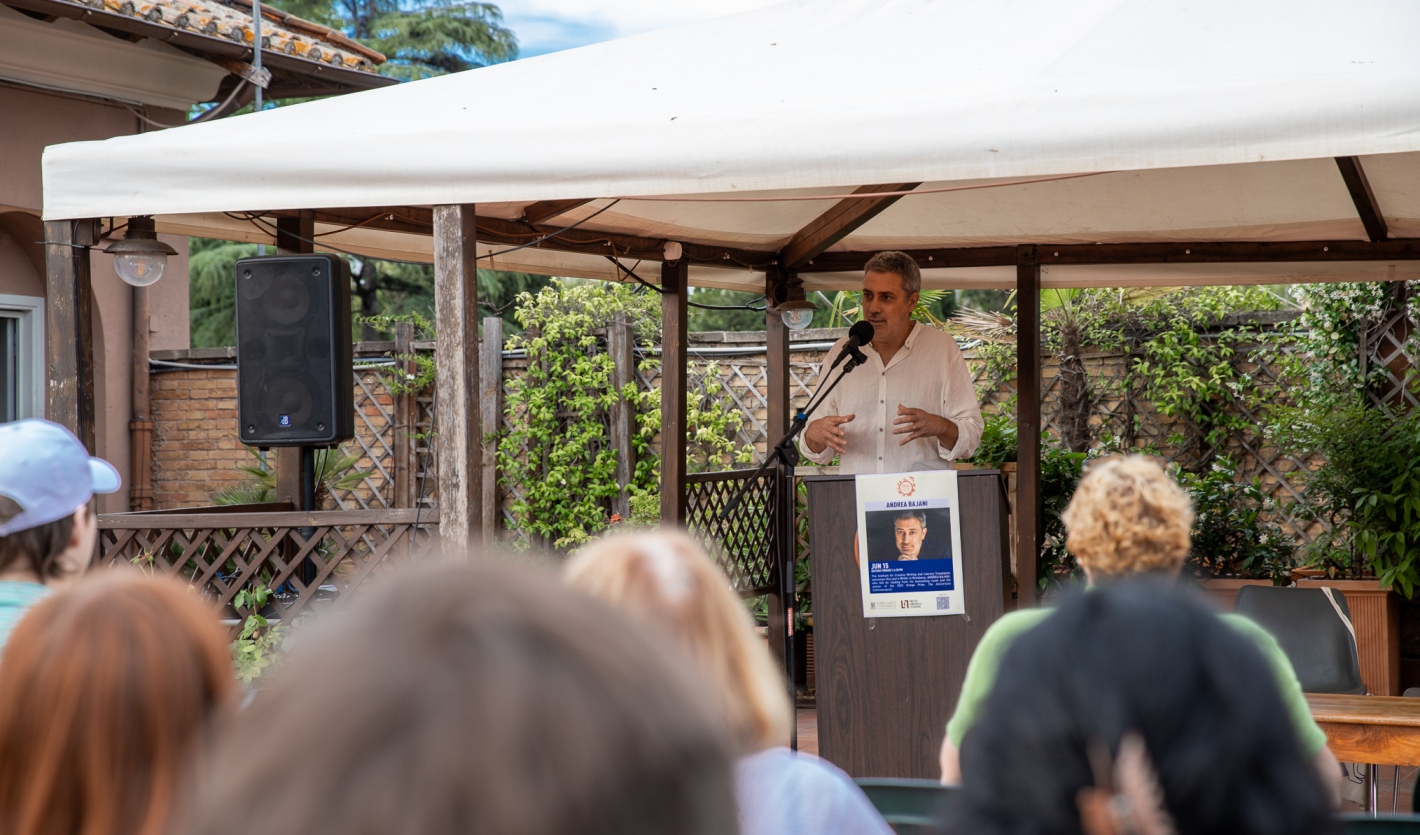
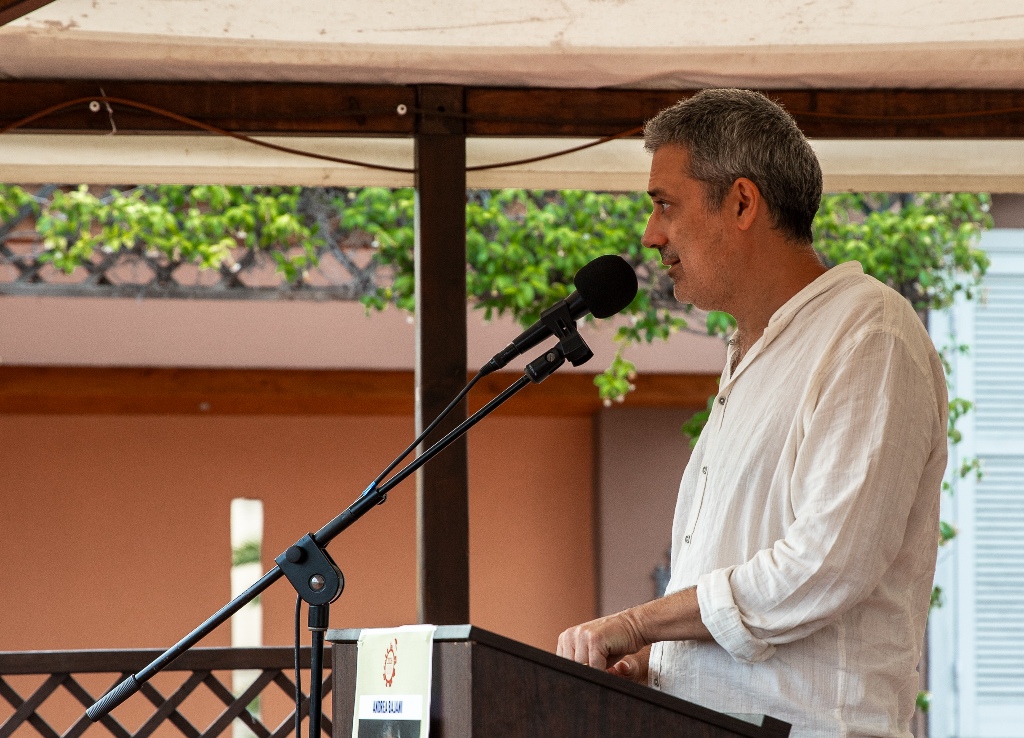
John Cabot University had the honor of hosting acclaimed Italian author Andrea Bajani as Writer in Residence for the 2026 Summer Institute for Creative Writing and Literary Translation. Bajani’s latest novel L’anniversario (Feltrinelli, 2025) won the Premio Strega, Italy’s most prestigious literary prize.
Bajani taught a masterclass for JCU students and gave a preview from the English translation of his award-winning novel, The Anniversary, which will be published in the US (Other Books/Penguin Random House) and in the UK (Penguin Books) later this summer. He also delivered a lecture titled “Be uncertain, be insecure, read poetry,” focused on poet Joseph Brodsky and on themes of solitude, language, and exile.
June 15, 2026: A Reading from The Anniversary
Bajani read three chapters from The Anniversary in Geoffrey Brock’s translation. In conversation with the audience, he discussed the main themes he explores in the novel – from family relationships and power structures to the challenge of resisting official narratives, especially patriarchy – and spoke about his writing process and the political foundations that make up his latest literary work.
A distinctive feature of the novel is the absence of character names. This choice shifts the emphasis from the characters’ identity onto the relationships and power structures, presenting the family as a political system shaped by stereotypical roles, such as mother, father, son, and daughter. The unnamed characters also encourage readers to see themselves reflected in the story.
Andrea Bajani
Although the first draft was written in just 20 days, Bajani spent three years revising it, with a mission to preserve its emotional intensity while removing unnecessary stylistic flourishes. He focused on clarity, empathy, and avoiding moral judgments, rather than reducing the characters to simple stereotypes. In this process of simplification of his Italian prose, Bajani found he was influenced by the English-speaking environment at Rice University in Houston, Texas, where he teaches creative writing.
Bajani also reflected on writing an Italian story for an international audience. He believes that imagining foreign readers helped him strip away unnecessary details and focus on the essential truths of the story.
June 18, 2026: “Be uncertain, be insecure, read poetry” – Andrea Bajani on Joseph Brodsky
In this talk, Andrea Bajani explored the relationship between exile, language, and literary creation through the life and work of Nobel Prize-winning poet Joseph Brodsky (1940-1996). Drawing from his own experience of living in Houston, Texas, Bajani reflected on the strange mixture of homesickness and awareness that accompanies life away from home.
Brodsky’s story served as the central example. Expelled from the Soviet Union, stripped of his citizenship, and forced to live stateless for years, Brodsky embodied exile not only as a political condition but also as a profound existential experience. For him, exile meant “radical solitude” and a complex relationship with language. As Bajani explained, a writer’s native language becomes both a refuge and a prison: the only real “home” left, which can bring isolation.
Bajani emphasized Brodsky’s belief that poetry is an “accelerator of conscience.” Poetry disciplines literary taste and teaches readers to resist empty language in politics, philosophy, fiction, and many other aspects. This conviction was famously presented by Brodsky at the first Turin Book Fair in 1988, in a lecture titled “How to Read a Book,” where he polemically criticized the commercialization of books and urged readers to immerse themselves in poetry instead.
In his talk, Bajani addressed the loneliness of exiled writers, who often hunger for recognition while feeling disconnected from the culture around them. At the same time, Bajani suggested that this very discomfort is essential to produce genuine literary work. Writing requires a continual rejection of accepted narratives and “common sense,” the assumptions we carry within ourselves.
In addressing the students in the audience, Bajani concluded with a challenge: embrace uncertainty, seek intellectual discomfort, and learn to question inherited truths. True writing, he argued, begins when we leave the safety of consensus and find the courage to speak with our own words.