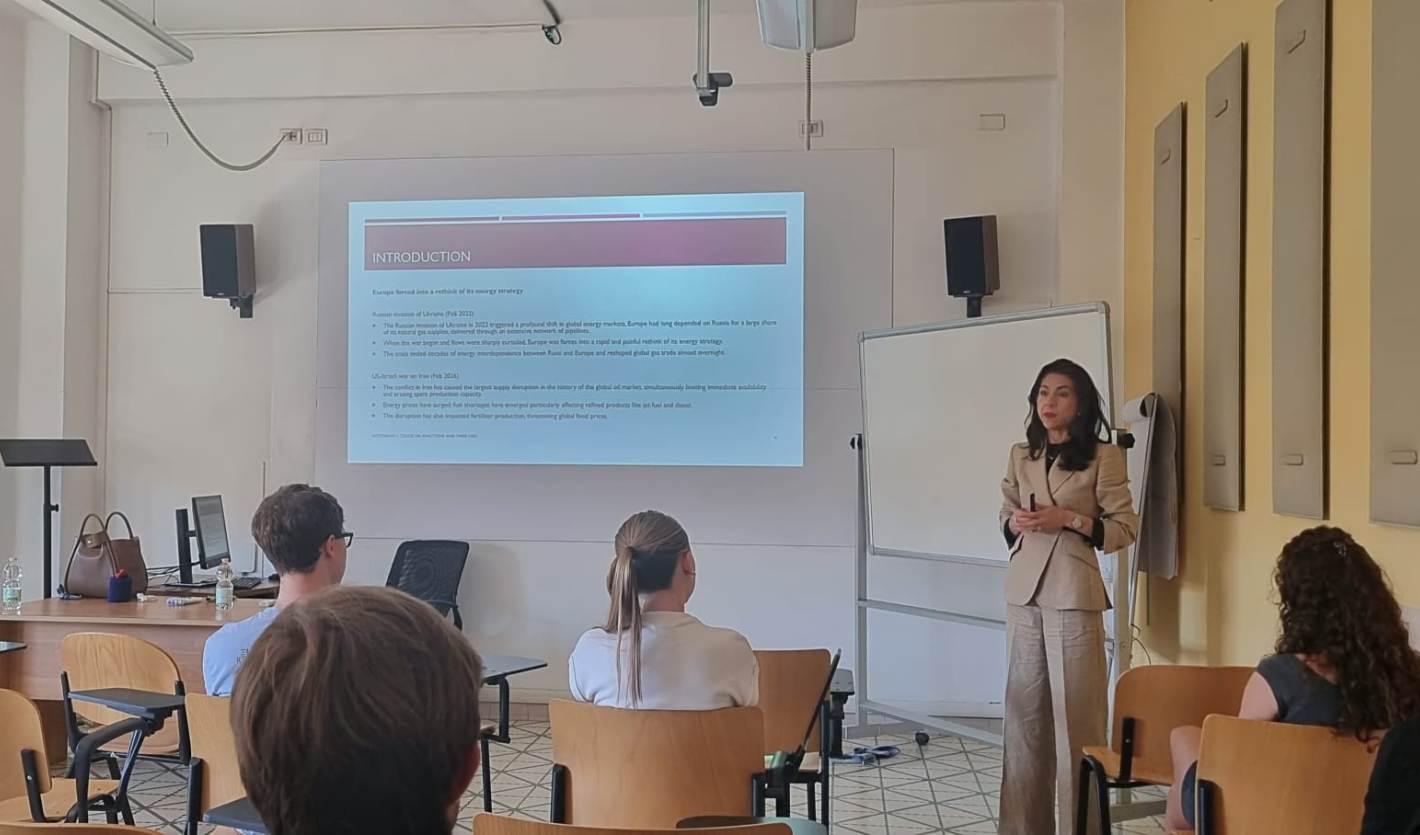
On April 27, 2026, students in JCU’s Introduction to Derivatives course, taught by Professor Andrea Delle Foglie, attended a seminar by Dr. Stela Gerova, Deputy Global Head of Derivatives Execution & Clearing Corporate Sales at BNP Paribas Corporate and Institutional Banking. Dr. Gerova discussed the diversification of energy supplies in Europe and its implications for hedging strategies. The lecture examined how a sequence of geopolitical shocks—most consequentially, the Russian invasion of Ukraine in 2022—has forced the European Union to fundamentally reconsider its energy model and, with it, the tools that companies use to manage energy risk.
Europe’s Energy Diversification Strategy
The starting point of Dr. Gerova’s analysis was a structural vulnerability that the 2022 crisis made impossible to ignore: Europe’s excessive dependence on a single supplier for natural gas. The response at the EU level has been a broad diversification agenda encompassing demand reduction, energy efficiency, import source diversification, accelerated renewable deployment, expanded strategic reserves, and infrastructure reinforcement. The scale of the challenge is reflected in the numbers: as of 2024, the EU still imports 57% of its energy needs, with oil and petroleum products representing the largest share of the mix, followed by natural gas, renewables, nuclear, and solid fuels. Despite meaningful progress, Europe remains materially exposed to external supply disruptions and international price swings.
The Role of LNG and Renewables
Two developments have reshaped the European energy landscape since 2022. The first is the rapid expansion of Liquefied Natural Gas imports. With Russian pipeline flows curtailed, Europe has turned to alternative suppliers—the United States, Norway, Algeria, and others—whose volumes arrive by ship and can be redirected according to market conditions. That flexibility comes with a consequence: European gas prices are now more tightly coupled to global LNG markets, importing a degree of volatility that pipeline supply had previously dampened.
The second development is the accelerated build-out of renewable energy. Wind and solar reduce dependence on imported fossil fuels and support the EU’s climate commitments, but they introduce a new category of risk. Because output is weather-dependent, energy markets are becoming more volatile and less foreseeable. Companies are no longer managing price risk alone—they must also contend with volume risk, since the amount of energy available at any given moment is no longer fully predictable.
Impact on Hedging Strategies
The second half of the seminar turned to the practical consequences for corporate risk management. Historically, energy hedging was a relatively contained exercise: lock in a price, protect the margin. That model is no longer adequate. Today, a company operating in European energy markets must simultaneously manage price volatility, renewable production uncertainty, LNG availability, cross-border flow dynamics, and carbon prices.
For renewable energy producers and offtakers, instruments such as Power Purchase Agreements, virtual PPAs, pay-as-produced contracts, and battery flexibility tools have moved from niche to mainstream. These structures allow companies to stabilize revenues and costs in markets where electricity prices can swing sharply with weather and grid demand. For gas and LNG, hedging has become increasingly global. Pricing benchmarks—TTF in Europe, Henry Hub in the United States, JKM in Asia—are now interconnected, and because LNG cargoes can be redirected between regions, traders use spread hedging to manage price differentials across markets. The result is a hedging environment that is considerably more dynamic and geographically complex than it was a decade ago.
Takeaway
Dr. Gerova’s seminar made clear that Europe’s energy transition is not only an environmental and political project—it is a risk management challenge of the first order. The growth of LNG, the expansion of renewables, and the tighter integration of regional energy markets have collectively made hedging a more demanding discipline. A static, set-and-forget approach is no longer sufficient. What is required instead is a flexible, active strategy that accounts for price volatility, supply uncertainty, renewable intermittency, and geopolitical risk. In that context, hedging is not speculation: it is the practical foundation of sound financial planning.