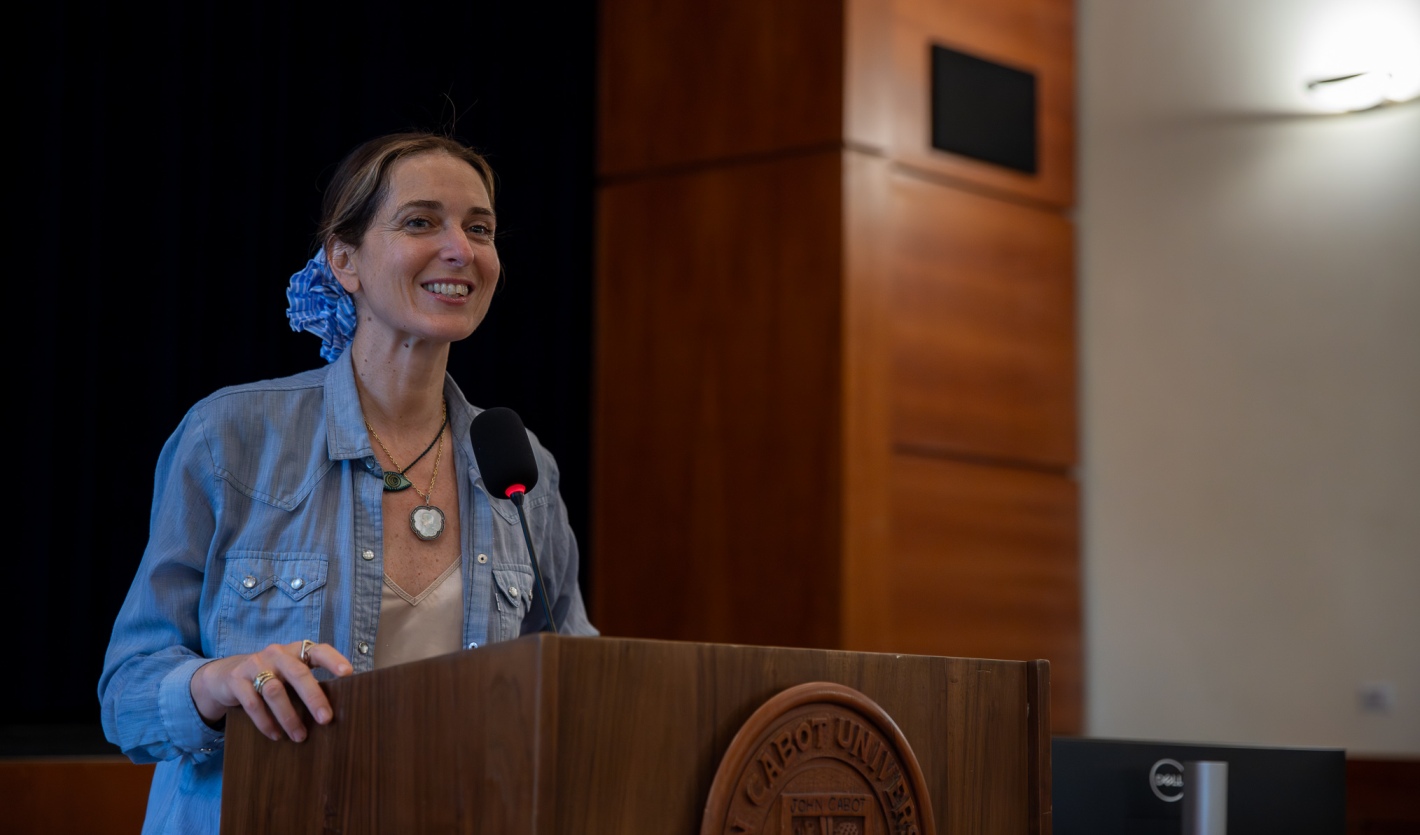
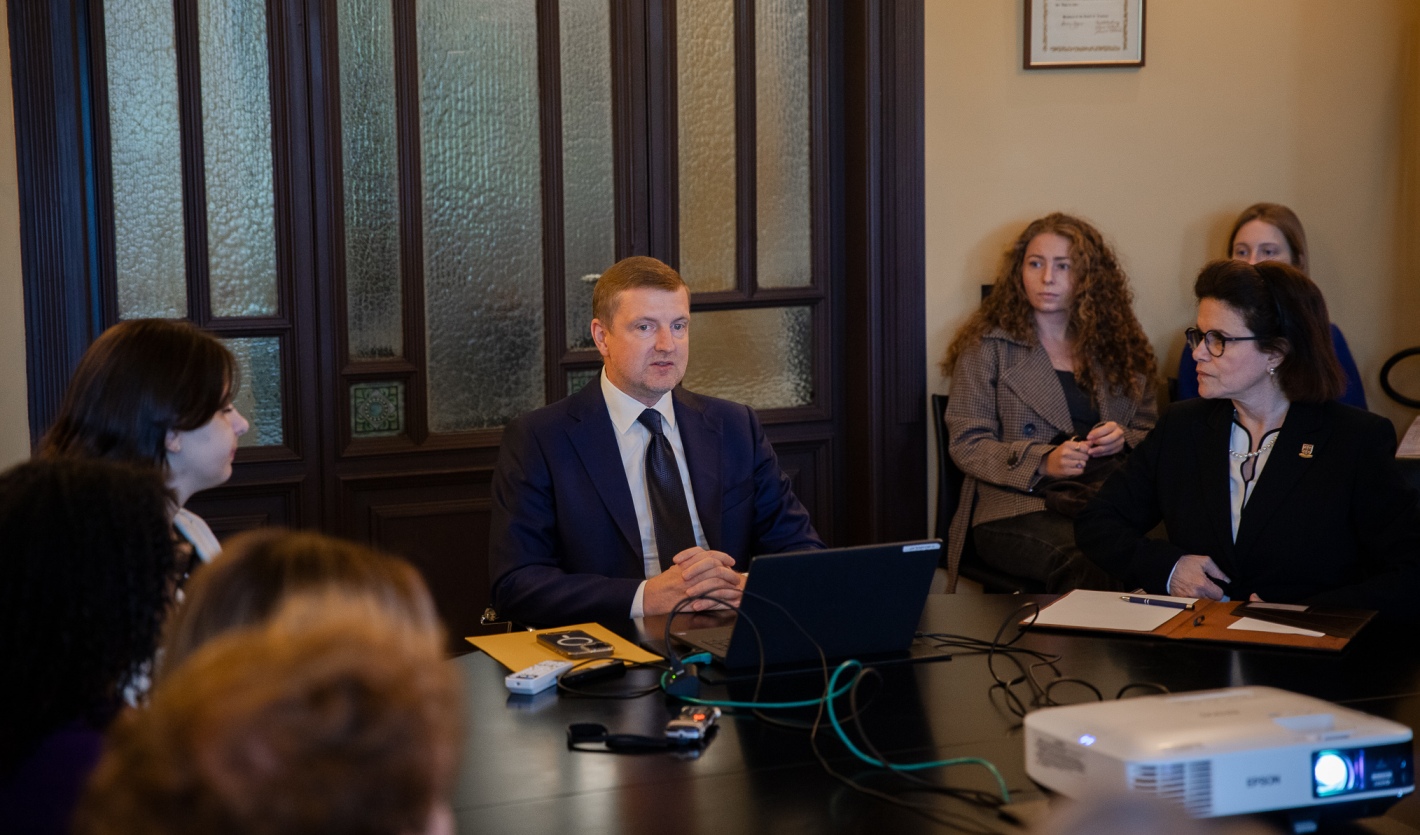
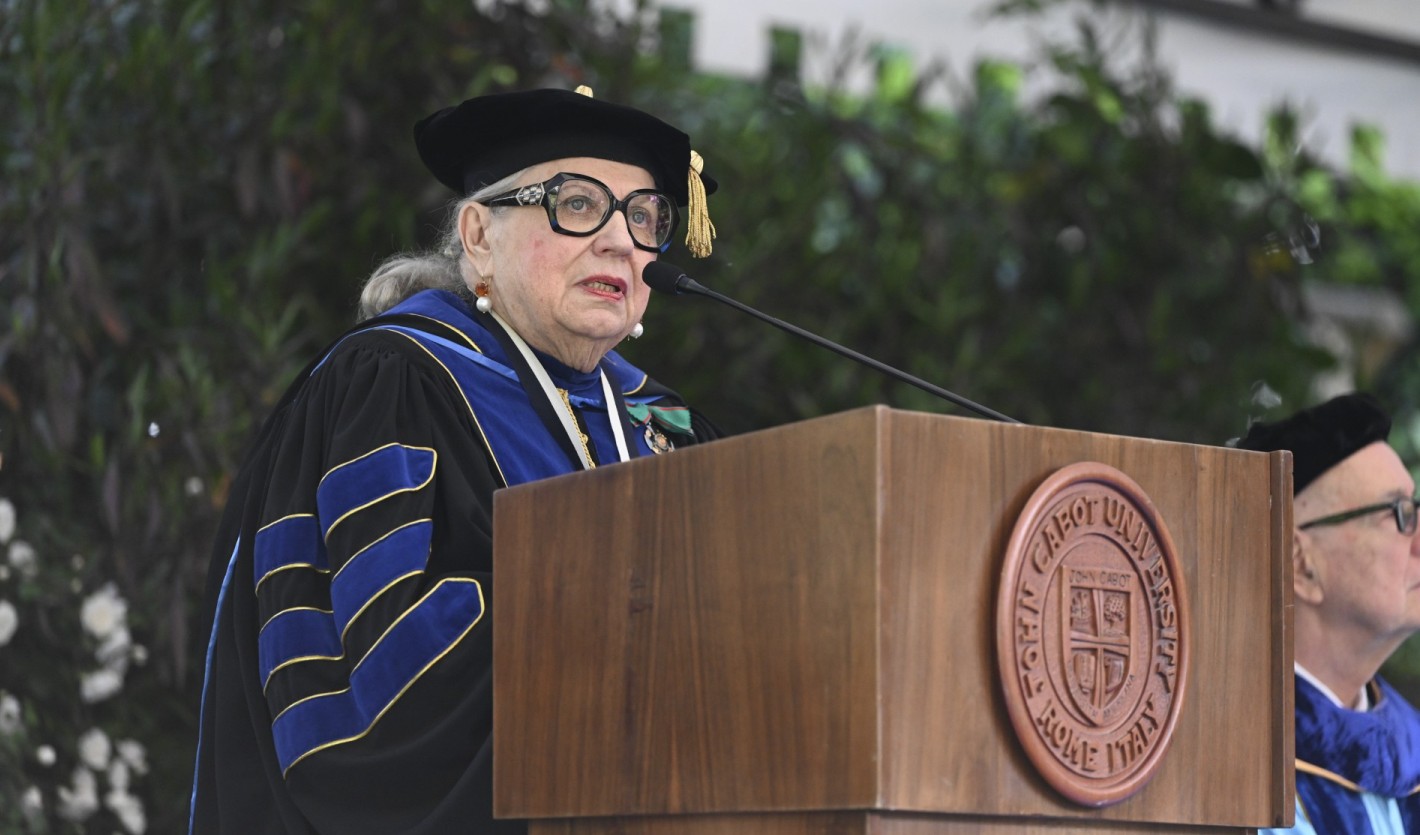
On May 28, 2026, John Cabot University kicked off the Summer 2026 Institute for Creative Writing and Literary Translation with an opening event featuring award-winning Italian screen and fiction writer Chiara Barzini.
Writing creatively in both English and Italian, Barzini embodies the true spirit of the Institute. She read from her latest book Aqua: A Story of Water and Lost Dreams (Canongate Books, 2025), originally composed in English. The reading was followed by a conversation with students, faculty, and guests.
Born in Rome, Barzini has lived and studied in the United States, where she covered lifestyle and culture for numerous American and Italian publications. She writes and translates in both English and Italian and is the author of the short story collection Sister Stop Breathing (Calamari Press, 2012), the novel Things That Happened Before the Earthquake (Doubleday, 2017), named a Best Book of the Year by Vogue, Esquire, Elle, Bustle, and the Guardian, and a Best Summer Book by the New York Times, Publishers Weekly, BBC, and O, The Oprah Magazine. Her most recent book, Aqua: A Story of Water and Lost Dreams, was selected as a Book of the Year by the Times Literary Supplement in 2025. Her fiction has appeared in numerous anthologies and literary journals. She writes a regular column for the Italian daily La Repubblica and serves as Literature Advisor at the American Academy in Rome.
A Hybrid Work
Aqua is a hybrid work of memoir, travel writing, philosophy, and cultural history that explores how water shaped Los Angeles and, in turn, the history of film. In 1913, civil engineer William Mulholland completed the Los Angeles Aqueduct, a 233-mile engineering feat that diverted water from the Owens Valley to a barren corner of California that would soon become the center of the film industry. More than a century later, Barzini traces the geography of the aqueduct from its source across the desert to the city it helped bring into existence, while reckoning with her own personal history in this landscape. From the artificial waters of Universal Studios’ Jaws attraction to the Salton Sea (California’s largest lake and “the only man-made mistake visible from space”), Aqua examines water’s presence and absence as forces that shaped a modern empire built on dreams, illusion, and impending catastrophe.
Barzini explained that she wrote Aqua, her first non-fiction book, during and just after the COVID-19 pandemic. The book connects ecological decline with the collapse of illusions and infrastructures that once made large-scale dreams possible. She views Mulholland’s aqueduct as the material backbone that made the California “dream” possible and a symbol of a Western cultural empire now in decline.
The book takes the form of a road trip memoir as Barzini and two close friends travel along the LA Aqueduct through the deserts of California. They are “three middle-aged women searching for water and meaning.” At the same time, she awaits news of a potential Hollywood film adaptation of her earlier novel, Things That Happened Before the Earthquake, creating a parallel narrative: the pursuit of water and the pursuit of a Hollywood dream.
From Water to Fire
Barzini explained that the Italian edition of the book was initially conceived as a water-focused story, but on the very day in 2025 that she submitted her final edits, catastrophic fires broke out in Los Angeles. She halted publication to rewrite the introduction, realizing that her journey through water must now end in flames. She described the massive destruction in the Palisades and the San Gabriel Mountains, drawing parallels between LA burning and the devastation elsewhere in the world, evoking a shared sense of apocalyptic imagery and collective responsibility.
The Construction Manual and Magical Thinking
A friend gave Barzini an original construction manual for the LA Aqueduct, signed by Mulholland. She described the moment as an initiation and embarked on a journey along the aqueduct, hoping that investigating the roots of California’s ecological problems might act as a “magical protection” against ruin. Later, she recognized this as a form of overreliance on writing as exorcism; the fires proved that no exorcism can be sufficient.
Empire in Decline: Rome and California
Having grown up between Rome and Los Angeles, Barzini draws compelling parallels between the two cities. The fallen empire of Rome is a place of visible ruins (the Roman aqueducts, the Forum, and the Coliseum), while California represents an empire of Hollywood, music, and pop culture that now shows signs of decay. She recognizes in California some of the same codes of a declining empire she learned from Rome, an unsettling realization in a place usually associated with perpetual youth and fantasy.
Barzini also cited writer Olivia Laing, who helped her understand that infrastructures and ruins, even when no longer in active use, still matter. They sustained previous generations, and their beauty and magic can still nourish us in different ways. Barzini applies this perspective to Roman aqueducts and the LA Aqueduct, to old dreams and new ones, and to the possibility of finding poetry, hope, and endurance in a world of ecological and cultural decline.
Despite its darker themes, Barzini stressed that Aqua is not meant to be pessimistic. With humor and irony, it asks fundamental questions: How do we keep dreaming when the material foundations of our dreams (water, abundance, Hollywood, empire) are collapsing? What do we do with the end of something great that has formed our identity and imagination? And how can ruins and infrastructures of the past still help us live, hope, and find poetry and meaning today?