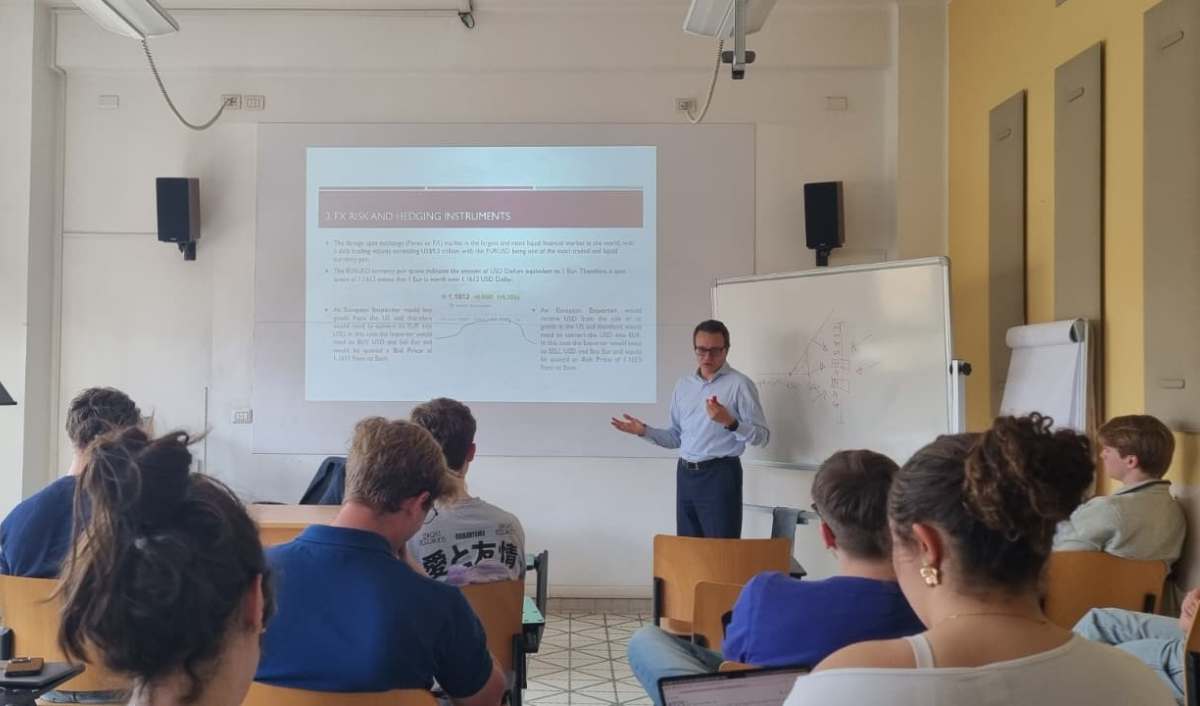
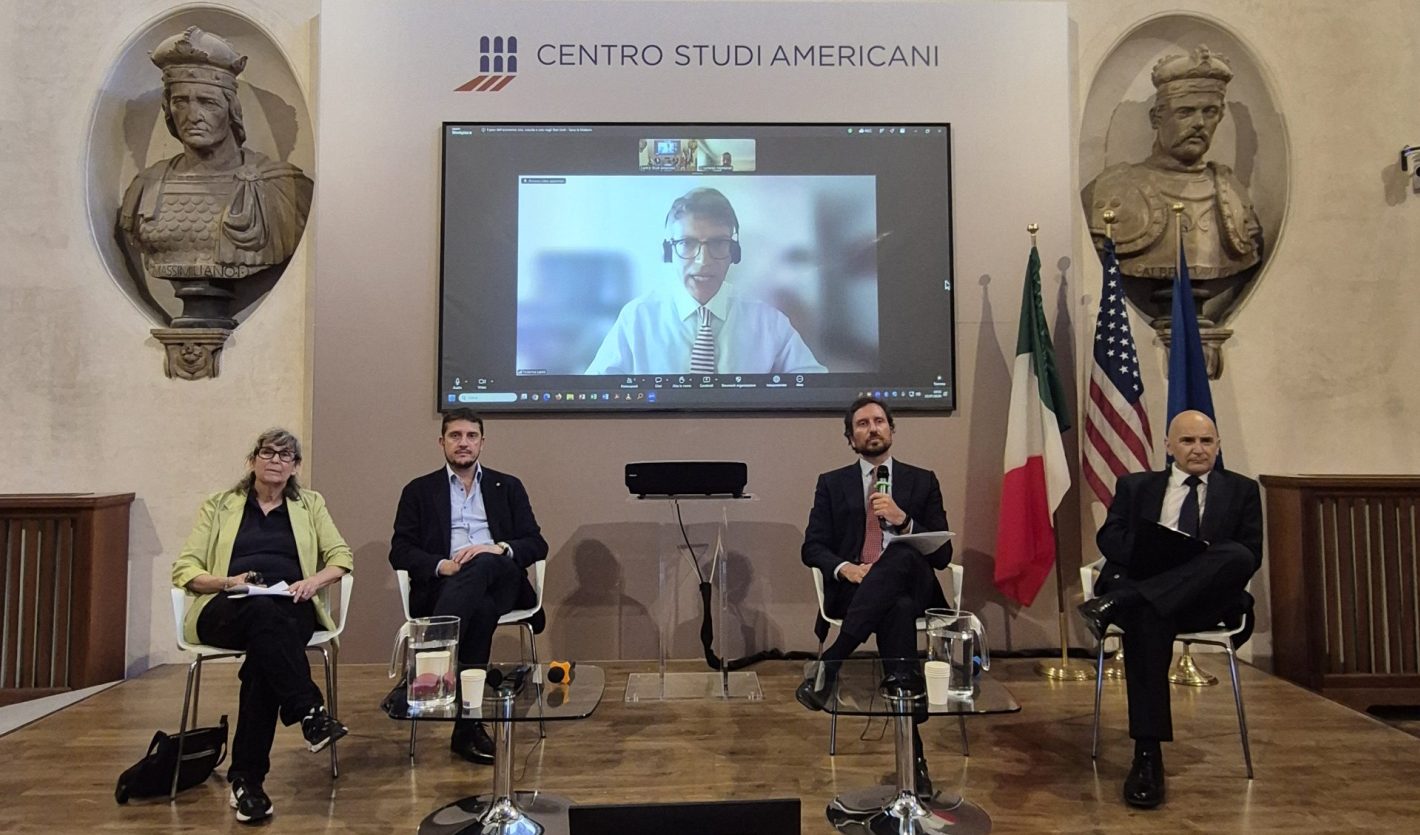
On April 15, 2026, students from Professor Andrea Delle Foglie’s Introduction to Derivatives course at John Cabot University attended a guest lecture by Andrea Creton, Co-Head of Global Markets Corporate Network Europe at BNP Paribas Corporate and Institutional Banking. Drawing on real-world examples and live market data, Creton illustrated the core hedging instruments used by corporate treasurers and CFOs to manage interest rate and foreign exchange risk.
Why Companies Hedge
Creton opened with a deceptively simple question: why should a corporation hedge at all? His answer was grounded in a company’s core purpose. A business exists to create value through its products and services, not to take positions on financial markets. For a CFO, this translates into a clear mandate: protect the predictability of cash flows from variables unrelated to the quality of the business. Left unmanaged, interest rate movements and currency swings erode margins and distort the financial picture presented to investors. A sound hedging policy removes that distortion.
Managing Interest Rate Risk
In Europe, most corporate loans are priced as a floating rate—typically Euribor—plus a fixed credit spread. Euribor has been historically volatile, exceeding five percent during the 2008 crisis and then turning negative for nearly seven years. A treasurer who ignores that exposure is not being neutral: they are making an implicit bet on rates.
The Interest Rate Swap is the most direct solution. Two counterparties agree to exchange floating-rate payments for fixed-rate payments over a defined period, with the fixed rate set so that both legs are equivalent in present value at inception. A company with a €10 million Euribor-linked loan can lock in a fixed rate—say, 2.526%—converting an unpredictable obligation into a stable cost. The trade-off is symmetrical: no benefit if rates subsequently fall.
For firms that want a ceiling on rates while retaining some upside, an Interest Rate Cap acts as insurance: an upfront premium buys the right to receive a payment whenever Euribor exceeds a pre-agreed strike. The Zero Cost Collar refines this further by pairing the cap with the sale of a floor option, whose premium offsets the cap’s cost entirely. The result is a defined band: above the cap the company is fully protected, within the band it pays market Euribor, and below the floor it is obliged to pay the floor rate regardless of where rates actually sit.
Managing Foreign Exchange Risk
FX risk is asymmetric in its impact: a stronger Euro hurts exporters earning in dollars, while a weaker Euro raises costs for importers. Creton illustrated this with a recent EUR/USD move from 1.0750 to 1.2050—an unhedged exporter would have lost roughly eleven percent of dollar revenues in Euro terms, with no change in the underlying business.
The FX Outright Forward is the standard response: it locks in an exchange rate for a future date, calculated from the spot rate and the interest rate differential between the two currencies. Beyond the forward, a Flexiterm allows the company to draw down currency at any point within an agreed window rather than on a fixed date, while FX Options provide the right—not the obligation—to exchange at a set rate, preserving the benefit of favorable moves. FX Collars, combining the purchase of one option with the sale of another, offer protection at reduced or zero premium cost.
The Cross-Currency Swap
The seminar concluded with the Cross-Currency Swap, an instrument that addresses both interest rate and FX risk in a single structure. Consider a European parent funding a dollar fixed-rate loan to its U.S. subsidiary through a floating Euro bank loan: it faces Euribor exposure on its liability and EUR/USD exposure on the dollar cash flows it receives. A CCS resolves both simultaneously. The parent swaps Euro principal for dollars at inception, receives Euro floating payments to service its bank loan, pays dollar fixed rates sourced from the subsidiary, and reverses the principal exchange at maturity. The outcome is a fully hedged position with predictable cash flows in both currencies throughout the life of the arrangement.
Takeaway
Creton’s lecture offered students a practitioner’s perspective on instruments they had studied theoretically. The IRS, cap, zero cost collar, FX forward, and cross-currency swap are the standard toolkit of European treasury departments. Their shared purpose is to convert unpredictable market costs into foreseeable figures, ensuring that a company’s financial results reflect the quality of its business rather than the direction of interest rates or exchange rates.